

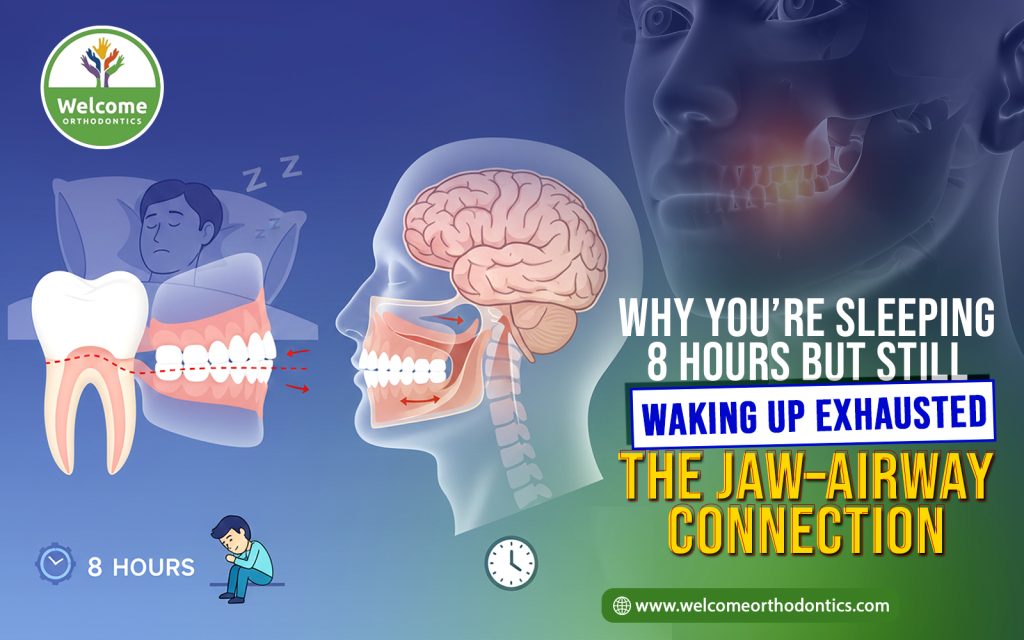
You shut your eyes for a full eight hours. You didn’t stay up scrolling. You didn’t binge another episode. You did everything right, yet you still wake up feeling like you barely slept. Your body feels heavy, your head foggy, and your energy, well, nowhere to be found. Sound familiar?
If so, you’re far from alone. Millions of people struggle with persistent morning fatigue, and despite trying new mattresses, supplements, earlier bedtimes, or blue-light blockers, nothing seems to make a difference. That’s because the issue often has nothing to do with how long you sleep and everything to do with how well you breathe during sleep.
What many don’t realize is that poor-quality sleep is frequently linked to something unexpected: your jaw position, bite alignment, and airway structure. These factors determine how easily air flows while you’re asleep, and when airflow is restricted, even slightly, your brain is forced to micro-wake throughout the night just to keep you breathing. You might never notice these interruptions, but your body certainly does.
This jaw–airway connection is becoming a major topic in modern sleep science and orthodontics, and for good reason: understanding it can completely change how we approach chronic exhaustion, snoring, and sleep-disordered breathing. More adults than ever are now exploring orthodontic solutions not just for aesthetics but for improved oxygen intake, deeper rest, and better long-term health.
In this comprehensive guide, we’ll walk you through the science behind the jaw–airway relationship, how orthodontic issues disrupt breathing, and why treatments like teeth braces for adults in California, including affordable and quality braces, are helping people finally wake up refreshed.
The Hidden Epidemic: Why Millions Are Sleeping But Not Resting
Feeling groggy despite “perfect” sleep isn’t rare. In fact, up to 30% of adults report excessive daytime sleepiness even when they meet standard sleep recommendations.
This represents a growing issue: people assume they are simply “bad sleepers,” when in reality, their bodies are fighting for oxygen all night long.
Common symptoms of poor nighttime breathing include:
- Waking up with a dry mouth
- Snoring
- Grinding teeth
- Morning headaches
- Neck and shoulder tension
- Difficulty concentrating
- Waking up multiple times without knowing why
If you relate to even 2–3 of these symptoms, the real problem may not be sleep… but airflow obstruction.
And airflow obstruction has a surprisingly strong link to jaw and bite alignment.
Understanding the Jaw–Airway Relationship: A Quick Science Lesson
Your airway is like a soft, flexible tube that sits behind your tongue, jaw, and throat. When everything is aligned correctly, air flows smoothly while you sleep.
But when structural issues are present, such as a retruded lower jaw, narrow dental arches, or a high palate, the airway can become partially blocked, especially when your muscles relax at night.
Here’s how your jaw affects your airway:
The Lower Jaw (Mandible)
If the mandible sits too far back (a condition known as mandibular retrognathia), it pulls the tongue backward with it.
What happens?
The tongue collapses into the airway, blocking oxygen flow.
The Upper Jaw (Maxilla)
A narrow upper jaw leads to:
- Crowded teeth
- A high, narrow palate
- Less space for the nasal airway
Nasal breathing becomes difficult, forcing mouth breathing, which worsens sleep quality and oxygen intake.
The Tongue
Your tongue is supposed to rest against the roof of your mouth. If your palate is too narrow, the tongue can’t maintain that posture and instead falls backward.
This again leads to:
- Snoring
- Breathing pauses
- Micro-awakenings
The Result: Sleep-Disordered Breathing (SDB)
SDB includes:
- Snoring
- Upper Airway Resistance Syndrome (UARS)
- Obstructive Sleep Apnea (OSA)
Even mild forms can cause exhaustion by repeatedly pulling you out of deep sleep stages.
Why Adults Are Facing More Jaw–Airway Issues Today
While jaw development is largely influenced by genetics, modern lifestyle plays a major role in worsening airway problems. Epidemiologists have noticed a significant rise in airway-related sleep problems in adults due to:
Soft Modern Diets
Humans today chew far less than previous generations. A lack of chewing weakens:
- Jaw muscles
- Bone growth
- Dental arch expansion
This results in smaller jaws and crowded teeth.
Poor Posture (Especially Tech Neck)
Forward head posture restricts airway function and alters jaw alignment over time.
Chronic Mouth Breathing
Often caused by allergies or nasal obstruction, long-term mouth breathing leads to underdeveloped dental arches and facial structures.
Late Orthodontic Treatments
Many adults never received orthodontic treatment as children. Others had treatments that focused on straightening teeth but did not address airway health, which is now a key area in modern orthodontics.
The Consequence: How Jaw Misalignment Disrupts Sleep Quality
Even if you sleep for eight hours, your body may not get the oxygen-rich, deep sleep it needs. Here’s what happens at night when the jaw–airway connection is compromised:
Micro-Arousals All Night Long
Each time your airway collapses slightly, your brain wakes you just enough to resume breathing. You won’t remember these interruptions, but they:
- Reset your sleep cycle
- Reduce REM and deep sleep
- Cause inflammation
- Spike stress hormones
Snoring as the First Red Flag
Snoring is not “normal.” It’s a sign of airway resistance and vibration, your body is literally struggling to pull air in.
Teeth Grinding (Bruxism) as the Body’s Defense Mechanism
Many people grind their teeth because:
- The jaw is trying to push forward to open the airway.
- The body is attempting to stabilize the tongue.
This leads to worn enamel, cracked teeth, headaches, and jaw pain.
Oxygen Desaturation
Even slight drops in oxygen affect:
- Energy levels
- Cognitive speed
- Mood regulation
- Hormone balance
Poor sleep and poor breathing become a cycle that is hard to break without treating the underlying jaw–airway issue.
Symptoms That Indicate Your Jaw May Be Affecting Your Sleep
How do you know if jaw structure is the culprit behind your exhaustion?
Here are the most telling signs:
Physical Symptoms
- Morning headaches
- Sore jaw, facial tension, or clicking joints
- Dry mouth or sore throat
- Ear pressure or popping
- Neck and shoulder tightness
Sleep Symptoms
- Snoring
- Waking unrefreshed despite enough sleep
- Restless sleep or frequent awakenings
- Teeth grinding
- Drooling at night (a sign of mouth breathing)
Daytime Symptoms
- Fatigue
- Trouble focusing
- Brain fog
- Anxiety
- Irritability
If these feel familiar, your jaw is very likely affecting your airway, and orthodontic treatment may help.
How Orthodontics Helps Improve Your Airway and Sleep Quality
Modern orthodontics is not only about straightening teeth. It is now deeply connected with airway health, facial balance, and long-term wellness.
Here’s how orthodontic treatment helps restore natural breathing:
Expanding the Dental Arches
A broader upper arch:
- Increases nasal cavity volume
- Supports proper tongue posture
- Reduces snoring and airway obstruction
This not only improves breathing but also provides enough space for teeth to align without extraction.
Correcting Overbites and Underbites
Jaw misalignment is a major contributor to a collapsed airway. Correcting the bite improves:
- Tongue space
- Jaw position
- Muscle balance
- Airflow
Forward Growth Guidance
Some orthodontic treatments encourage the lower jaw to move forward. This widens the airway space behind the tongue, reducing nighttime blockage.
Reducing Teeth Grinding
Once the bite is in harmony, bruxism often decreases significantly because the body no longer needs to “protect” the airway through grinding.
Long-Term Structural Improvements
Orthodontics can bring lasting benefits:
- Better posture
- Improved oxygen intake
- Balanced facial aesthetics
- More efficient breathing during exercise and rest
Why Adults Are Choosing Orthodontics Specifically for Sleep Issues
Many adults never considered orthodontics beyond aesthetics. But today, people are discovering how structural jaw improvements can help:
- Reduce snoring
- Improve energy levels
- Decrease headaches
- Enhance mental clarity
- Improve athletic performance
- Reduce nighttime anxiety
- Boost overall quality of life
This is why more people are actively seeking teeth braces for adults in California, not just for straighter teeth, but for better breathing and better sleep.
Types of Orthodontic Treatments That Help with Airway and Sleep Health
Orthodontic technology has advanced dramatically. Adults now have multiple treatment options that correct the jaw–airway relationship without discomfort or embarrassment.
Traditional Braces (Highly Effective for Complex Cases)
Traditional braces apply controlled pressure to:
- Adjust teeth alignment
- Expand arches
- Improve bite function
They are among the most predictable options, especially for more complicated structural issues.
This is ideal for adults seeking affordable and quality braces with proven results.
Clear Aligners (Discreet & Comfortable)
Clear aligners help:
- Widen arches
- Improve tongue posture
- Correct minor to moderate bite problems
For adults who want a nearly invisible approach, this is a popular choice.
Self-Ligating Braces (Faster and Gentler Movement)
Self-ligating systems use advanced brackets that:
- Reduce friction
- Shorten treatment time
- Create wider arch development
This is excellent for improving airway space.
Functional Orthopedic Appliances
These appliances help reposition the jaw and encourage forward growth, ideal for correcting airway constriction.
Are You a Candidate for Airway-Focused Orthodontics?
You may benefit from orthodontic airway correction if you:
- Snore
- Grind your teeth
- Wake up unrested
- Experience chronic fatigue
- Have difficulty breathing through your nose
- Have been told you have sleep apnea or UARS
- Have a receding jaw or facial imbalance
Orthodontists trained in airway function can evaluate:
- Jaw position
- Tongue posture
- Palatal width
- Bite alignment
- Nasal breathing
This is not a one-size-fits-all approach. Airway-focused orthodontics is customized for your anatomy, sleep patterns, and long-term health needs.
Lifestyle Changes That Support Better Breathing and Sleep
Even with orthodontic treatment, certain lifestyle adjustments can significantly improve nighttime breathing:
Practice Nasal Breathing
Nasal breathing warms, filters, and humidifies air—supporting better oxygen absorption.
Strengthen Jaw and Tongue Muscles
Myofunctional exercises can improve tongue posture and airway tone.
Reduce Elevation of Pillows
Too many pillows push the head forward, restricting airflow.
Treat Allergies and Sinus Issues
A blocked nose encourages mouth breathing, which worsens sleep quality.
Maintain Good Posture During the Day
Posture affects jaw alignment and airway diameter.
The Bigger Picture: How Jaw Alignment Influences Your Overall Health
The jaw–airway connection affects far more than sleep. It influences hormones, metabolism, brain function, and emotional well-being.
When your airway is compromised:
- Cortisol levels increase
- Blood pressure rises
- Inflammation intensifies
- Weight gain becomes more likely
- Focus and productivity decline
- Mood stability is disrupted
Improving the airway can translate into:
- Better mental clarity
- Enhanced mood
- More balanced hormones
- Improved athletic endurance
- Healthier heart function
This is why airway-focused orthodontic care is gaining global momentum.
How to Choose the Right Orthodontist for Airway-Focused Treatment
Not all orthodontists specialize in airway and sleep dentistry. When searching, especially for teeth braces for adults in California, look for:
- Experience with sleep-disordered breathing
- Understanding of facial growth patterns
- Training in both orthodontics and airway health
- Ability to evaluate nasal breathing and tongue posture
- Treatment plans that avoid unnecessary extractions
- A holistic approach to long-term wellness
A great orthodontist will combine aesthetics, structure, and function—not just straighten teeth but transform your well-being.
Conclusion: Better Sleep Starts With Better Airflow, and Better Airflow Starts With Your Jaw
If you’re sleeping eight hours but still waking up exhausted, your body may be fighting for oxygen all night long—and your jaw position could be a major reason why. The jaw–airway connection plays a critical role in your sleep quality, energy levels, mental clarity, and overall wellness.
The good news? Modern orthodontic solutions, including affordable and quality braces and airway-focused treatments, can dramatically improve your breathing and sleep. Adults today have more options than ever, from advanced braces to discreet aligners, making it easier to correct structural issues that may have gone unnoticed for decades.
If you’ve been searching for teeth braces for adults in California or simply want to understand how orthodontics can help you breathe and sleep better, it’s worth scheduling a consultation with a trusted provider.
Welcome Orthodontics is known for combining high-level orthodontic expertise with an airway-centered approach—helping patients not only achieve beautiful smiles but also enjoy deeper, healthier, more restorative sleep.
A healthier jaw. A clearer airway. A better night’s sleep.
Your transformation starts now.
0 comments on “Why You’re Sleeping 8 Hours but Still Waking Up Exhausted: The Jaw–Airway Connection”