

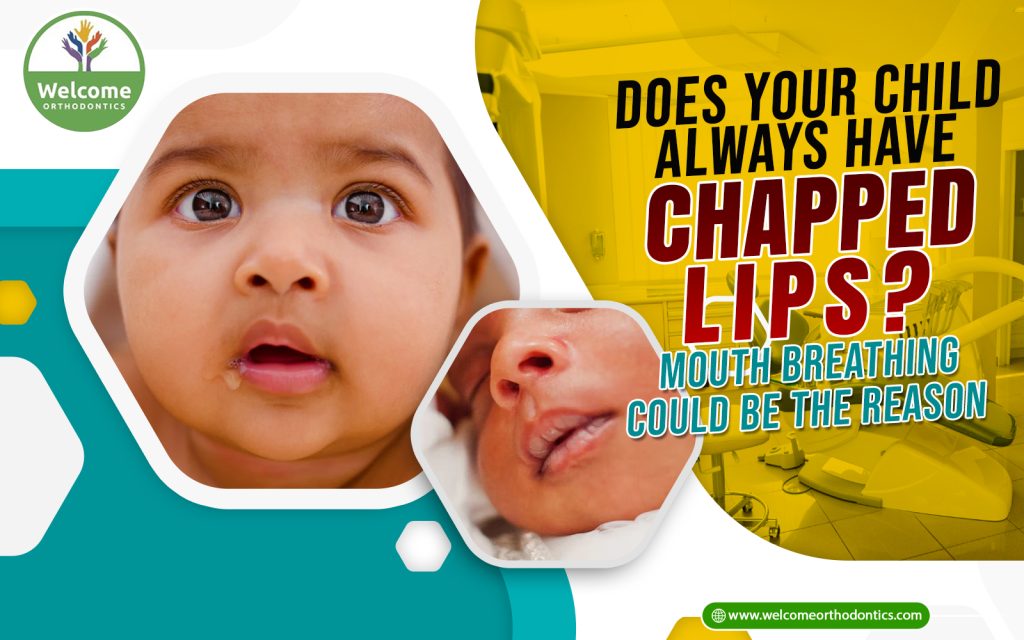
Many parents assume chapped lips in children are caused by weather, dehydration, or lip licking. During colder months especially, dry lips can seem completely normal. So when a child constantly reaches for lip balm or wakes up every morning with cracked lips, most families focus on treating the dryness itself.
But what if the lips aren’t actually the real problem? In many children, chronic chapped lips are not just a skin issue, they’re a breathing issue.
Children who breathe through their mouth, especially during sleep, continuously expose the lips and surrounding tissues to airflow that dries them out overnight. Unlike nasal breathing, mouth breathing bypasses the body’s natural humidifying system, leaving the lips dehydrated for hours at a time. This is why some children continue struggling with dry, irritated lips no matter how much water they drink or how often lip balm is applied.
What makes this especially important is that mouth breathing rarely affects only the lips. Over time, it can influence sleep quality, jaw growth, facial development, chewing patterns, and even daytime energy levels. The challenge is that these changes often happen slowly, making them easy to overlook.Understanding the connection between chronic chapped lips and mouth breathing can help parents recognize when a seemingly small issue may actually be pointing to a much larger developmental pattern.
Why Some Children Constantly Struggle With Chapped Lips
Almost every child experiences dry lips occasionally. Weather changes, sun exposure, dehydration, or frequent lip licking can all cause temporary irritation. But when chapped lips become constant, especially throughout the year, it may signal something deeper than environmental dryness.
Why Lip Balm Sometimes Doesn’t Solve the Problem
Many parents notice a frustrating cycle:
- The lips improve temporarily
- Dryness quickly returns
- Cracking happens again overnight
- Constant reapplication becomes necessary
This often happens because the underlying cause is still present. If a child is breathing through their mouth for hours during sleep, the lips are repeatedly exposed to drying airflow night after night. In these cases, lip balm may soothe symptoms temporarily without addressing the reason the lips are becoming dry in the first place.
The Role of Open-Mouth Posture
Children who breathe through their mouth often keep their lips slightly apart during the day as well. This open-mouth posture prevents the lips from retaining natural moisture properly.
Over time, parents may notice:
- Peeling lips
- Redness around the mouth
- Cracking near the corners of the lips
- Persistent dryness despite hydration
The lips are constantly working against a drying environment.
Why Mornings Are Often the Worst
Many parents specifically notice severe dryness first thing in the morning. This is because nighttime mouth breathing exposes the lips to unfiltered airflow for hours at a time.
Children may wake up with:
- Tight or painful lips
- Dry mouth
- Thirst
- Cracking or bleeding around the lips
These symptoms often improve slightly during the day, only to return again after another night of mouth breathing.
The Hidden Link Between Chapped Lips and Mouth Breathing
To understand why mouth breathing affects the lips so dramatically, it helps to understand the difference between nasal breathing and mouth breathing.
Why Nasal Breathing Protects the Lips
The nose is designed to:
- Filter air
- Warm it
- Humidify it before it reaches the body
When children breathe through their nose, the lips remain comfortably closed and moisture is preserved much more effectively.
Nasal breathing also supports:
- Proper tongue posture
- Balanced muscle function
- Healthy jaw development
This creates a more stable oral environment overall.
What Happens During Mouth Breathing
When children breathe through their mouth:
- Air constantly passes over the lips and oral tissues
- Saliva evaporates more quickly
- The lips lose moisture continuously
This creates chronic dryness, especially during sleep. Unlike occasional mouth breathing during illness, persistent mouth breathing becomes a long-term functional pattern. Many children adapt to it so gradually that parents don’t immediately realize it has become their normal way of breathing.
Why Children Mouth Breathe Without Realizing It
Children rarely complain that they “can’t breathe properly.” Instead, they simply adapt.
They may:
- Sleep with their mouth open
- Breathe loudly at night
- Keep their lips apart during the day
- Develop a habit of open-mouth posture
Because these patterns develop slowly, they are often mistaken for harmless habits instead of signs of airway-related concerns.
What Causes Mouth Breathing in Children?
Mouth breathing itself is not usually the root problem, it is often the body’s response to difficulty breathing comfortably through the nose.
Nasal Congestion and Allergies
One of the most common causes is chronic nasal congestion.
Children with:
- Seasonal allergies
- Frequent colds
- Nasal inflammation
- Sinus issues
Many begin relying on mouth breathing simply because nasal airflow feels restricted. Over time, even after congestion improves, the breathing pattern may remain habitual.
Enlarged Tonsils or Adenoids
Enlarged tonsils and adenoids can partially block airflow, especially during sleep.
Children may:
- Snore
- Sleep restlessly
- Breathe heavily at night
- Keep their mouth open while sleeping
Because the airway feels restricted, the body compensates by breathing through the mouth instead.
Narrow Jaw and Airway Development
The structure of the jaws also affects breathing efficiency.
A narrow upper jaw may:
- Reduce nasal airway space
- Limit tongue room
- Encourage mouth breathing patterns
This is one reason orthodontic evaluation increasingly includes airway assessment—not just teeth alignment.
Habitual Open-Mouth Posture
Some children continue mouth breathing simply because it has become their normal resting pattern. Even when nasal breathing is physically possible, the muscles and posture associated with mouth breathing may remain deeply ingrained over time.
How Chronic Mouth Breathing Can Affect More Than Just the Lips
Chapped lips are often one of the earliest visible signs of mouth breathing, but the effects usually extend much further.
Sleep Quality and Restlessness
Children who mouth breathe during sleep often experience:
- Restless sleep
- Frequent movement during the night
- Snoring or noisy breathing
- Difficulty reaching deep restorative sleep
Even if they sleep through the night, sleep quality may still be reduced.
Daytime Fatigue and Mood Changes
Poor-quality sleep affects daytime function significantly.
Children may:
- Seem irritable
- Struggle to focus
- Become emotionally reactive
- Have low energy
- Appear hyperactive or overstimulated
Because children often respond differently to fatigue than adults, these signs are frequently misunderstood.
Effects on Jaw Growth and Facial Development
Mouth breathing changes how the tongue and facial muscles function during growth.
Over time, this may contribute to:
- Narrow upper jaws
- Crowded teeth
- Longer facial appearance
- Bite imbalance
- Weak lip seal
These changes often happen gradually and may initially appear to be genetic traits.
Changes in Chewing and Swallowing
Children who mouth breathe sometimes struggle with:
- Closed-mouth chewing
- Efficient swallowing patterns
- Proper tongue posture during eating
Some may eat slowly, avoid chewy foods, or frequently open their mouth while chewing.
Speech and Oral Function
Because the tongue plays such an important role in both speech and breathing, mouth breathing can also influence speech clarity and oral muscle coordination in some children.
How Orthodontic Evaluation Can Help Identify the Root Cause
Parents often spend years treating symptoms like dry lips, poor sleep, or crowding without realizing these issues may be connected.
This is why early orthodontic evaluation can be so valuable.
Looking Beyond the Teeth
Modern orthodontic evaluation often considers:
- Jaw development
- Airway structure
- Tongue posture
- Breathing habits
- Facial growth patterns
- Bite alignment
The goal is not simply to straighten teeth, but to understand how the entire system is developing.
Why Timing Matters
Childhood is a critical stage because:
- The jaws are still growing
- Facial structures remain adaptable
- Breathing patterns influence development
Identifying concerns early may help prevent more complex issues later.
How Welcome Orthodontics Helps Families Understand the Bigger Picture
At Welcome Orthodontics, care is centered around understanding why certain symptoms are happening, not just correcting what is visible on the surface. A child who constantly has chapped lips, sleeps with their mouth open, snores, or develops crowded teeth may actually be showing signs of underlying airway and developmental concerns. That’s why evaluations focus on much more than simply checking whether braces are needed.
The team takes a comprehensive approach that looks at how breathing patterns, jaw growth, airway development, tongue posture, bite alignment, and oral habits all work together during childhood. Because these systems are closely connected, even small breathing issues can gradually influence how a child’s face, jaws, and teeth develop over time. Identifying these patterns early allows families to better understand what may be contributing to concerns that often seem unrelated at first.
Using advanced digital imaging and diagnostic technology, Welcome Orthodontics carefully evaluates growth and development from multiple angles. Instead of relying on quick visual assessments alone, the practice looks at how the jaws are developing, whether the airway appears restricted, how the teeth are erupting, and whether mouth breathing may be influencing facial growth or sleep quality. This allows parents to receive a much clearer picture of what is actually happening.
One of the most reassuring aspects of care at Welcome Orthodontics is the conservative, patient-focused philosophy. Not every child requires immediate treatment, and parents are never pressured into unnecessary procedures. In many cases, careful monitoring and growth observation are the best first steps. When treatment is recommended, it is designed to work with a child’s natural development rather than forcing aggressive correction too early.
With over 30 years of clinical experience, Dr. Tavakoli combines orthodontic expertise with a strong understanding of growth, function, and long-term oral health. Families receive honest guidance, individualized treatment planning, and clear explanations that help them feel informed and confident throughout the process.
Most importantly, the goal is not just straighter teeth. The focus is on helping children breathe more comfortably, sleep better, develop healthier jaw function, and build a stronger foundation for lifelong oral and overall health.
Conclusion
Chapped lips in children are often treated as a minor cosmetic issue, but when the dryness becomes constant, it may be pointing to something much deeper. Chronic mouth breathing can dry the lips night after night while also affecting sleep quality, jaw growth, facial development, and overall oral function. Because these changes happen gradually, many parents never realize that a child’s breathing patterns may be connected to symptoms that seem completely unrelated at first.
Understanding the relationship between mouth breathing and development allows families to move beyond temporary symptom relief and begin identifying the root cause of the problem.
With thoughtful evaluation and growth-focused care from practices like Welcome Orthodontics, parents can gain a clearer understanding of how breathing, airway development, and oral health are connected, helping children not only feel more comfortable, but also grow and develop more healthily over time.
0 comments on “Does Your Child Always Have Chapped Lips? Mouth Breathing Could Be the Reason”