

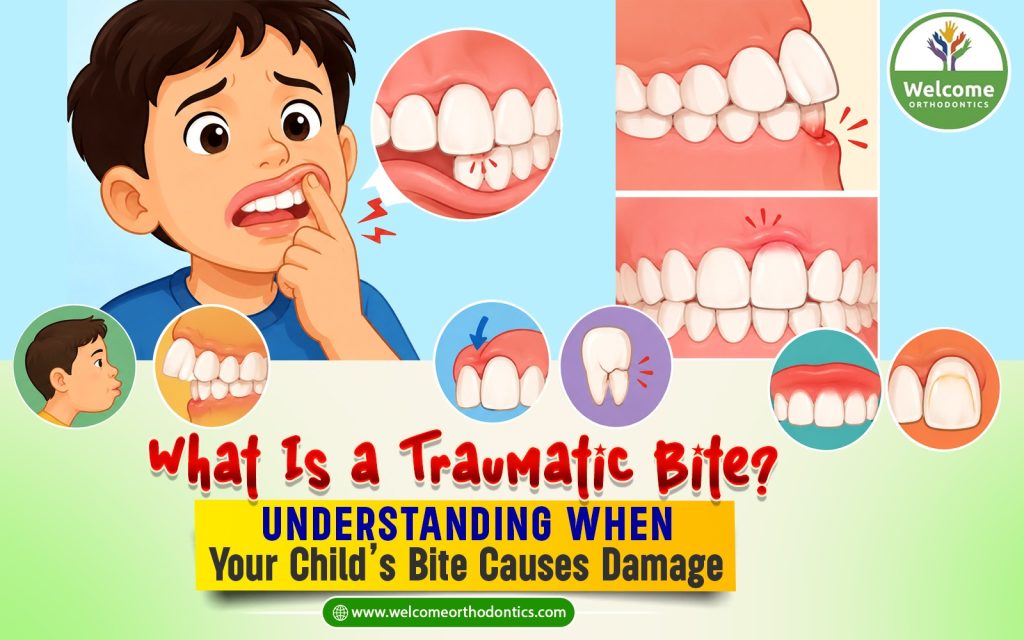
A child’s bite does more than determine how straight their teeth look. Every time your child chews, swallows, or closes their mouth, the upper and lower teeth come into contact and place forces on the teeth and surrounding tissues. Normally, these forces are well tolerated. But when certain teeth repeatedly hit too hard, contact too early, or in an unfavorable direction, the bite itself can contribute to injury.
This is generally referred to as traumatic occlusion or a traumatic bite. It occurs when biting forces cause injury to the teeth or the tissues that support them. Signs associated with traumatic occlusal forces can include tooth mobility, discomfort when chewing, excessive tooth wear, tooth migration, and other changes in the supporting structures.
For parents, the important distinction is that not every unusual bite is traumatic. A child may have a deep bite, crossbite, or another form of malocclusion without experiencing damage. The concern arises when the way the teeth meet is actually placing harmful stress on a tooth or its supporting tissues.
Understanding what a traumatic bite looks like, why it happens, and how it can affect a growing child can help parents recognize when an orthodontic evaluation may be appropriate.
What Is a Traumatic Bite?
A traumatic bite occurs when the forces created when the teeth come together exceed the ability of the teeth and their supporting tissues to adapt comfortably.
The term trauma from occlusion is used to describe injury associated with abnormal or excessive occlusal forces. The tissues involved can include the periodontal ligament, cementum, and surrounding supporting bone. In simple terms, the problem is not necessarily that your child bites strongly. Instead, the way the teeth contact each other may cause force to be concentrated in an area that cannot tolerate it well.
A traumatic bite may develop suddenly, such as when a tooth or dental restoration changes the way the teeth meet. It can also develop gradually as teeth shift, erupt, wear, or respond to habits such as grinding and clenching.
What Causes a Traumatic Bite?
A traumatic bite can develop from several different orthodontic and dental conditions. In children, the developing nature of the bite makes it particularly important to consider tooth eruption and growth alongside current tooth contacts.
Deep Bite and Excessive Overbite
A deep bite occurs when the upper front teeth overlap the lower front teeth excessively. In a severe case, the lower incisors may contact the gum tissue or palate. If this contact produces repeated injury, the deep bite may become traumatic.
Crossbite and Uneven Tooth Contacts
A crossbite changes the normal relationship between upper and lower teeth. When particular teeth sit inside or outside their expected positions, they may contact at unfavorable angles. This can create localized forces that are poorly distributed across the bite.
Crowded or Misaligned Teeth
Crowding can place individual teeth in unusual positions. A rotated or displaced tooth may make contact differently from neighboring teeth, potentially creating premature or concentrated forces. However, crowding itself does not mean a child has a traumatic bite. The actual tooth contacts and clinical effects need to be evaluated.
Tooth Eruption Problems
A developing child’s bite changes as permanent teeth erupt. If a tooth erupts significantly out of position, it may interfere with the normal bite. An orthodontist can determine whether the eruption pattern is temporary or whether the tooth is creating a persistent interference that needs attention.
Jaw Growth and Bite Development
The upper and lower jaws continue developing throughout childhood. Changes in jaw relationships can alter how the teeth meet, potentially creating new areas of premature or excessive contact.
This is one reason orthodontic monitoring can be valuable during growth. A bite that is functioning comfortably at one age may change as the permanent teeth emerge and the jaws develop.
Teeth Grinding and Clenching
Grinding and clenching can increase the amount of force placed on the teeth. Chronic trauma from occlusion may develop gradually alongside tooth wear, drifting, extrusion, grinding, and clenching habits.
For this reason, an orthodontic evaluation may consider not only how the teeth fit together but also how the child uses their bite during everyday activities.
How Can You Tell If Your Child’s Bite Is Causing Damage?
The most important point for parents is that appearance alone cannot determine whether a bite is traumatic. A child can have crooked teeth without traumatic occlusion, while a child whose teeth appear relatively straight may have an isolated contact causing repeated stress.
Look for functional or physical changes such as:
- Pain when chewing
- A tooth becoming noticeably mobile
- Repeated gum irritation
- Excessive or localized tooth wear
- A tooth gradually changing position
- Sensitivity associated with a particular tooth
- Repeated contact between teeth and soft tissues
If any of these signs are present, a dental or orthodontic examination can help determine whether the bite is responsible or whether another condition is involved.
Tooth Wear
One of the most visible consequences can be abnormal wear. When particular teeth repeatedly receive excessive forces, their biting surfaces may become flatter or show distinct wear areas. Wear can also result from grinding, acid erosion, brushing habits, or other causes, so an orthodontist or dentist must consider the complete clinical picture.
Gum Irritation or Recession
If a tooth repeatedly contacts or traumatizes nearby gum tissue, inflammation or recession may occur. A deep bite that causes the lower incisors to contact the tissue behind the upper incisors is one example of how a bite relationship can create localized trauma. A pediatric case report documented gingival recession and hypersensitivity in association with traumatic anterior contacts.
Pain When Biting
Pain during chewing can be another warning sign. However, pain is not specific to traumatic occlusion. Cavities, cracked teeth, infections, dental trauma, and other problems can also cause discomfort. For that reason, persistent bite-related pain should be evaluated rather than attributed to the child’s orthodontic alignment without an examination.
Tooth Mobility
A tooth that moves more than expected may indicate a problem involving its supporting tissues. Traumatic occlusal forces are one possible explanation, but mobility has multiple potential causes. A professional examination can determine whether the tooth is responding to excessive bite forces or whether another condition needs to be addressed.
Repeated Soft-Tissue Trauma
If a child’s teeth repeatedly contact the gums, palate, or other oral tissues, the resulting irritation may indicate an unfavorable bite relationship. The location and pattern of the injury can provide useful clues about which teeth are responsible.
Changes in Chewing
Children are often excellent at adapting. If a particular tooth hurts when it contacts another tooth, a child may unconsciously avoid using that area.
Parents might notice that their child:
- Chews primarily on one side
- Takes longer to finish meals
- Avoids harder foods
- Changes how they bite into food
These behavioral changes are worth mentioning during a dental or orthodontic evaluation because they provide information about how the bite functions in everyday life.
Traumatic Bite vs. Normal Bite: What Is the Difference?
Every bite involves force. The goal is not to eliminate pressure between the teeth but to ensure that the forces are appropriate and well distributed. A normal bite allows the teeth and supporting tissues to tolerate everyday activities such as chewing. A potentially traumatic bite is different because a particular tooth or area repeatedly experiences an unfavorable contact that may produce clinical changes.
For example, a child may have:
Normal bite:
The upper and lower teeth contact comfortably, forces are distributed, and there is no evidence of tissue injury.
Unusual bite without trauma:
The teeth may not be perfectly aligned, but there is no pain, abnormal wear, mobility, or tissue damage.
Traumatic bite:
A specific contact repeatedly produces signs such as localized wear, discomfort, mobility, or soft-tissue injury.
This distinction prevents parents from assuming that every orthodontic irregularity needs treatment.
How Do Orthodontists Diagnose a Traumatic Bite?
Diagnosis involves determining whether the child’s tooth contacts are actually responsible for the observed changes.
Clinical Examination
The orthodontist examines the teeth, gums, and bite together.
They may look for:
- Localized tooth wear
- Gum irritation
- Tooth mobility
- Unusual tooth positions
- Areas of soft-tissue trauma
- Premature tooth contacts
The location of these findings can help identify whether they correspond with a particular bite contact.
Checking Tooth Contacts
The orthodontist observes how the teeth come together naturally.
They may assess whether:
- One tooth contacts before others
- The jaw shifts during closure
- Certain teeth receive unusually heavy contact
- The bite changes during movement
This provides information that cannot be obtained simply by looking at the teeth while the mouth is open.
Evaluating Tooth Mobility and Wear
If a parent has noticed that one tooth looks worn or moves more than expected, the orthodontist evaluates the tooth in relation to the surrounding teeth. This helps determine whether the finding could be related to bite forces or whether another dental problem may be responsible.
Digital X-Rays and Imaging
When appropriate, digital imaging can provide information about:
- Tooth roots
- Developing permanent teeth
- Bone structures
- Jaw relationships
- Tooth eruption
Imaging can be particularly useful when the orthodontist suspects that the visible bite problem may have an underlying developmental or skeletal component.
Assessing Jaw Movement and Function
The orthodontist may also observe how the child opens, closes, and moves the lower jaw. Functional movements can reveal whether the child shifts the jaw to avoid an uncomfortable contact or accommodate an uneven bite.
Evaluating Growth in Children
Children require an additional consideration: growth. The relationship between the teeth and jaws can change as permanent teeth erupt and the facial structures develop. An orthodontist may therefore recommend monitoring rather than immediate treatment if the bite is not currently causing significant problems.
How Is a Traumatic Bite Treated?
Treatment is directed at the cause of the traumatic contact, rather than simply treating the symptom.
Correcting Problematic Tooth Contacts
If a specific tooth is hitting prematurely or in an unfavorable position, orthodontic treatment may be used to establish a healthier contact relationship.
Orthodontic Tooth Movement
Braces or clear aligners may be appropriate when tooth position contributes to the traumatic bite. The objective is not simply to straighten visible teeth. Treatment aims to improve the relationship between the upper and lower teeth so that biting forces can be distributed more appropriately.
Bite-Opening Appliances
For some children with a deep bite or other vertical discrepancy, orthodontic appliances may be used to temporarily change the way the teeth contact while correction takes place. The appliance selected depends on the child’s specific bite and stage of development.
Managing Grinding or Clenching
If excessive grinding or clenching contributes to tooth wear, that behavior may also need to be addressed.
The appropriate approach depends on the child’s age and the reason the habit is occurring. Treating the bite alone may not resolve damage if excessive parafunctional forces continue.
How Welcome Orthodontics Helps Children With Traumatic Bites
At Welcome Orthodontics, Dr. Mark Tavakoli takes a comprehensive approach to evaluating bite problems in growing children. With more than 30 years of clinical experience, he looks beyond the appearance of the teeth to understand how they contact, how the jaws move, and whether the bite is causing actual damage.
Advanced orthodontic technology, including digital scans and X-rays, helps the team evaluate tooth position, eruption, jaw relationships, and developing bite patterns. This allows the underlying cause of a traumatic contact to be identified before treatment is recommended.
The practice follows a conservative approach to orthodontic care. If a child does not need immediate intervention, monitoring may be recommended instead. When treatment is appropriate, the plan is customized around the child’s growth, dental development, bite function, and long-term oral health.
Conclusion
A traumatic bite is more than an imperfect tooth alignment. It occurs when the way the teeth come together creates excessive or unfavorable forces that can affect the teeth, gums, supporting tissues, or overall bite function.
Children may show signs such as unusual tooth wear, mobility, pain when biting, gum irritation, or repeated soft-tissue injury. These symptoms can have other causes as well, which is why an accurate diagnosis is essential.
A deep bite, crossbite, crowding, or another malocclusion does not automatically mean a child has traumatic occlusion. The key question is whether the bite is actually causing injury or harmful stress.
Because children are still growing, monitoring can be particularly valuable. An orthodontist can determine whether the bite is stable, changing, or creating damage that warrants treatment.
Recognizing the signs early gives parents an opportunity to understand what is happening before a small bite-related concern develops into a more significant problem. The goal of orthodontic care is not simply a straighter smile—it is a bite that allows the teeth and jaws to function comfortably and protects the health of the developing smile over time.
:::
0 comments on “What Is a Traumatic Bite? Understanding When Your Child’s Bite Causes Damage”