

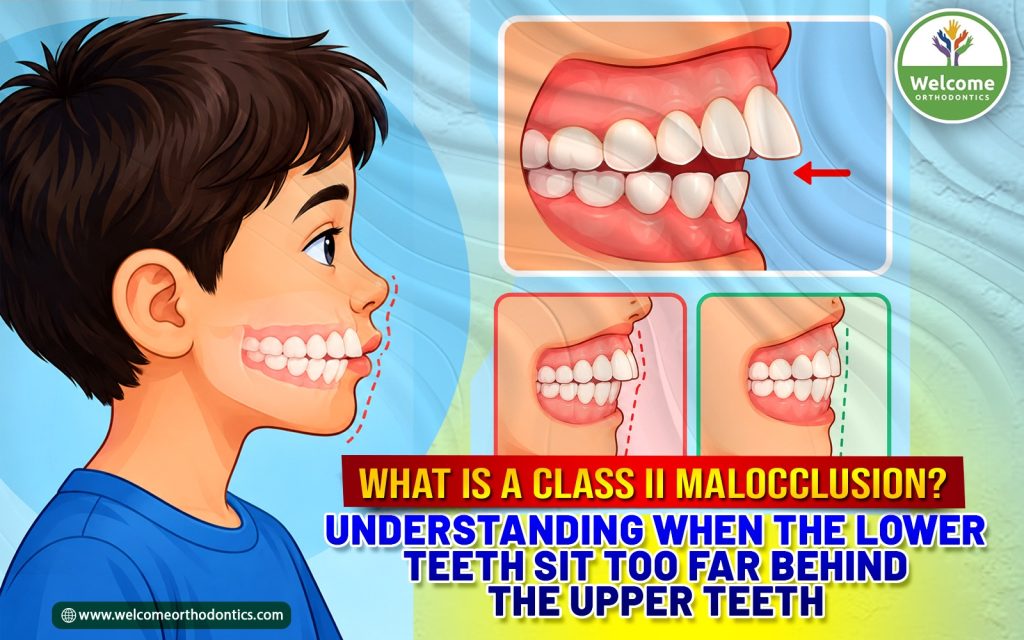
When a child smiles or bites down, parents may notice that the upper front teeth extend noticeably farther forward than the lower teeth. In some cases, the lower jaw may also appear positioned farther back, creating a difference in the child’s bite and side profile. These features can be associated with a condition called Class II malocclusion.
Class II malocclusion is a common orthodontic problem involving the relationship between the upper and lower teeth and, in some children, the position of the jaws. It can develop because of differences in jaw growth, tooth position, or a combination of both.
Although the condition may be noticeable in childhood, not every child requires immediate treatment. Understanding the type and severity of the malocclusion helps parents make informed decisions about evaluation, monitoring, and orthodontic care.
What Is a Class II Malocclusion?
A malocclusion is a problem with the way the upper and lower teeth fit together when the mouth closes. Class II malocclusion describes a bite relationship in which the lower dental arch sits relatively farther back than the upper dental arch. Orthodontists assess this relationship by examining how the teeth meet, particularly the position of the upper and lower first permanent molars. They also evaluate the front teeth, jaw relationships, and facial proportions.
Class II malocclusion can arise in different ways. In some children, the lower jaw is positioned farther back relative to the upper jaw. In others, the upper jaw may be positioned farther forward, or the teeth themselves may be arranged in a way that creates a Class II bite relationship.
These differences matter because a dental problem and a skeletal jaw discrepancy may require different treatment approaches. Class II malocclusion is also frequently associated with increased overjet, which is the horizontal distance between the upper and lower front teeth. However, the two terms do not mean exactly the same thing. Overjet describes the front teeth’s horizontal relationship, while Class II describes a broader bite classification.
What Does a Class II Malocclusion Look Like in a Child?
The appearance of Class II malocclusion varies according to its severity and underlying cause. Some children have noticeably prominent upper front teeth, while others have a more subtle difference in how the upper and lower teeth meet. A child with a skeletal discrepancy may also have a side profile in which the chin appears relatively far back.
Parents may notice the following features:
- Upper front teeth that extend noticeably ahead of the lower teeth
- A visible horizontal gap between the upper and lower incisors
- A lower jaw or chin that appears relatively recessed
- Difficulty bringing the lips together comfortably in some cases
- An uneven relationship between the upper and lower teeth when biting
- Front teeth that appear prominent when the child smiles
These signs do not establish a diagnosis on their own. For example, prominent upper incisors may result from the position of the teeth rather than a small lower jaw.
The appearance may also change as a child grows and permanent teeth erupt. A clinical examination helps determine whether the bite relationship is developing normally or whether an orthodontic concern is present.
What Causes Class II Malocclusion?
Class II malocclusion develops through a combination of genetic, skeletal, dental, and environmental influences. There is no single cause that explains every child’s bite.
Differences in Jaw Growth
One contributing factor is the relationship between the upper and lower jaws. If the lower jaw grows less forward than expected relative to the upper jaw, the lower teeth may sit farther back.
Alternatively, a relatively forward-positioned upper jaw can contribute to the same overall relationship. Some children have a combination of these characteristics. Assessing jaw growth helps the orthodontist understand whether the malocclusion is primarily skeletal or mainly related to tooth position.
Tooth Position and Dental Development
Class II malocclusion can also occur when the teeth are positioned in a way that creates an abnormal bite relationship, even without a major difference in jaw size.
For example, upper front teeth may be inclined forward, increasing overjet. The position of the lower teeth can also influence how the dental arches fit together. Dental development, available space, and the eruption of permanent teeth may affect the final arrangement.
Genetic Influences
Inherited characteristics can influence jaw size, facial growth patterns, tooth dimensions, and the relationship between the upper and lower jaws.
A family history of a similar bite may therefore be relevant during an orthodontic assessment. However, genetics does not determine the outcome in every child, and environmental factors may also influence dental development.
Oral Habits
Certain prolonged oral habits, such as thumb sucking, can affect the developing teeth and bite. Depending on their duration, intensity, and the child’s stage of development, these habits may contribute to forward positioning of the upper incisors or other dental changes.
However, oral habits should not automatically be considered the cause of Class II malocclusion. Many children with this bite relationship do not have a history of thumb sucking or similar habits.
What Is the Difference Between Class II Division 1 and Division 2?
Class II malocclusion is commonly divided into two categories based on the position and inclination of the upper front teeth.
Class II Division 1
In Class II Division 1, the upper front teeth typically incline forward, often creating increased overjet. Parents may notice that the upper incisors look prominent or that there is a noticeable horizontal gap between the upper and lower front teeth.
Because the upper front teeth may project farther forward, they can be more exposed during falls, sports, and other accidents. The degree of prominence varies from child to child.
Class II Division 2
In Class II Division 2, the upper central incisors are typically inclined backward rather than forward. The bite may also involve substantial vertical overlap of the front teeth, known as a deep overbite. The front teeth may therefore look less prominent than they do in Division 1, even though the underlying Class II relationship remains.
The distinction is important because the two divisions have different dental characteristics and may require different orthodontic mechanics. An orthodontist identifies the division through a clinical examination rather than relying on the child’s facial appearance alone.
How Is Class II Malocclusion Diagnosed?
Diagnosis begins with an examination of the child’s teeth, bite, and facial proportions. The orthodontist assesses how the upper and lower dental arches fit together and determines whether the Class II relationship is primarily dental, skeletal, or a combination of both.
The evaluation may include:
- Examining the relationship between the upper and lower molars
- Measuring the overjet and assessing the overbite
- Checking the inclination and position of the front teeth
- Evaluating jaw relationships and facial profile
- Assessing crowding, spacing, and tooth eruption
- Reviewing the child’s dental and orthodontic history
Diagnostic records may include photographs, digital scans, dental models, and X-rays when clinically appropriate. A cephalometric X-ray may help evaluate the relationship between the jaws and the position of the teeth within the facial skeleton. Not every child needs every type of record. The orthodontist selects the necessary investigations according to the clinical findings and treatment questions.
The purpose of diagnosis is to understand the nature of the discrepancy, identify any associated dental concerns, and determine the most appropriate treatment timing.
Does Every Child With Class II Malocclusion Need Treatment?
Not every child with a Class II bite requires immediate orthodontic treatment. The decision depends on the severity of the discrepancy, the child’s age, dental development, functional concerns, and risk of injury. A mild discrepancy may be monitored if the teeth function adequately and there are no significant concerns requiring intervention.
Treatment may be more strongly considered when the child has:
- A pronounced increase in overjet
- Upper front teeth that are vulnerable to injury
- Difficulty closing the lips comfortably
- A significant jaw discrepancy
- A deep bite or another associated bite problem
- Dental alignment concerns that affect function or oral hygiene
The child’s emotional and social experience may also be relevant, particularly if the appearance of the teeth is causing distress or exposing the child to teasing.
However, treatment decisions should not be based on appearance alone. An orthodontist considers the child’s overall dental health, growth, and individual needs before recommending intervention.
How Is Class II Malocclusion Treated in Children?
Treatment depends on whether the problem is primarily dental, skeletal, or a combination of both. The orthodontist also considers the child’s growth stage, available space, and ability to follow treatment instructions.
Braces
Braces can move teeth into improved positions and help correct the relationship between the upper and lower dental arches.
They may be used when the main concern involves tooth alignment or as part of a broader treatment plan addressing a Class II bite. Braces alone do not necessarily correct every underlying skeletal discrepancy, so the treatment plan must reflect the diagnosis.
Functional Appliances
Functional appliances may be considered for selected growing children whose Class II relationship involves the position of the lower jaw relative to the upper jaw.
These appliances are designed to influence the relationship between the dental arches while the child is growing. Their effects and suitability vary, and they do not guarantee a particular amount of jaw growth.
Examples include removable functional appliances and certain fixed appliances that connect the upper and lower arches.
Interarch Elastics
In some cases, orthodontists use elastics that connect the upper and lower braces to help improve the bite relationship. These are generally part of a comprehensive orthodontic plan rather than a standalone solution for every Class II malocclusion.
Consistent use, as prescribed, is important because treatment depends partly on patient cooperation.
Other Treatment Approaches
Some children may need additional measures to manage crowding, tooth position, or a more substantial skeletal discrepancy. In severe cases that persist into adulthood, a combination of orthodontic treatment and jaw surgery may be considered.
Jaw surgery is not a routine treatment for children with Class II malocclusion. The approach depends on the severity of the discrepancy and the child’s stage of growth.
Is Early Orthodontic Treatment Necessary for Class II Malocclusion?
Early treatment can be helpful for selected children, but it is not necessary for every child with a Class II bite.
One important reason to consider early intervention is a pronounced overjet that increases the risk of injury to the upper front teeth. Reducing the prominence of these teeth may lower that risk in appropriate cases. Early treatment may also be considered when the discrepancy is severe, the child has particular functional concerns, or there are other reasons to intervene during growth.
However, starting treatment earlier does not automatically produce a better final result for every child. Research and professional guidance indicate that Class II malocclusion can often be corrected through either early two-phase treatment or treatment later in development, depending on the individual case.
Two-phase treatment usually involves an initial phase during childhood followed by further orthodontic treatment later. It can require a longer overall period of care, so its potential benefits should be weighed against the additional time and appointments.
The American Academy of Pediatric Dentistry recommends individualized assessment of developing malocclusions, with treatment timing based on the diagnosis, risks, growth pattern, and the appropriateness of intervention. Parents should therefore seek an assessment when concerned rather than assume that treatment must begin immediately.
When Should Parents Have Their Child’s Bite Evaluated?
Parents should consider an orthodontic evaluation if their child’s upper front teeth appear significantly prominent, the lower jaw seems far back, or the upper and lower teeth do not meet comfortably.
An assessment may be particularly useful when:
- The horizontal gap between the upper and lower front teeth appears large.
- The child has injured an upper front tooth.
- The lips do not close comfortably at rest.
- The bite looks uneven or the child has difficulty biting into food.
- The child’s teeth or jaw relationship appears to be changing as they grow.
- A dentist has identified a possible Class II bite.
An orthodontic evaluation can be useful even when the child still has baby teeth. It allows the clinician to assess the developing bite and decide whether monitoring or treatment is appropriate.
Parents do not need to diagnose the condition themselves. Describing what they have noticed and sharing any concerns about dental injuries, chewing, or the child’s bite can help the orthodontist understand the reason for the visit.
Why Choose Welcome Orthodontics?
Understanding a child’s bite requires more than looking at the position of the front teeth. A thorough evaluation considers the teeth, jaws, facial growth, and stage of dental development before a treatment plan is recommended.
Welcome Orthodontics focuses on personalized orthodontic care in a comfortable, family-focused environment. Dr. Mark Tavakoli has more than 30 years of clinical orthodontic experience and is a specialist in orthodontics and dentofacial orthopedics. The practice emphasizes individualized treatment planning and a conservative approach, recommending procedures based on each patient’s needs.
The practice also uses modern technology, including iTero digital scanning and CBCT imaging when appropriate, to support diagnosis and treatment planning. These tools can help the orthodontic team gather information about tooth positions and relevant anatomical structures. The type of imaging used depends on the clinical situation.
For children with a suspected Class II malocclusion, an evaluation can help clarify the bite relationship, identify any concerns that need attention, and explain whether monitoring or orthodontic treatment may be appropriate.
Conclusion
Class II malocclusion is a bite relationship in which the lower dental arch sits relatively farther back than the upper dental arch. It may be related to differences in jaw growth, tooth position, or a combination of factors. Some children have prominent upper front teeth, while others have a less obvious appearance but still show a Class II relationship during examination.
The condition can be classified into Division 1 and Division 2 according to the position of the upper front teeth. Diagnosis involves evaluating the bite, tooth alignment, jaw relationships, and facial development. Treatment is individualized. Some children may benefit from braces, functional appliances, or other orthodontic approaches, while others can be monitored until treatment is more appropriate. Early treatment is particularly worth considering when the risk of injury or other significant concerns are present, but it is not automatically necessary for every child.
A professional orthodontic assessment helps parents understand their child’s specific bite pattern and make informed decisions about timing and treatment. The goal is to support a functional, stable bite while taking the child’s growth and individual needs into account.
0 comments on “What Is a Class II Malocclusion? Understanding When the Lower Teeth Sit Too Far Behind the Upper Teeth”