

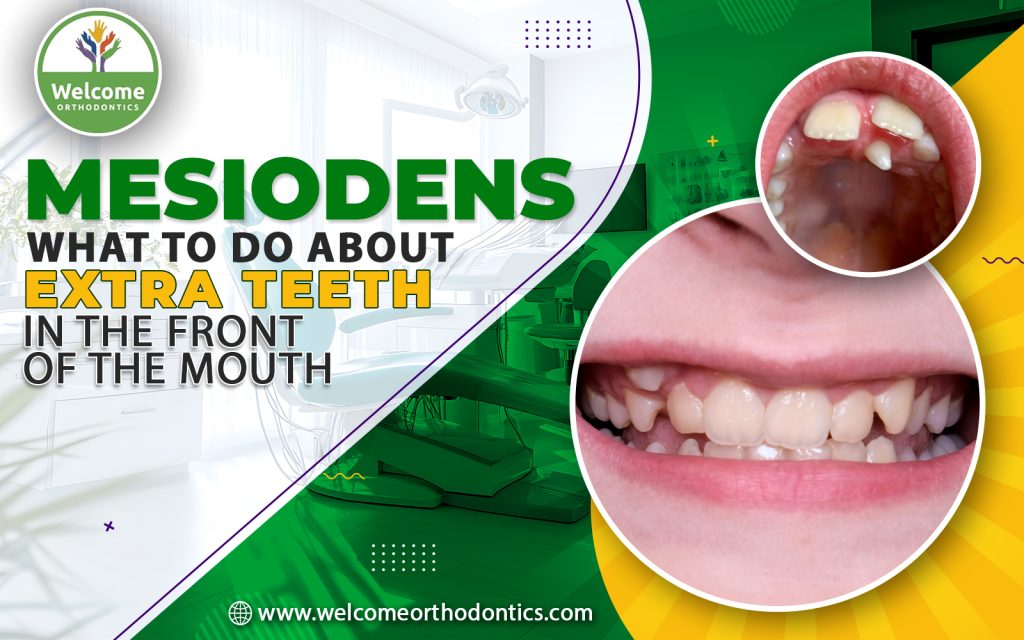
Discovering that a child has an extra tooth in the front of their mouth can be both surprising and concerning for parents. What may first appear as a simple cosmetic issue often raises deeper questions: Why did this happen? Will it interfere with permanent teeth? Is treatment necessary, or will it resolve on its own? These concerns are completely valid, especially when the extra tooth affects a child’s smile, speech, or confidence. One of the most common causes of extra teeth in the upper front region is a condition known as mesiodens.
While the term may sound uncommon, mesiodens is a well-documented dental anomaly that orthodontists and pediatric dentists encounter regularly, often during the critical years when permanent front teeth are expected to erupt. In many cases, mesiodens is discovered after parents notice delayed eruption, unusual spacing, or misalignment of the front teeth. In other instances, it may remain hidden beneath the gums and only become visible through dental X-rays.
Mesiodens can significantly influence how the front teeth erupt, align, and function. When identified early and managed appropriately, most children go on to develop healthy, well-aligned smiles with minimal intervention. However, when left undetected or untreated, mesiodens can trigger a chain of dental and orthodontic complications that may require more extensive treatment later.
This in-depth guide explains what mesiodens is, why it occurs, how it affects dental development, and what treatment options exist, empowering parents and patients to make informed decisions with clarity and confidence.
What Are Mesiodens?
Mesiodens refers to a supernumerary (extra) tooth that develops in the midline of the upper jaw, positioned between the two central incisors. It is the most common type of extra tooth seen in children and adolescents and often becomes noticeable during the early mixed dentition phase, when baby teeth are being replaced by permanent teeth.
Unlike normally developing teeth, a mesiodens does not follow a predictable eruption pattern. In many cases, it may remain completely hidden beneath the gums or within the jawbone, causing no immediate visible signs. In other instances, it may erupt partially or fully into the mouth, appearing as an extra tooth between the front teeth or pushing neighboring teeth out of alignment. Some mesiodens grow at unusual angles, tilted, horizontal, or even inverted, making them harder to detect without dental imaging.
The shape of a mesiodens can also vary. It may appear conical or peg-like, which is the most common form, or present as a tuberculate tooth with multiple cusps. Less commonly, it may resemble a normal tooth in size and shape, making diagnosis more challenging.
In the majority of cases, mesiodens occurs in the upper jaw. Although rare, occurrences in the lower jaw have also been documented. Regardless of location or appearance, early identification is essential to prevent interference with normal dental development.
How Common Is Mesiodens?
Mesiodens occurs in approximately 0.15% to 1.9% of the population, making it an uncommon but well-recognized dental condition rather than a rare anomaly. It is diagnosed far more frequently in children than in adults, largely because it often interferes with the eruption of permanent front teeth during early growth years. Studies consistently show that mesiodens is more common in boys than girls, though the reason for this gender difference is not fully understood.
Most cases are identified during the mixed dentition stage, typically between the ages of six and ten, when baby teeth are being replaced by permanent teeth. Parents may first notice delayed eruption, spacing, or misalignment of the front teeth, prompting further evaluation. However, because a mesiodens does not always erupt into the mouth, many children show no obvious signs at all. As a result, a significant number of cases are discovered only through routine dental X-rays taken during orthodontic or pediatric dental assessments, highlighting the importance of early dental monitoring.
What Does a Mesiodens Look Like?
Mesiodens teeth vary in shape and position, which can affect how noticeable they are.
Common Shapes
- Conical (peg-shaped) – the most common form
- Tuberculate – barrel-shaped with multiple cusps
- Supplemental – looks like a normal tooth (less common)
Possible Positions
- Upright (normal direction)
- Tilted sideways
- Completely inverted (upside down)
- Buried deep in the jawbone
Because of these variations, some mesiodens are visible while others are only detected on X-rays.
Why Does Mesiodens Develop?
The exact cause of mesiodens is not fully understood, but several contributing factors are widely accepted.
Genetic Influence
Mesiodens often runs in families. Children with a parent or sibling who had extra teeth are more likely to develop the condition themselves.
Dental Lamina Hyperactivity
One leading theory suggests that the tissue responsible for tooth formation becomes overactive, creating an additional tooth bud.
Developmental Factors
Abnormal interactions during early tooth development may cause extra teeth to form independently of normal eruption patterns.
Association with Syndromes (Rare Cases)
Mesiodens may occur alongside certain genetic syndromes, such as:
- Cleidocranial dysplasia
- Gardner syndrome
- Cleft lip and palate conditions
However, the majority of children with mesiodens do not have any underlying medical condition.
Different Types of Mesiodens
Not all mesiodens are the same. Classification is based on shape and orientation.
By Shape
- Conical: Small, peg-shaped; most common and often erupt on their own
- Tuberculate: Barrel-shaped; usually do not erupt and can block permanent teeth
- Supplemental: Resembles a normal tooth but appears in excess
By Orientation
- Vertical: Aligned upright like a normal tooth
- Inverted: Grows upside down toward the nasal cavity
- Horizontal: Lies sideways beneath the gums
The shape and orientation significantly influence treatment decisions.
How Mesiodens Affects Dental Development
Even a single extra tooth can disrupt the delicate process of dental eruption and alignment.
Delayed Eruption of Permanent Teeth
A mesiodens can physically block the path of the permanent front teeth, preventing them from erupting on schedule.
Misalignment and Crowding
Extra teeth compete for space, often causing:
- Crooked front teeth
- Rotations
- Uneven spacing
- Midline shifts
Diastema (Gaps Between Teeth)
Mesiodens may create or maintain a gap between the central incisors, even after orthodontic treatment.
Root Resorption (Rare)
In some cases, pressure from a mesiodens can affect the roots of adjacent teeth.
Cysts or Infection
An unerupted mesiodens may occasionally lead to cyst formation or localized infection if left untreated.
Signs and Symptoms Parents Should Watch For
Not all mesiodens cause immediate symptoms, but warning signs include:
- Delayed eruption of one or both front teeth
Permanent front teeth fail to appear on time despite normal growth milestones. - Front teeth growing in crooked or spaced apart
Front teeth erupt misaligned, creating noticeable gaps or overlapping during early development. - A visible extra tooth between the front teeth
An extra tooth appears between front teeth, affecting symmetry and confidence levels. - Rotation or shifting of nearby teeth
Surrounding teeth rotate or drift from positions due to pressure exerted abnormally. - Speech difficulties (in some cases)
Changes in tooth position may interfere with clear pronunciation of certain sounds. - Bulging or swelling in the gum area
Localized gum swelling or bulging may signal an unerupted tooth beneath tissue.
If you notice any of these signs, an orthodontic evaluation is recommended.
Why Mesiodens Should Not Be Ignored
While some mesiodens remain harmless, many cause problems if left untreated.
Potential Complications
- Delayed or blocked eruption of permanent front teeth
- Severe crowding or spacing issues
- Midline shifts, affecting facial symmetry
- Cysts or infections around the extra tooth
- Damage to nearby tooth roots
- Increased need for complex orthodontic treatment later
Early diagnosis allows for simpler, more predictable treatment.
How Is Mesiodens Diagnosed?
Diagnosis involves a combination of clinical examination and imaging.
Clinical Exam
An orthodontist checks:
- Tooth eruption patterns
- Alignment and spacing
- Gum swelling or unusual bumps
Dental Imaging
- Panoramic X-rays
- Periapical X-rays
- 3D CBCT scans (in complex cases)
Imaging helps determine:
- Exact position
- Orientation
- Impact on surrounding teeth
Treatment Options for Mesiodens
Treatment depends on several factors, including age, tooth position, and impact on surrounding teeth.
Monitoring (Observation Only)
If the mesiodens is:
- Not interfering with eruption
- Not causing alignment issues
- Stable and asymptomatic
Regular monitoring may be recommended, especially in very young children.
Surgical Removal
Extraction is the most common treatment when the mesiodens:
- Blocks permanent teeth
- Causes misalignment
- Risks cyst formation
- Erupts in an undesirable position
Timing is crucial, removal is often planned when it will cause minimal disruption to developing teeth.
Orthodontic Guidance After Removal
Once the mesiodens is removed, orthodontic treatment may be needed to:
- Guide impacted teeth into position
- Close gaps
- Align rotated incisors
- Stabilize the bite
In some cases, spontaneous eruption of permanent teeth occurs after removal; in others, orthodontic assistance is required.
When Is the Best Time to Treat Mesiodens?
There is no universal “perfect age,” but many specialists recommend evaluation around:
- Ages 6–7, when permanent incisors begin erupting
- Early mixed dentition, when jaw growth can still be guided
Early treatment often leads to:
- Shorter orthodontic treatment
- Reduced complexity
- Better aesthetic outcomes
Long-Term Outlook After Mesiodens Treatment
With timely diagnosis and appropriate care:
- Most children achieve normal eruption of permanent teeth
- Long-term complications are rare
- Orthodontic results are stable and predictable
Delayed treatment, however, may require:
- More extensive orthodontics
- Surgical exposure of impacted teeth
- Longer overall treatment time
Why Choosing the Right Orthodontic Team Matters
Managing mesiodens is not just about removing an extra tooth—it’s about understanding growth, timing, eruption patterns, and facial development. This requires experience, advanced diagnostics, and a coordinated treatment approach.
Why Families Trust Welcome Orthodontics for Complex Cases Like Mesiodens
When it comes to conditions like mesiodens, precision and planning make all the difference. Welcome Orthodontics is known for delivering thoughtful, growth-focused orthodontic care in a comfortable and modern environment.
What sets Welcome Orthodontics apart is their ability to combine advanced technology with a conservative, patient-first philosophy. Their state-of-the-art digital imaging systems allow for accurate diagnosis of hidden dental anomalies like mesiodens, while minimizing discomfort and unnecessary procedures.
The team emphasizes:
- Early orthodontic evaluations
- Clear, detailed explanations for parents
- Customized treatment planning based on each child’s growth stage
- Seamless coordination between surgical and orthodontic care when needed
- A calm, welcoming atmosphere designed to put children and families at ease
From initial assessment to post-treatment monitoring, patients benefit from a structured, transparent approach that prioritizes long-term oral health, not just quick fixes. This commitment to quality care, affordability, and patient education is why so many families trust Welcome Orthodontics with complex developmental cases.
Frequently Asked Parent Questions
Can mesiodens cause pain?
Most mesiodens are painless initially, but pain can develop if infection, pressure, or cysts form around the extra tooth.
Is mesiodens hereditary?
Yes, genetics play a role. If a parent or sibling had extra teeth, children may have a higher risk.
Will my child need surgery?
If removal is needed, it is usually a minor surgical procedure performed under local anesthesia or light sedation, depending on age and complexity.
What happens if we do nothing?
Leaving mesiodens untreated may lead to:
- Impacted front teeth
- Severe spacing or crowding
- More invasive orthodontic treatment later
Early evaluation helps avoid these outcomes.
Conclusion
Mesiodens may begin as a small developmental irregularity, but its impact on dental alignment, eruption timing, and overall facial harmony can be significant if left unaddressed. What often starts as a delayed or crooked front tooth can gradually lead to spacing problems, crowding, bite issues, and the need for more complex orthodontic intervention later in life. Understanding this condition empowers parents and patients to take timely action rather than adopting a “wait and see” approach that may limit future treatment options.
Early diagnosis plays a critical role in achieving the best outcome. With accurate imaging, careful evaluation, and well-timed intervention, most children with mesiodens experience smooth eruption of their permanent teeth and avoid long-term complications. When treatment is guided by orthodontic expertise, even cases involving impacted or hidden mesiodens can be managed predictably and safely.
For families seeking clarity, confidence, and comprehensive care, Welcome Orthodontics provides the experience, advanced diagnostic technology, and patient-centered approach needed to manage mesiodens effectively. From early detection to long-term smile development, their focus remains on protecting both dental health and facial balance, helping children grow into healthy, confident smiles that last a lifetime.
0 comments on “Mesiodens: What to Do About Extra Teeth in the Front of the Mouth”