

When parents think about orthodontic problems in children, the first things that usually come to mind are crooked teeth, gaps, or crowded smiles. These issues are easy to spot because they affect the front teeth and are visible when a child smiles. However, not all orthodontic concerns are obvious. Some problems develop quietly in the back of the mouth and may go unnoticed for years. One such condition is a scissor bite.
A scissor bite is considered one of the less common bite problems in children, but it can have a meaningful impact on oral health, jaw development, and chewing function if left untreated. Because it typically affects the back teeth and often causes little or no discomfort in the early stages, many parents and even routine dental visits may overlook it.
The challenge with scissor bites is that children naturally adapt. They may shift their jaw slightly while chewing, favor one side of the mouth, or avoid certain foods without realizing anything unusual is happening. Over time, however, these adaptations can place strain on the jaw muscles and joints and influence how the jaws grow.
Understanding how a scissor bite develops, and why it is often missed, is important for parents who want to support their child’s long-term oral health. In this article, we’ll explore what a scissor bite is, why it can be difficult to detect, what causes it during childhood growth, how it can affect oral development, and the early signs parents should watch for. We’ll also discuss how orthodontic evaluation and early treatment can help correct the problem before it becomes more complex.
Understanding Scissor Bite in Children
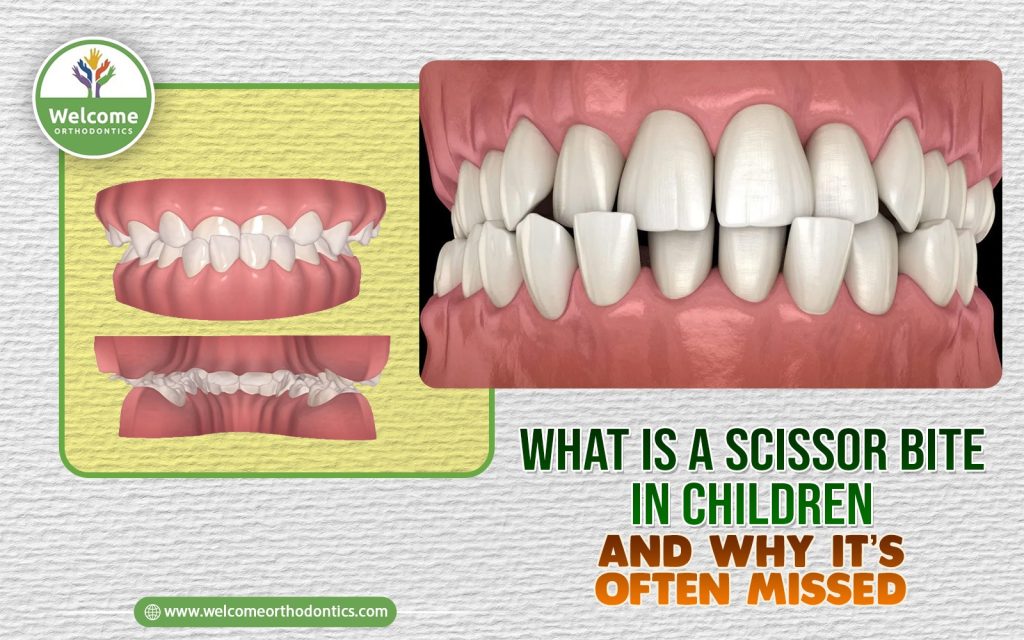
A scissor bite is a type of dental misalignment where the upper back teeth sit completely outside the lower back teeth when the child bites down. Instead of the upper teeth slightly overlapping the lower teeth in a normal bite relationship, the teeth pass by each other without proper contact, similar to the blades of a pair of scissors.
This condition most commonly affects the molars and premolars located in the back of the mouth. Because these teeth are not easily visible when a child smiles or talks, a scissor bite can go unnoticed for a long time.
How a Normal Bite Should Work
In a healthy bite:
- The upper teeth slightly overlap the lower teeth.
- The molars fit together in a balanced, interlocking pattern.
- Both sides of the mouth share chewing forces evenly.
This alignment allows the teeth and jaws to function smoothly during chewing, speaking, and swallowing.
What Happens in a Scissor Bite
In a scissor bite:
- The upper molars sit too far outward.
- The lower molars may sit too far inward.
- The teeth fail to make proper contact during biting.
Because of this misalignment, chewing forces may become uneven. The child may chew more on one side of the mouth or adjust their jaw position unconsciously to compensate.
How It Differs From Other Bite Problems
Parents often confuse scissor bites with other orthodontic conditions. However, it is different from several more commonly known bite issues.
Crossbite:
In a crossbite, some upper teeth sit inside the lower teeth. A scissor bite is the opposite, upper teeth sit too far outside.
Overbite:
An overbite refers to vertical overlap between the front teeth. Scissor bites affect the back teeth and involve horizontal positioning.
Underbite:
An underbite occurs when the lower front teeth extend beyond the upper teeth. Again, this typically affects the front of the mouth.
Because a scissor bite involves the back teeth and does not always affect the visible part of the smile, it often remains unnoticed until orthodontic evaluation.
Why Scissor Bite Often Goes Undetected
Scissor bites are frequently missed during childhood for several reasons. Unlike many dental problems, the condition does not always produce obvious visual or physical symptoms in its early stages.
The Problem Is Hidden in the Back of the Mouth
Most scissor bites involve molars and premolars located toward the back of the dental arch. Parents typically notice changes in the front teeth first, such as crowding or gaps, because they are visible when children smile.
Since the back teeth are harder to observe, subtle bite discrepancies in this area may go unnoticed.
Lack of Pain in Early Stages
One of the main reasons scissor bites are overlooked is that they often do not cause immediate discomfort. Children can function with this type of bite without feeling pain, especially during the early years.
Without pain or complaints, parents may assume their child’s bite is functioning normally.
Children Adapt Their Chewing Patterns
Children are remarkably adaptable. When teeth do not fit together properly, they may instinctively adjust how they chew.
Common adaptations include:
- Chewing mainly on one side of the mouth
- Shifting the jaw slightly during biting
- Avoiding harder foods
Because these adjustments happen naturally, the underlying bite imbalance may remain hidden.
Routine Dental Visits Focus on Cavities and Hygiene
General dental visits often focus on oral hygiene, cavity detection, and gum health. While dentists do evaluate the bite, subtle scissor bites may not always be immediately obvious unless a detailed orthodontic assessment is performed.
Orthodontists are specifically trained to evaluate jaw relationships, tooth eruption patterns, and bite alignment in greater depth.
Gradual Development During Growth
Scissor bites often develop slowly as children grow. Changes in jaw width, tooth eruption, or growth patterns may gradually shift the relationship between the upper and lower teeth.
Because the change occurs over time, parents may not recognize when the bite begins to deviate from normal alignment.
Common Causes of Scissor Bite During Growth
A scissor bite rarely develops from a single cause. In most cases, it results from a combination of developmental, structural, and behavioral factors that influence how the teeth and jaws grow.
Uneven Jaw Development
One of the most common causes of scissor bite is an imbalance between the width of the upper and lower jaws.
If the upper jaw develops wider than the lower jaw, the upper molars may sit too far outside the lower molars. This difference in jaw width can create the scissor-like relationship between the teeth.
These discrepancies often become more noticeable as permanent molars erupt.
Abnormal Tooth Eruption Patterns
Teeth erupt along specific paths guided by surrounding structures. If molars erupt at unusual angles or positions, they may bypass their normal bite relationship.
This can happen when:
- Baby teeth are retained longer than expected
- Permanent teeth erupt earlier than neighboring teeth
- Space limitations alter eruption direction
Over time, these altered eruption patterns can contribute to a scissor bite.
Oral Habits
Certain habits during childhood can influence jaw development and tooth alignment.
Examples include:
- Prolonged thumb sucking
- Tongue thrusting
- Chewing primarily on one side
- Extended pacifier use
These habits can affect muscle forces in the mouth and alter how the jaws grow relative to each other.
Genetic Factors
Genetics also play an important role in bite development. Children who inherit certain jaw shapes or sizes may be more prone to developing bite discrepancies.
For example, a child may inherit:
- A wider upper jaw
- A narrower lower jaw
- Crowded dental arches
These inherited characteristics can increase the likelihood of scissor bite formation.
Growth Timing Differences
The upper and lower jaws do not always grow at the same rate. During growth spurts, one jaw may temporarily outpace the other.
If this imbalance persists during tooth eruption, it may influence how molars align and contribute to scissor bite development.
How a Scissor Bite Affects Oral Health and Facial Development
Although a scissor bite may appear minor at first, it can influence several aspects of oral function and facial growth if left untreated.
Chewing Efficiency
Molars are responsible for grinding food during chewing. When these teeth fail to meet properly, chewing efficiency decreases.
Children may take longer to chew food or rely on one side of the mouth, which can place additional strain on certain teeth and muscles.
Muscle Imbalance
When the bite is uneven, jaw muscles may work harder on one side than the other. Over time, this imbalance can lead to muscle fatigue or tension.
Children may not describe this discomfort directly, but it may show up as:
- Jaw tiredness after meals
- Mild facial tension
- Changes in chewing behavior
Jaw Joint Stress
The temporomandibular joints (TMJ) connect the lower jaw to the skull. These joints allow smooth jaw movement during speaking and chewing.
A scissor bite can cause uneven pressure on these joints, potentially leading to joint strain over time.
Tooth Wear
When certain teeth receive excessive pressure due to misalignment, they may experience uneven wear.
Over many years, this can contribute to:
- Tooth sensitivity
- Enamel wear
- Increased risk of dental damage
Facial Growth Patterns
The way teeth meet influences jaw positioning during growth. Persistent bite imbalance can affect how the jaws develop and how facial structures mature.
While subtle in many cases, long-term asymmetry can occur if bite discrepancies remain uncorrected during critical growth years.
Early Signs Parents Should Watch For
Because scissor bites often develop quietly, parents should watch for functional or behavioral signs rather than relying only on visible tooth alignment.
Favoring One Side While Chewing
Children with a scissor bite may chew primarily on one side of the mouth. This happens because the teeth on the other side may not make effective contact.
Over time, this pattern can reinforce muscle imbalance and uneven chewing forces.
Difficulty Chewing Certain Foods
Children may avoid foods that require more grinding effort, such as tougher meats or crunchy vegetables. They may chew slowly or complain that certain foods are difficult to eat.
This can indicate that the back teeth are not functioning efficiently together.
Jaw Shifting When Biting
Some children shift their jaw slightly to one side when biting down in order to achieve a more comfortable position.
Although this movement can be subtle, repeated shifting can place strain on the jaw joints and muscles.
Jaw Fatigue During Meals
Children may report that their jaw feels tired after eating, especially during longer meals. This fatigue often results from the muscles working harder to compensate for an uneven bite.
Speech or Tongue Position Changes
In some cases, uneven tooth contact can influence how the tongue rests during speech or swallowing. This may contribute to minor pronunciation changes.
While not always caused by scissor bites alone, speech differences combined with chewing issues may suggest a broader bite problem.
Dental Observations by a Dentist
Dentists may notice signs such as:
- Uneven molar wear
- Outward positioning of upper molars
- Asymmetrical bite relationships
These findings may prompt referral for orthodontic evaluation.
How Orthodontic Evaluation and Early Treatment Can Correct a Scissor Bite
Early orthodontic evaluation is essential for detecting scissor bites before they affect long-term development. Orthodontists assess not only tooth alignment but also how the jaws fit together and how growth patterns influence bite relationships.
Why Early Evaluation Matters
Children’s jaws are still developing, which makes them more responsive to guidance during orthodontic treatment.
Early evaluation allows orthodontists to:
- Monitor jaw growth
- Identify bite discrepancies early
- Plan treatment at the most effective stage
This approach often leads to simpler and more predictable outcomes.
Growth-Guided Treatment Approaches
Treatment for scissor bite may involve guiding the development of the jaws and teeth while growth is still occurring.
Depending on the child’s needs, treatment may include:
- Orthodontic appliances
- Space-guiding techniques
- Bite correction methods
- Alignment treatment when necessary
Early intervention can prevent the bite imbalance from becoming more severe during adolescence.
The Approach at Welcome Orthodontics
Practices like Welcome Orthodontics focus on early detection and individualized treatment planning. Their approach combines advanced diagnostic tools with a growth-focused philosophy that prioritizes conservative and effective treatment.
By carefully evaluating each child’s development, the team designs treatment plans that address both functional bite problems and long-term facial growth.
Parents are guided through every step of the process, ensuring they understand the diagnosis, treatment options, and expected outcomes.
Conclusion
A scissor bite in children is an orthodontic condition that often goes unnoticed, yet it can significantly influence oral health and jaw development over time. Because it usually affects the back teeth and may not cause immediate discomfort, the problem can remain hidden until functional issues begin to appear.
The encouraging news is that early detection makes a meaningful difference. With timely orthodontic evaluation and growth-guided treatment, scissor bites can often be corrected efficiently during childhood. Addressing the issue early helps restore balanced chewing, support healthy jaw development, and prevent more complex orthodontic treatment later in life.
Parents who remain attentive to subtle signs, such as uneven chewing patterns or jaw movement, can play a vital role in protecting their child’s long-term oral health.
With expert guidance and thoughtful care from providers like Welcome Orthodontics, families can ensure that developing smiles grow in a healthy, balanced way, laying the foundation for strong bites, comfortable function, and confident smiles for years to come.
0 comments on “What Is a Scissor Bite in Children and Why It’s Often Missed”