

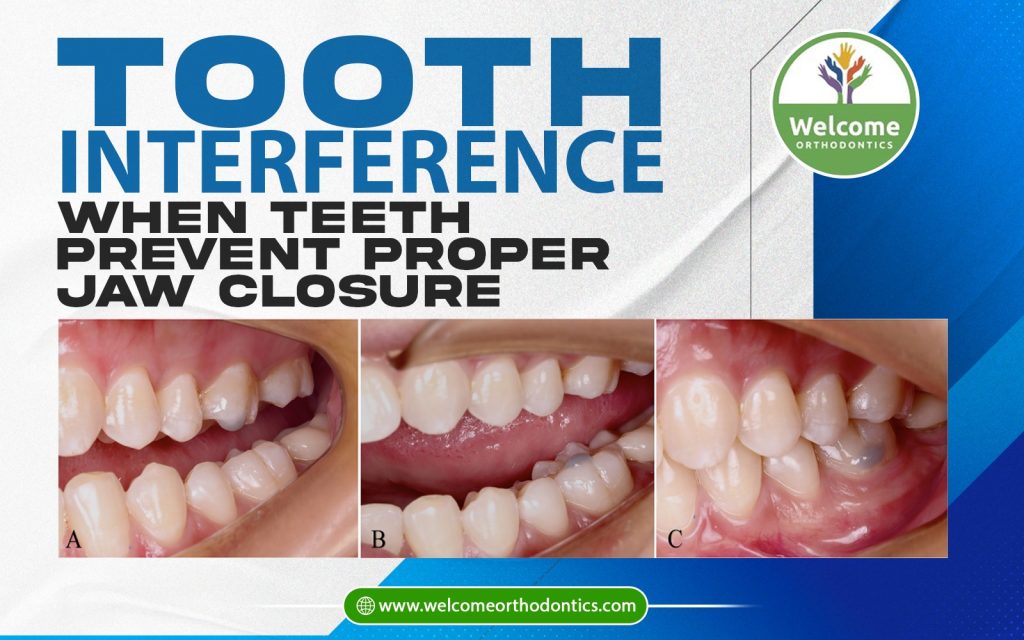
Most parents expect orthodontic problems to be visible, crooked teeth, gaps, or crowding. These are the signs that are easy to spot during everyday moments like brushing or smiling. But not all dental issues are that obvious. Some of the most important bite problems develop quietly beneath the surface, affecting how the teeth and jaws function rather than how they look. One such condition is tooth interference, where certain teeth prevent the jaw from closing naturally.
In a healthy bite, the upper and lower teeth come together smoothly and evenly. The jaw closes in a straight, stable position without needing to adjust or compensate. This balance allows for efficient chewing, proper muscle function, and healthy jaw development. But when interference is present, even a small irregularity can disrupt this process. One or more teeth may make contact too early, forcing the jaw to shift slightly forward, backward, or to the side in order to find a comfortable position.
What makes this condition particularly challenging is that it rarely causes immediate pain. Children are highly adaptable, and they often adjust without realizing it. They may begin chewing on one side, shifting their jaw unconsciously, or avoiding certain movements that feel less comfortable. Because these changes happen gradually, they are easy to overlook and may seem like normal behavior.
Over time, however, these small adaptations can have a bigger impact. Repeated jaw shifting can influence how the jaws grow, how muscles develop, and how teeth align. What starts as a minor interference can gradually contribute to bite imbalances, uneven wear, or more noticeable orthodontic concerns. Understanding tooth interference early allows parents to move from uncertainty to clarity. With the right evaluation at the right time, it becomes possible to identify these hidden issues and guide development before they turn into more complex problems.
Understanding Tooth Interference in Children
Tooth interference occurs when certain teeth come into contact earlier than they should, blocking the jaw from closing in its natural position.
What tooth interference means
In simple terms, interference happens when:
- One or more teeth “hit first” when the mouth closes
- The jaw cannot close evenly
- The bite forces the jaw into a different position
Instead of a smooth, balanced closure, the jaw is redirected to avoid that interference.
How it affects jaw closure
When interference is present, the jaw may:
- Shift slightly forward, backward, or sideways
- Close in an altered position rather than its ideal alignment
- Repeat this compensatory movement every time the child bites
Over time, this becomes the child’s “normal,” even though it isn’t optimal.
Normal bite vs interference
In a healthy bite:
- Teeth meet evenly across both sides
- The jaw closes without shifting
- Movement feels smooth and natural
With interference:
- Contact is uneven
- Movement feels restricted or adjusted
- The jaw may need to “find” a comfortable position
Why it often goes unnoticed
Tooth interference is easy to miss because:
- It often involves back teeth, not visible in a smile
- Children rarely feel pain in early stages
- Adaptation hides the issue
- It develops gradually, not suddenly
This is why early orthodontic monitoring is so valuable.
Common Causes of Tooth Interference During Growth
Tooth interference doesn’t usually come from a single cause. Instead, it develops gradually as a result of how teeth erupt, how the jaws grow, and how daily habits influence function. Because these factors often overlap, the interference may not be obvious at first but can become more noticeable as the child grows.
Uneven tooth eruption
As permanent teeth begin to emerge, they don’t always come in at the same time or at the same height. Some teeth may erupt slightly earlier or sit a bit higher than others. When this happens, that tooth can make contact before the rest of the teeth have a chance to align properly. This early contact creates a pressure point in the bite, forcing the jaw to adjust its position to avoid discomfort. Over time, repeated closure in this altered position can establish an uneven bite pattern.
Bite discrepancies
Certain bite conditions naturally create uneven contact between the upper and lower teeth. For example, in a crossbite, some teeth may sit inside or outside their normal position, while in a deep bite, the front teeth may overlap excessively. These discrepancies change how the teeth meet when the mouth closes, often causing specific areas to come into contact too soon. This uneven contact can interfere with smooth jaw movement and lead to compensatory shifts during biting.
Crowding and lack of space
When there isn’t enough room in the jaw for all the teeth to align properly, crowding can occur. Crowded teeth may erupt in rotated, tilted, or overlapping positions. Even a slight misalignment can cause one tooth to protrude more than others, leading to premature contact. As the child continues to grow, this uneven positioning can affect how the bite develops and increase the likelihood of interference.
Premature tooth contact
In some cases, interference can result from something as subtle as a small difference in tooth height. A single tooth that sits just slightly higher than the surrounding teeth can disrupt the balance of the entire bite. Each time the child closes their mouth, that tooth makes contact first, forcing the jaw to shift into a different position. Although the difference may be minimal, the repeated adjustment can have a noticeable impact over time.
Oral habits and functional patterns
Daily habits and functional behaviors can also influence how teeth and jaws develop. Patterns such as chewing consistently on one side, thumb sucking, or tongue thrusting can create uneven forces within the mouth. These forces may gradually shift tooth positions or affect jaw growth, increasing the chances of interference. Over time, the body adapts to these patterns, reinforcing the imbalance and making it more difficult for the bite to correct itself naturally.
Because these causes often develop slowly and without obvious symptoms, early monitoring plays a key role in identifying and managing tooth interference before it leads to more significant concerns.
How Tooth Interference Affects Jaw Function and Development
Tooth interference may seem minor at first, but it can have a wide range of effects on a child’s oral health and development.
Impact on jaw positioning
When the bite is not balanced, the jaw is forced to close in a position that avoids interference. Over time, this altered position can become habitual, affecting how the jaw grows and functions.
Chewing inefficiency
Children may not chew evenly across both sides of the mouth. Instead, they may favor one side, leading to:
- Reduced chewing efficiency
- Uneven muscle use
- Avoidance of certain foods
Muscle strain and imbalance
The muscles that control jaw movement rely on balanced function. With interference:
- Some muscles work harder than others
- One side may become dominant
- The other side may weaken
This imbalance can affect comfort and stability.
Tooth wear and alignment changes
Uneven pressure on teeth can lead to:
- Premature wear on certain teeth
- Shifting of teeth over time
- Worsening alignment issues
Influence on facial growth
During childhood, the jaws are still developing. If the bite is not balanced:
- Growth may be uneven
- Facial symmetry may be affected
- Changes may become more noticeable during adolescence
Long-term risks
If left untreated, tooth interference can contribute to:
- Chronic jaw strain
- Persistent bite problems
- More complex orthodontic treatment later
Early Signs Parents Should Watch For
Tooth interference is often subtle, but certain patterns can indicate that something isn’t quite right.
Jaw shifting when closing
Parents may notice that the jaw does not close straight. Instead, it may shift slightly to one side before the teeth fully come together. This shift is often the body’s way of avoiding interference.
Uneven chewing patterns
Children may consistently chew on one side of the mouth. This preference usually develops because one side feels more comfortable or functional.
Difficulty with certain foods
Harder or chewy foods may be avoided. Children might take longer to eat or complain that chewing feels tiring.
Clicking or irregular movement
Subtle clicking, shifting, or hesitation during jaw movement may be present. These signs are often mild but can indicate functional imbalance.
Changes in comfort or behavior
Children may not describe discomfort clearly, but they might:
- Eat more slowly
- Avoid certain textures
- Show signs of jaw fatigue
Subtle bite irregularities
During brushing or observation, parents may notice that:
- Teeth don’t meet evenly
- Some teeth touch before others
- The bite looks slightly off when closing
If these signs persist, it’s worth seeking professional evaluation.
How Orthodontic Evaluation and Treatment Can Help
For parents, the biggest benefit of orthodontic evaluation is understanding what’s happening early, before the problem becomes more complex.
Orthodontic assessment focuses on how the teeth, jaws, and bite work together, not just how they look.
When interference is detected early, orthodontists can:
- Identify the exact point of interference
- Evaluate how it affects jaw movement
- Determine whether growth is being influenced
In many cases, the first step is monitoring. Not every child needs immediate treatment. Growth is observed, and intervention is recommended only when it can make the most impact.
When treatment is needed, options may include:
- Growth-guided correction to improve jaw positioning
- Alignment solutions such as Teeth braces in California or Orthodontics braces in California
- Conservative approaches like Braces without extraction of permanent teeth
Some children may even be able to straighten teeth without braces, depending on how early the issue is addressed.
How Welcome Orthodontics Helps Manage Tooth Interference
Tooth interference is one of those conditions where experience and timing matter greatly. It’s not just about fixing teeth, it’s about understanding how the bite is developing and when to intervene. At Welcome Orthodontics, the focus is on early detection and thoughtful planning. The goal is to identify hidden issues like interference before they begin affecting growth and function.
From the first visit, parents are given a clear understanding of their child’s bite and development. The evaluation includes detailed analysis using advanced digital scans and imaging, allowing even subtle interference patterns to be identified.
What makes their approach stand out is balance. Not every case requires immediate treatment. In many situations, careful monitoring is the best course of action. When intervention is recommended, it is timed to work with the child’s natural growth, making treatment more effective and less invasive.
With over 30 years of clinical experience, Dr. Tavakoli brings the ability to distinguish between cases that need early action and those that simply need observation. This prevents unnecessary treatment while ensuring important issues are not overlooked. Families also benefit from a practical, supportive approach. For those searching for Affordable orthodontics near me, the practice offers flexible financing and helps maximize insurance benefits, making care accessible without added stress.
Most importantly, every treatment plan is personalized. The focus is not just on straightening teeth, but on creating a balanced, functional bite that supports long-term health.
Conclusion
Tooth interference in children is often overlooked because it develops quietly and doesn’t always cause immediate discomfort. However, its impact on jaw function, tooth alignment, and overall development can become significant over time. By recognizing early signs, such as jaw shifting, uneven chewing, or difficulty with certain foods, parents can take proactive steps toward evaluation and care.
Early orthodontic monitoring allows these issues to be identified at the right stage, often preventing more complex problems later. Instead of correcting established issues, treatment can guide development in a more natural and effective way. With expert care from practices like Welcome Orthodontics, families can feel confident that even subtle, hidden bite problems are being addressed with precision and care. supporting healthier growth, better function, and confident smiles for years to come.
0 comments on “Tooth Interference: When Teeth Prevent Proper Jaw Closure”