

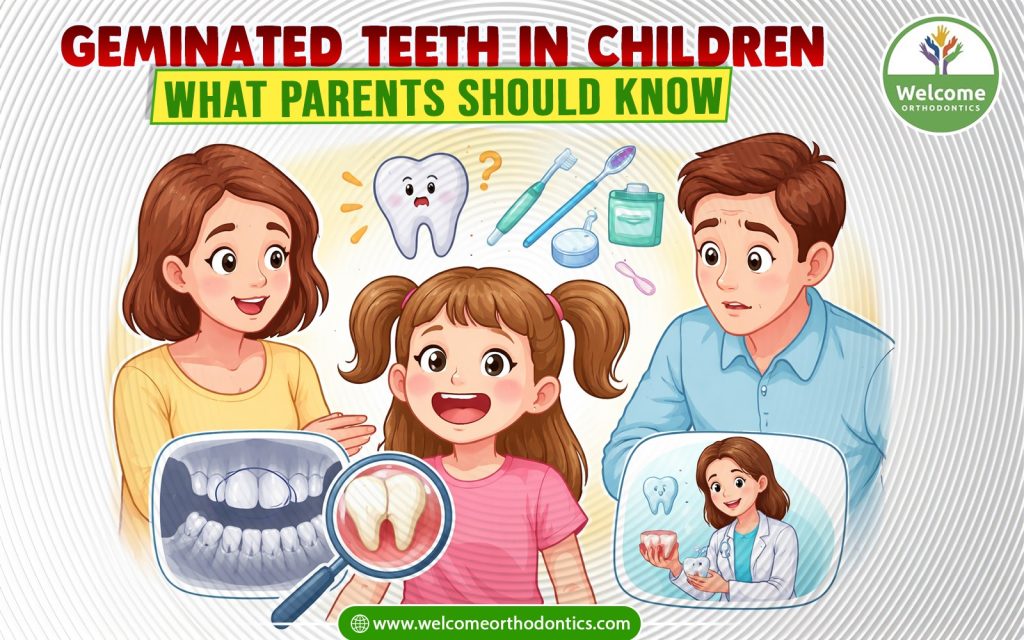
As children grow, it’s completely normal for parents to notice changes in how their teeth look and develop. Some variations, like mild crowding or temporary gaps, are part of the natural transition from baby teeth to permanent teeth. But occasionally, a tooth may appear unusually wide or look like it has split into two parts. This condition is known as gemination, and it often raises concern for parents seeing it for the first time.
Geminated teeth are not very common, but they are not rare either. They typically appear in the front teeth and can affect both baby and permanent teeth. While the condition itself is not harmful, it can influence spacing, alignment, and how the bite develops over time. What makes geminated teeth particularly important is that they can sometimes be mistaken for other conditions, such as fused teeth. Without proper evaluation, it can be difficult to understand what’s actually happening and whether treatment is needed.
The good news is that with early orthodontic monitoring and the right approach, geminated teeth can be managed effectively. This article will help you understand what geminated teeth are, why they occur, how they affect your child’s dental development, and what steps you can take to ensure a healthy, balanced smile.
Understanding Geminated Teeth in Children
Gemination is a developmental condition in which a single tooth attempts to divide into two during its early formation. Instead of forming two separate teeth, the tooth partially splits, resulting in one enlarged tooth that may appear as two joined together. This process happens long before the tooth erupts into the mouth, which is why parents typically notice it only once the tooth becomes visible.
Although the appearance can be unusual, it’s important to understand that gemination is not a sign of damage or decay. It is simply a variation in how the tooth developed. In many cases, the tooth functions normally, but its size and shape can influence spacing, alignment, and overall dental development.
What geminated teeth look like
A geminated tooth often appears noticeably wider than surrounding teeth. It may have a groove, notch, or indentation running down the center, giving it a “split” appearance. From a distance, it can look like two teeth fused together, especially if the division is pronounced. However, unlike two separate teeth, it originates from a single tooth bud and is structurally one unit.
The depth of the groove can vary. In some children, it may be shallow and barely noticeable, while in others, it can be more defined, making the tooth look almost like a pair of teeth joined side by side.
Key characteristics of gemination
Several features help identify a geminated tooth. Typically, one tooth appears larger or “double” compared to the rest. A visible groove or notch often divides the crown into two sections, although they remain connected. The tooth usually has a single root system beneath the surface, even though the crown looks split. Most importantly, the total number of teeth in the mouth remains normal.
This last point is essential for diagnosis. Because gemination involves one tooth attempting to divide, it does not increase or decrease the total tooth count.
How it differs from fused teeth
Gemination is commonly confused with fusion, but the two conditions are fundamentally different. In gemination, a single tooth bud tries to split, resulting in a larger tooth while maintaining a normal tooth count. In fusion, two separate tooth buds join together, creating one large tooth and reducing the total number of teeth.
Visually, both conditions can look similar, which is why professional evaluation is often necessary. Dentists or orthodontists may use X-rays or digital imaging to determine whether the tooth has one root or two, helping confirm the correct diagnosis.
How common is it?
Geminated teeth are relatively uncommon, but they are seen more often in primary (baby) teeth than in permanent teeth. They most frequently affect the upper front teeth, where they are easier to notice due to their position in the smile. Because these teeth are so visible, parents are more likely to spot the condition early, even if it does not cause any discomfort.
While gemination may look unusual, understanding its nature helps parents approach it with confidence and seek the right guidance when needed.
What Causes Geminated Teeth to Develop
Gemination occurs during the early stages of tooth development, long before the tooth becomes visible in the mouth. While the exact cause is not always clear, several factors may contribute to this variation in tooth shape.
Tooth development irregularities
Teeth begin forming as small structures called tooth buds deep within the gums. During normal development, each tooth bud grows into a single, well-defined tooth. However, if this process is slightly disrupted, the tooth bud may attempt to divide instead of forming as one unit. This partial division results in a single enlarged tooth with a split or grooved appearance, which is characteristic of gemination.
Genetic influences
Genetics can play a meaningful role in how teeth develop. Children may inherit traits related to tooth size, shape, or structure from their parents. If there is a family history of unusual dental formations, such as small teeth, missing teeth, or irregular tooth shapes, the likelihood of geminated teeth may be higher. While not every case is hereditary, genetic predisposition can influence how tooth buds form during early development.
Environmental factors
Although less common than genetic causes, certain external influences during early childhood can affect tooth development. These may include minor trauma to the mouth or jaw during the stages when teeth are forming, which can interfere with normal tooth bud growth. Nutritional deficiencies, especially during critical growth periods, may also impact how teeth develop. Additionally, certain health conditions that affect overall growth and development could play a role, although these cases are relatively rare.
Why front teeth are more commonly affected
Geminated teeth are most often seen in the front teeth, particularly the upper incisors. This is partly because front teeth develop earlier than many other teeth, making them more susceptible to developmental variations during those early stages. Their shape and position also make any irregularity more noticeable compared to back teeth. Since front teeth are more visible when a child smiles or speaks, parents are more likely to detect gemination in this area.
How Geminated Teeth Affect Oral Health and Development
While geminated teeth are not harmful on their own, they can influence several aspects of dental development, especially as permanent teeth begin to erupt.
Impact on spacing
Because a geminated tooth is wider than normal, it can take up more space in the dental arch. This may lead to:
- Crowding of nearby teeth
- Reduced space for permanent teeth
- Shifting of adjacent teeth
Effects on alignment
The presence of a larger tooth can disrupt how neighboring teeth align. As other teeth erupt, they may adjust their position to accommodate the extra width, potentially leading to misalignment.
Bite considerations
In some cases, geminated teeth can affect how the upper and lower teeth meet. This may not always be noticeable early on, but it can influence bite development over time.
Oral hygiene challenges
Geminated teeth often have grooves or indentations that can trap food and plaque. This makes them harder to clean effectively, increasing the risk of:
- Cavities
- Gum irritation
- Plaque buildup in hard-to-reach areas
Aesthetic concerns
Because these teeth are often located in the front of the mouth, they can affect the appearance of a child’s smile. As children grow older, this may impact confidence, especially during adolescence.
Early Signs Parents Should Watch For
Geminated teeth are often noticeable early, but some signs can still be subtle or easily misunderstood. Recognizing these indicators can help parents seek timely evaluation and avoid confusion.
A tooth that looks wider than usual
One of the most noticeable signs is a tooth that appears significantly larger than the others. Instead of matching the size and shape of neighboring teeth, it may look unusually broad or bulky. In many cases, it gives the impression that two teeth are joined together, especially when compared to the symmetry of the surrounding teeth.
A visible groove or split
Geminated teeth often have a distinct groove, notch, or line running down the center of the tooth. This indentation can make the tooth look like it is partially divided into two sections. In some cases, the groove may be shallow, while in others it can be deeper, making the separation more noticeable.
Delayed or unusual eruption
Parents may notice that the affected tooth erupts differently from others. It might come in later than expected, or it may emerge in a slightly different position or angle. Because the tooth is larger, it may take more time to fully appear or may not align neatly with adjacent teeth during eruption.
Changes in spacing
The extra width of a geminated tooth can affect how surrounding teeth position themselves. This may lead to gaps forming on one side or crowding on the other, depending on how space is distributed in the dental arch. Over time, these spacing changes can influence overall alignment.
Confusion with “extra teeth”
At first glance, many parents assume their child has an extra tooth because of the double appearance. This is especially common when the groove is pronounced, making the tooth look like two separate teeth fused together. However, in gemination, it is actually a single tooth with a split crown.
If any of these signs are present or seem unusual, a dental or orthodontic evaluation can provide clarity and help determine the best course of action.
How Orthodontic Evaluation and Treatment Can Help
When it comes to managing geminated teeth, early evaluation makes a significant difference. Not every case requires immediate treatment, but understanding how the tooth will affect future development is essential.
Orthodontic evaluation focuses on:
- How the tooth affects spacing
- Whether there is enough room for permanent teeth
- How the bite is developing
- Whether alignment issues are likely
In many cases, the first step is monitoring. As the child grows, orthodontists track how the teeth and jaws develop and determine whether intervention is needed.
When treatment is required, options may include:
- Alignment solutions such as Teeth braces in California or Orthodontics braces in California
- Space management to guide proper eruption
- Conservative approaches like Braces without extraction of permanent teeth
In some situations, treatment may also allow patients to Straighten teeth without braces, depending on the case.
How Welcome Orthodontics Helps Children with Geminated Teeth
For parents, one of the most important factors is choosing the right orthodontic team. Conditions like geminated teeth require careful evaluation, timing, and a personalized approach.
At Welcome Orthodontics, the focus is on understanding each child’s development before recommending treatment. The goal is not just to correct what is visible, but to identify how the condition may affect long-term alignment and function. The evaluation process is thorough and precise. Using advanced digital imaging and diagnostic tools, the team assesses tooth structure, spacing, and jaw development in detail. This allows them to detect potential issues early, even those that may not yet be visible.
What sets their approach apart is its balance. Not every child with geminated teeth needs immediate treatment. In many cases, the team recommends monitoring growth and intervening only when necessary. This avoids unnecessary procedures while ensuring the best possible outcome.
With over 30 years of clinical experience, Dr. Tavakoli brings a deep understanding of developmental dental conditions. This experience helps guide decisions about when to act and when to wait, an important distinction in growing children. Parents also benefit from clear communication. Every step is explained in a way that is easy to understand, so families can make informed decisions without feeling overwhelmed.
Affordability is another key consideration. For families searching for Affordable orthodontics near me, Welcome Orthodontics offers flexible financing and helps maximize insurance benefits, making high-quality care more accessible. Most importantly, treatment plans are always personalized. Each child’s smile develops differently, and care is tailored to match their unique needs, growth pattern, and long-term goals.
Conclusion
Geminated teeth in children can be surprising at first, especially when a single tooth appears to split into two. While the condition itself is not harmful, it can influence spacing, alignment, and overall dental development if not properly monitored. What may seem like a small variation in tooth shape can gradually affect how surrounding teeth erupt and how the bite forms over time.
By understanding the causes, recognizing early signs, and seeking timely evaluation, parents can take a proactive role in their child’s oral health. Early orthodontic monitoring allows professionals to track how the tooth and surrounding structures develop, making it possible to guide growth rather than simply correct problems later. This approach often leads to simpler, more effective outcomes and reduces the likelihood of complex treatment in the future.
Just as importantly, early awareness helps avoid confusion and unnecessary worry. With the right guidance, parents can clearly understand whether the condition requires treatment or simply observation. This clarity makes it easier to make confident decisions at every stage of development.
With expert care from practices like Welcome Orthodontics, families can feel reassured that even unique dental conditions are being managed with precision and care. The focus goes beyond appearance, supporting proper function, balanced development, and long-term stability. The result is not just a straighter smile, but a healthier, more confident one that grows with the child into adulthood.
0 comments on “Geminated Teeth in Children: What Parents Should Know”