

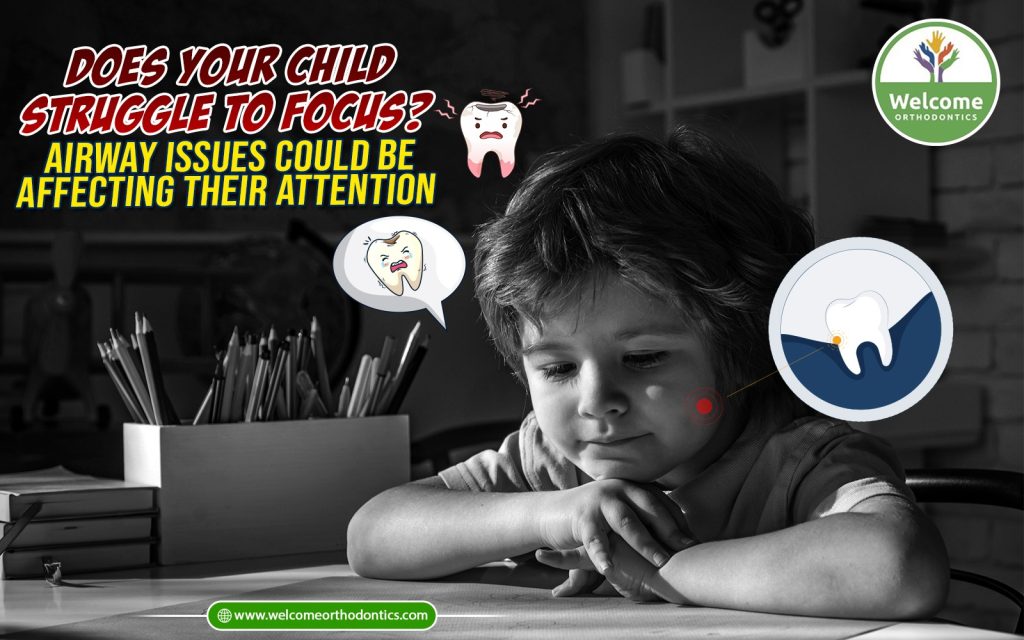
When a child struggles to focus, most parents immediately think about school challenges, screen time, behavior, or attention disorders. Teachers may mention distraction in class, unfinished work, or difficulty staying engaged during lessons. At home, parents may notice forgetfulness, emotional outbursts, or constant restlessness. These concerns can feel overwhelming, especially when there’s no clear explanation for why a child seems mentally exhausted despite trying their best.
What many families don’t realize is that attention and focus are closely connected to something much more physical: breathing. Children who do not breathe efficiently, especially during sleep, may experience subtle but ongoing disruptions in sleep quality and oxygen flow. Over time, this can affect concentration, mood, emotional regulation, learning, and overall daytime function. The challenge is that these airway-related issues are often hidden. A child may appear healthy while quietly adapting to mouth breathing, restless sleep, or restricted airflow for years.
This growing awareness is one reason airway-focused orthodontic evaluation has become increasingly important. Modern orthodontics is no longer only about straightening teeth, it also considers how jaw development, airway function, and breathing patterns influence a child’s overall health and development. Understanding the connection between airway issues and attention problems can help parents recognize signs that are often overlooked and take proactive steps toward healthier development.
Why Focus Problems in Children Aren’t Always Behavioral
When children struggle to pay attention, behavioral explanations are often the first thing considered. Parents may hear that their child is:
- Easily distracted
- Hyperactive
- Unmotivated
- Emotionally impulsive
- Too dependent on screens
While these factors can contribute to attention difficulties, they don’t always explain the full picture.
Focus Is Closely Linked to Sleep Quality
A child’s brain depends heavily on deep, restorative sleep. During sleep, the brain:
- Processes information
- Consolidates memory
- Regulates emotions
- Recovers mentally and physically
If sleep quality is repeatedly disrupted, even subtly, the brain may struggle to function efficiently during the day.
Children who experience poor-quality sleep may:
- Have shorter attention spans
- Become easily overwhelmed
- Struggle with emotional regulation
- Appear restless or mentally fatigued
Because these symptoms overlap with behavioral conditions, the underlying cause may go unnoticed.
Why Physical Factors Are Often Missed
Many airway-related issues occur during sleep, when parents may not fully observe what’s happening. A child might sleep through the night but still experience:
- Reduced airflow
- Mouth breathing
- Frequent micro-awakenings
- Poor oxygen exchange
As a result, they wake up tired even after spending enough hours in bed. The problem is that children rarely describe these symptoms clearly. Instead, they simply adapt. Parents often assume the child is naturally energetic, emotional, or distractible without realizing sleep and breathing may be contributing.
Understanding the Connection Between Airway Development and Brain Function
The airway is the pathway that allows air to move from the nose and mouth into the lungs. In growing children, the size and shape of the airway are closely connected to jaw development, tongue posture, and facial growth.
Why Nasal Breathing Matters
Healthy nasal breathing plays a major role in:
- Oxygen intake
- Sleep quality
- Brain function
- Jaw development
The nose filters and humidifies air before it reaches the lungs while also supporting proper tongue posture and balanced facial growth. When children breathe primarily through their mouth instead, several developmental changes may occur.
How Mouth Breathing Affects Development
Children who chronically mouth breathe may develop:
- Narrow upper jaws
- Poor tongue posture
- Crowded teeth
- Altered facial growth patterns
- Reduced airway space
These structural changes can further affect breathing efficiency, especially during sleep.
The Brain Needs Consistent Oxygen During Sleep
Even mild airway restriction can affect oxygen flow and sleep quality. When breathing becomes less efficient overnight, the brain may not receive the restorative rest it needs.
Over time, this may contribute to:
- Difficulty focusing
- Daytime fatigue
- Mental fog
- Emotional sensitivity
- Reduced academic performance
This is why airway development and cognitive function are more connected than many people realize.
How Airway Issues Can Affect Attention, Mood, and Daily Performance
Airway-related sleep disruption often affects children in ways that appear behavioral on the surface. Because the signs show up during the day, at school, during homework, or in social situations, many parents don’t immediately connect them to breathing or sleep quality. But when the brain and body are not getting proper restorative sleep night after night, it can influence nearly every part of a child’s daily functioning.
Symptoms That May Resemble ADHD
One of the most overlooked aspects of airway-related sleep problems is how closely the symptoms can resemble attention disorders. Children who are not sleeping well may struggle to regulate focus, impulses, and energy levels throughout the day.
Parents and teachers may notice that the child:
- Has difficulty sitting still for long periods
- Becomes distracted very easily
- Frequently interrupts conversations or activities
- Starts tasks but struggles to finish them
- Appears impulsive or mentally restless
In classroom settings, these children may seem inattentive even when they are trying hard to focus. They may lose track of instructions, drift mentally during lessons, or become frustrated by tasks that require sustained concentration.
Because these behaviors overlap with common ADHD symptoms, the possibility of poor-quality sleep or airway-related issues is often overlooked. This does not mean ADHD is never present, but it highlights how important it is to consider whether breathing and sleep may also be affecting attention and regulation.
Emotional and Behavioral Effects
Sleep plays a major role in emotional balance. When children are not getting enough restorative sleep, their ability to manage emotions can become significantly affected.
Children experiencing airway-related sleep disruption may become:
- More irritable than usual
- Easily overwhelmed by small frustrations
- Emotionally reactive in situations they previously handled well
- Sensitive to stress or overstimulation
- Less patient during daily routines
Parents may notice increased mood swings, emotional outbursts, or difficulty calming down after becoming upset. Teachers may observe frustration during academic tasks or social interactions. What makes this especially challenging is that the child often doesn’t realize they are functioning in a fatigued state. They may simply feel emotionally “off” without understanding why.
Daytime Fatigue Doesn’t Always Look Like Sleepiness
One reason airway-related sleep issues are so difficult to identify is because tired children do not always behave like tired adults. Adults who are sleep deprived often appear sluggish or low-energy. Children, however, frequently react in the opposite way. Their nervous systems may become overstimulated as the body tries to compensate for fatigue.
Instead of seeming sleepy, children may become:
- Hyperactive or constantly moving
- Loud, impulsive, or unusually energetic
- Mentally restless and unable to settle
- Easily overstimulated by noise or activity
- More reactive during transitions or structured tasks
This can create confusion for parents and teachers because the child appears energetic on the surface, even while functioning on inadequate rest internally. As a result, the connection between poor sleep and behavioral challenges is often missed.
Learning and Academic Challenges
The brain relies heavily on quality sleep to process and retain information. During deep sleep, children consolidate memory, organize learning, and restore cognitive function for the next day.
When sleep quality is disrupted repeatedly, children may struggle with:
- Retaining new information
- Processing instructions quickly
- Staying engaged during lessons
- Reading comprehension
- Mental endurance during schoolwork
Some children begin performing inconsistently academically. They may do well one day and struggle significantly the next depending on how well they slept.
Parents are often surprised because their child is clearly intelligent and capable, yet school performance doesn’t always reflect that potential. In many cases, the issue is not lack of ability, it’s that the brain is functioning without the restorative sleep and oxygen support it needs to perform consistently.
Understanding how airway issues can affect attention, mood, and learning helps parents recognize that these challenges are not always purely behavioral. Sometimes, the body is working much harder than it should simply to breathe and rest properly.
Subtle Signs Parents Often Miss
Airway-related attention concerns are rarely caused by one obvious symptom. Instead, small signs often appear together over time.
Mouth Breathing
Children who frequently breathe through their mouth while awake or asleep may have restricted nasal airflow.
Parents may notice:
- Open-mouth posture
- Dry lips
- Frequent thirst
- Noisy breathing at night
Restless Sleep
Children with airway issues often:
- Toss and turn
- Sleep in unusual positions
- Kick blankets off frequently
- Wake up multiple times without fully realizing it
Snoring or Heavy Breathing
Even light snoring is not considered normal in children and may suggest airflow resistance during sleep.
Difficulty Waking Up
Some children seem exhausted every morning despite getting enough hours of sleep.
They may:
- Struggle to wake up
- Seem groggy for long periods
- Need repeated reminders to get moving
Slow Eating or Chewing Difficulties
Airway-related jaw development can also affect chewing coordination and oral muscle function.
Some children:
- Eat very slowly
- Avoid chewy foods
- Breathe through their mouth while eating
Changes in Facial Appearance
Children with chronic mouth breathing sometimes develop:
- Tired-looking eyes
- Long facial growth patterns
- Narrow smiles
- Less defined jaw structure
These changes develop gradually and are often mistaken for simple genetics.
How Welcome Orthodontics Helps Identify and Support Airway-Related Concerns
When parents begin noticing concerns related to focus, sleep, or breathing, having the right orthodontic team becomes extremely important. At Welcome Orthodontics, evaluations focus on much more than straight teeth. The practice takes a comprehensive approach that considers how jaw growth, airway development, breathing patterns, and oral function work together during childhood.
A Growth-Focused Approach
Because children are still developing, early evaluation allows orthodontists to identify whether structural growth patterns may be affecting breathing or sleep quality.
The team carefully evaluates:
- Jaw width and positioning
- Bite development
- Airway-related growth patterns
- Facial development
- Oral habits and breathing patterns
This broader perspective helps identify concerns that might otherwise remain hidden for years.
Conservative and Personalized Care
One of the biggest concerns parents have is whether early orthodontic evaluation automatically means aggressive treatment. At Welcome Orthodontics, the philosophy is conservative and individualized.
Not every child needs immediate intervention. In many cases:
- Growth is simply monitored carefully
- Development is tracked over time
- Recommendations are made only when necessary
This approach gives families clarity without pressure.
The practice uses advanced imaging and diagnostic tools to evaluate development more accurately and understand how airway structure may be influencing overall function. With over 30 years of clinical experience, Dr. Tavakoli combines orthodontic expertise with a patient-centered approach focused on long-term health, comfort, and development, not just aesthetics.
Advanced Technology and Long-Term Planning
Families also appreciate:
- Clear communication
- Personalized treatment planning
- Flexible financing options
- A supportive environment for children and parents alike
Most importantly, care is designed to support healthier growth and function while helping children feel comfortable and confident throughout the process.
Conclusion
When children struggle with focus, attention, or emotional regulation, the underlying cause is not always purely behavioral. In many cases, breathing patterns, sleep quality, and airway development may be quietly affecting how the brain and body function every day.
Because airway-related concerns often develop gradually, the signs can be easy to overlook. Mouth breathing, restless sleep, slow eating, snoring, daytime fatigue, or even subtle facial changes may all be part of a larger developmental picture. Understanding this connection allows parents to move beyond surface-level explanations and recognize when a child may benefit from a more comprehensive evaluation.
With growth-focused care from Welcome Orthodontics, families can feel confident knowing their child’s smile, airway development, sleep quality, and overall well-being are being considered together, not as separate concerns, but as part of one complete picture.
0 comments on “Does Your Child Struggle to Focus? Airway Issues Could Be Affecting Their Attention”