

A healthy bite depends on much more than having straight front teeth. The back teeth, including the premolars and molars, play a critical role in chewing, distributing biting forces, and helping the jaws function efficiently. When these teeth fail to meet properly, everyday activities such as eating can become less effective, even if the problem is not immediately noticeable.
One condition that affects the back teeth is a posterior open bite. Unlike more obvious orthodontic concerns, a posterior open bite often goes undetected because it occurs toward the back of the mouth. Many children and adults do not experience pain, and the front teeth may appear completely normal. As a result, the condition is frequently discovered during a routine dental or orthodontic examination rather than by the patient.
Although it may seem like a small gap between the back teeth, a posterior open bite can influence chewing efficiency, bite stability, jaw function, and long-term oral health. Understanding why it develops and how it affects the bite is the first step toward determining whether monitoring or orthodontic treatment is appropriate.
In this article, we’ll explain what a posterior open bite is, why it happens, how it affects daily function, and how orthodontists diagnose and manage this unique bite condition.
What Is a Posterior Open Bite?
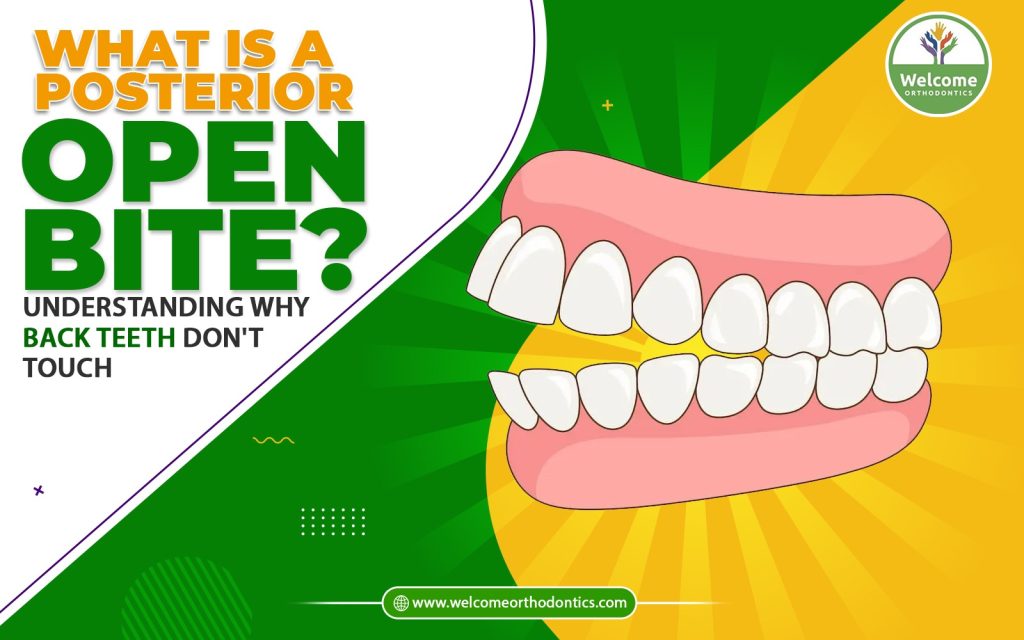
A posterior open bite is a type of malocclusion in which one or more of the upper and lower back teeth fail to make contact when the mouth is fully closed.
Normally, the upper and lower molars and premolars should fit together in a balanced way, allowing food to be chewed efficiently while distributing biting forces evenly throughout the mouth. With a posterior open bite, a space remains between the back teeth even though the jaws are completely closed.
The condition may involve:
- One side of the mouth (unilateral)
- Both sides of the mouth (bilateral)
- A few posterior teeth
- Several molars and premolars
The size of the gap varies from one patient to another, depending on the underlying cause and the number of teeth involved.
How a Healthy Bite Normally Works
In a properly aligned bite, each group of teeth has a specific role. The front teeth help bite into food, while the back teeth perform most of the grinding and crushing required for chewing.
When the mouth closes normally:
- The molars contact evenly.
- The premolars help stabilize the bite.
- Chewing forces are distributed across multiple teeth.
- The jaws move smoothly during chewing.
This coordinated relationship protects the teeth from excessive stress while allowing efficient oral function.
What Changes in a Posterior Open Bite?
A posterior open bite interrupts this normal relationship. Instead of meeting evenly, the upper and lower back teeth remain separated.
As a result:
- Some teeth perform more work than others.
- Food may not be chewed as efficiently.
- The bite becomes less balanced.
- Other teeth may compensate for the missing contact.
Many people are unaware these changes are occurring because the body gradually adapts to the altered bite.
Is It Different From Other Bite Problems?
Yes.
Unlike crowding, crossbites, or overbites, a posterior open bite is defined by the absence of contact between opposing back teeth rather than their position relative to one another. It is also different from an anterior open bite.
In an anterior open bite, the gap occurs between the upper and lower front teeth, making it easier to notice during smiling or speaking. A posterior open bite occurs toward the back of the mouth, where it is much less visible.
What Does a Posterior Open Bite Look Like?
Because the condition affects the back teeth, it is often difficult to recognize without looking closely inside the mouth. Many patients have no idea they have a posterior open bite until it is identified during a dental examination.
One Side vs Both Sides
A posterior open bite may occur on only one side of the mouth or affect both sides.
A unilateral posterior open bite involves one side only. Patients with this type sometimes develop a preference for chewing on the opposite side because it feels more comfortable.
A bilateral posterior open bite affects both sides simultaneously. Although chewing may still be possible, the lack of contact on both sides often reduces overall chewing efficiency.
How Parents or Patients May Notice It
Parents may observe subtle signs rather than an obvious gap.
For example, a child may:
- Take longer to chew food.
- Prefer softer foods.
- Chew mostly on one side.
- Seem unable to grind food completely.
Adults may notice that the back teeth simply do not touch when biting down. Sometimes the only indication is that the bite “doesn’t feel right.”
Why It Can Be Difficult to Detect
Unlike problems involving the front teeth, a posterior open bite is hidden toward the back of the mouth. Since the front teeth often appear completely normal, neither parents nor patients may suspect an orthodontic concern.
In addition, many people naturally adapt their chewing patterns over time, making the problem even less obvious. This is one reason routine orthodontic evaluations remain valuable even when no visible alignment concerns are present.
What Causes a Posterior Open Bite?
Posterior open bites develop for several different reasons. Some are related to tooth eruption, while others involve jaw growth or developmental conditions.
Tooth Eruption Problems
For the upper and lower teeth to meet properly, they must erupt into the correct positions. If one or more back teeth fail to erupt completely, a gap may remain between the upper and lower arches.
Eruption disturbances can occur because of:
- Delayed eruption
- Obstructed eruption
- Developmental abnormalities
- Local dental conditions
The exact cause varies from patient to patient.
Ankylosed (Infraoccluded) Teeth
One important cause of posterior open bites is ankylosis. An ankylosed tooth becomes fused directly to the surrounding bone instead of continuing its normal eruption. As neighboring teeth continue developing, the ankylosed tooth remains in a lower position, sometimes referred to as infraocclusion.
When this occurs in the back of the mouth, the surrounding bite relationship may gradually change, contributing to a posterior open bite.
Skeletal Jaw Differences
Not every posterior open bite is caused by individual teeth. Some develop because the upper and lower jaws themselves do not relate to each other normally.
Differences in jaw growth may prevent certain back teeth from meeting properly, even when the teeth themselves are healthy. These skeletal factors require careful orthodontic evaluation because treatment often differs from cases involving tooth eruption alone.
Oral Habits and Functional Factors
Certain oral habits may influence the development of the bite during childhood.
For example, abnormal tongue posture or swallowing patterns can occasionally affect how the teeth erupt and function together. In some patients, functional jaw movements may also contribute to uneven bite relationships over time. Because habits rarely act alone, orthodontists evaluate them alongside tooth eruption and jaw development.
Previous Dental Trauma or Developmental Conditions
In some cases, injury to developing teeth or underlying developmental conditions can interfere with normal eruption. Depending on which teeth are affected, this disruption may contribute to a posterior open bite later in childhood.
Although these situations are less common than other causes, they remain part of a comprehensive orthodontic evaluation.
How Does a Posterior Open Bite Affect Everyday Function?
The effects of a posterior open bite extend beyond the appearance of the teeth. Because the molars and premolars perform most of the work during chewing, a lack of contact between these teeth can change the way the entire bite functions.
Chewing Efficiency
The most immediate effect is reduced chewing efficiency. Without proper contact between the back teeth, food cannot be crushed and ground as effectively before swallowing.
Many patients unconsciously compensate by:
- Taking smaller bites
- Chewing for longer periods
- Using one side of the mouth more frequently
- Relying more heavily on the front teeth
Although these adjustments often allow people to eat normally, they do not restore the balanced function of a healthy bite.
Bite Stability
The back teeth provide important support for the overall bite. When they fail to contact properly, the stability of the bite may be reduced.
Instead of forces being shared evenly across multiple teeth, certain areas begin carrying a greater portion of the workload. Over time, this imbalance can influence how the teeth function together during everyday activities.
Distribution of Biting Forces
A healthy bite distributes pressure across many teeth during chewing. When the back teeth do not contact, this balance changes.
The remaining teeth may absorb greater forces than they were designed to handle, particularly the front teeth or the back teeth that still make contact. Although the body often adapts remarkably well, uneven force distribution may contribute to changes in bite function over time.
Jaw Movement During Chewing
The upper and lower jaws work together in a coordinated pattern while chewing. A posterior open bite can alter this natural movement because the back teeth no longer provide the support needed for balanced chewing.
Some patients unconsciously:
- Shift the jaw while chewing
- Favor one side of the mouth
- Develop different chewing patterns
- Take longer to process food
These adaptations may reduce chewing efficiency even if the patient does not experience pain.
How Orthodontists Diagnose a Posterior Open Bite
Because a posterior open bite often develops for different reasons in different patients, diagnosis involves much more than identifying the gap between the back teeth.
Clinical Examination
The orthodontist begins by evaluating:
- Tooth alignment
- Bite relationships
- Jaw movement
- Chewing function
- Facial symmetry
This examination helps determine how the teeth work together during normal function.
Bite Analysis
A detailed bite analysis identifies:
- Which teeth contact first
- Which teeth fail to meet
- Whether one or both sides are involved
- Overall bite stability
Understanding these relationships allows orthodontists to distinguish between tooth-position problems and more complex bite discrepancies.
Digital X-Rays and Imaging
Digital imaging provides valuable information that cannot be obtained through visual examination alone.
Depending on the patient’s needs, imaging may evaluate:
- Tooth eruption
- Developing permanent teeth
- Jaw relationships
- Bone structures
- Skeletal development
These findings help identify the underlying cause of the posterior open bite.
Evaluating Tooth Eruption and Jaw Development
In children, orthodontists carefully assess how the teeth and jaws are expected to develop.
Growth evaluation helps determine:
- Whether eruption is progressing normally
- If jaw development contributes to the condition
- Whether monitoring is appropriate
- The ideal timing for treatment if needed
Treatment Options for a Posterior Open Bite
Treatment is always based on the underlying diagnosis rather than the appearance of the gap alone.
Monitoring During Growth
Not every posterior open bite requires immediate treatment. When growth and eruption patterns remain favorable, periodic observation may be the most appropriate recommendation.
Monitoring allows orthodontists to identify changes before they become more complex.
Orthodontic Bite Correction
Many posterior open bites can be improved through orthodontic treatment designed to establish proper contact between the upper and lower teeth. Treatment focuses on improving overall bite function rather than simply moving individual teeth.
Managing Eruption-Related Problems
When eruption disturbances contribute to the condition, treatment may involve guiding developing teeth into healthier positions while preserving long-term bite stability.
Addressing Skeletal Causes
If jaw development plays a significant role, treatment planning must account for the patient’s age and remaining growth. Children may benefit from growth-guided approaches, while adults require treatment strategies appropriate for completed facial development.
Why Treatment Depends on the Underlying Diagnosis
Two patients may appear to have similar posterior open bites while requiring completely different treatment approaches. This is why orthodontists first determine whether the condition is related to:
- Tooth eruption
- Jaw development
- Functional bite changes
- Developmental conditions
Only after identifying the underlying cause can the most appropriate treatment plan be developed.
When Should You See an Orthodontist?
An orthodontic evaluation is recommended if you or your child notice:
- Back teeth that do not touch when biting down
- Difficulty chewing efficiently
- Chewing primarily on one side
- Bite changes during growth
- Concerns identified during routine dental examinations
Even if treatment is not needed immediately, an early evaluation provides valuable information about how the bite is developing and whether future monitoring is appropriate.
How Welcome Orthodontics Helps Patients With Posterior Open Bites
At Welcome Orthodontics, Dr. Mark Tavakoli evaluates posterior open bites by looking beyond the visible gap between the back teeth. Every patient receives a comprehensive assessment that considers tooth eruption, jaw relationships, bite function, facial development, and overall oral health.
Using advanced digital imaging and more than 30 years of clinical experience, Dr. Tavakoli determines whether the condition is related to tooth eruption, skeletal development, or another underlying factor before recommending treatment. This individualized approach ensures that every patient receives care based on their specific diagnosis rather than a one-size-fits-all solution.
Following a conservative treatment philosophy, Welcome Orthodontics recommends monitoring when appropriate and active treatment only when it supports healthy bite function, long-term stability, and confident smiles.
Conclusion
A posterior open bite is more than a gap between the back teeth. Because the molars and premolars play such an important role in chewing and stabilizing the bite, the absence of proper contact can influence how the entire oral system functions.
Although many people do not notice a posterior open bite immediately, the condition may contribute to reduced chewing efficiency, uneven bite forces, altered jaw movements, and progressive changes in bite development over time. Identifying the underlying cause—whether it involves tooth eruption, ankylosed teeth, jaw growth, or another developmental factor—is essential for choosing the most appropriate course of action.
The good news is that modern orthodontic evaluation allows these conditions to be identified early. Whether treatment involves careful monitoring, orthodontic correction, or growth-guided care, understanding why the back teeth are not touching helps patients and families make informed decisions that support healthy oral function for years to come.
0 comments on “What Is a Posterior Open Bite? Understanding Why Back Teeth Don’t Touch”