

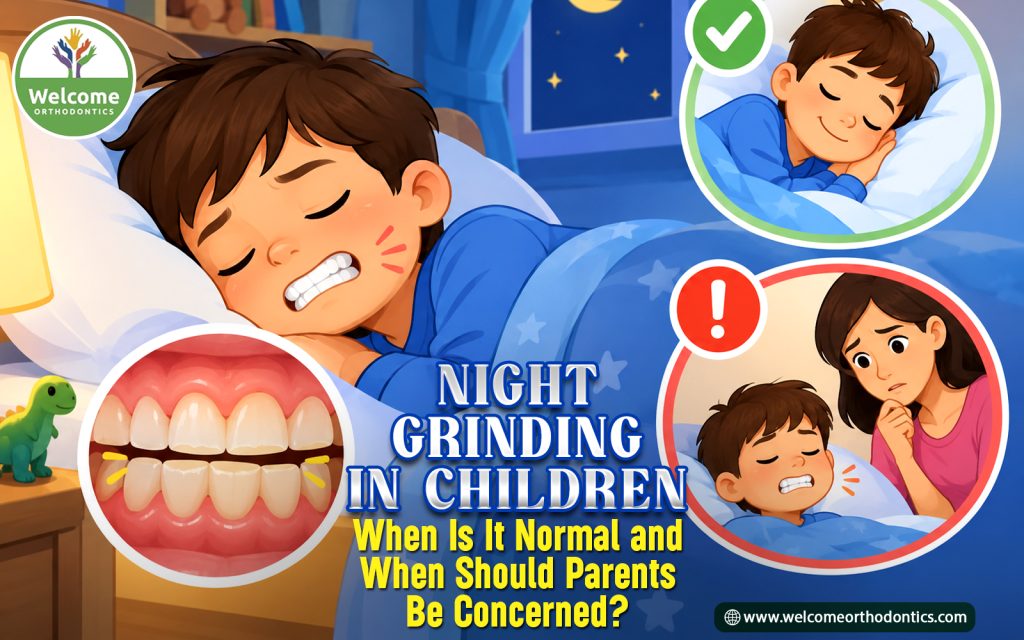
If you hear your child grinding their teeth while asleep, the sound can be surprisingly loud and concerning. This nighttime habit is commonly known as sleep bruxism. It involves repeated or sustained jaw-muscle activity during sleep that may include clenching, grinding, or forceful tooth contact. Children may grind their teeth without being aware of it. Unlike a daytime habit that a child can consciously notice, sleep grinding occurs while the child is asleep. Parents may be the first people to recognize it because of the sound or because they notice changes in the child’s teeth or morning behavior.
Night grinding does not always involve the same movement. Some children make obvious side-to-side grinding movements, while others primarily clench their teeth. It may occur intermittently during the night rather than continuously.
It is also important to distinguish sleep bruxism from ordinary tooth contact during sleep. Occasional jaw movements or brief tooth contact do not necessarily indicate a persistent grinding problem. What matters is the frequency, intensity, duration, and whether the activity is associated with other symptoms.
Is Teeth Grinding Normal in Children?
Teeth grinding is relatively common during childhood, and its presence alone does not necessarily mean that something is wrong. Children’s teeth, jaws, and facial structures are constantly developing. Grinding patterns can change as children move through different stages of dental development, and some children may stop grinding as they get older.
This is why parents should not automatically assume that every episode of nighttime grinding requires treatment. An occasional episode in an otherwise healthy child who has no pain, noticeable tooth damage, or sleep-related concerns may simply be monitored. The more important question is whether grinding is persistent or producing consequences.
For example, a child who occasionally grinds but has healthy teeth and no discomfort presents a different situation from a child who grinds frequently and develops flattened tooth surfaces, sensitivity, jaw soreness, or morning headaches.
The child’s age and stage of dental development also matter. Grinding involving baby teeth does not necessarily have the same implications as repeated heavy grinding affecting newly erupted permanent teeth.
Rather than judging the problem based solely on how loud the grinding sounds, parents and dental professionals consider the overall pattern and its effects.
Why Do Children Grind Their Teeth at Night?
There is rarely one explanation that applies to every child. Sleep bruxism is considered multifactorial, meaning that several factors may contribute to its occurrence. These can include characteristics of sleep, neurological factors, dental development, and other physical or behavioral influences.
Sleep-Related Factors
Because sleep bruxism occurs during sleep, characteristics of a child’s sleep may be relevant. Jaw-muscle activity can occur during changes between different stages of sleep and may be associated with brief arousals. This does not mean that every child who grinds has a sleep disorder. Rather, the relationship between sleep and grinding is one part of understanding why the behavior occurs.
Developing Teeth and Bite
A child’s mouth changes considerably as baby teeth are replaced by permanent teeth. Teeth erupt, spaces change, and the relationship between the upper and lower jaws develops over time.
These changes can alter the way the teeth come together. However, an uneven bite should not automatically be identified as the cause of grinding. Bruxism has multiple potential contributors, and the relationship between tooth alignment and grinding is more complicated than simply assuming that one causes the other.
Other Contributing Factors
Children may also experience grinding in association with broader physical or behavioral factors. Some children who grind may have other sleep-related symptoms, while others may show no obvious contributing factor at all. This variation is one reason an evaluation should focus on the individual child rather than assuming that a single factor explains the behavior.
In many cases, the precise reason a child grinds at night cannot be established from observation alone.
What Does Night Grinding Look or Sound Like?
The most obvious sign is often the sound. Parents may hear a repeated scraping, squeaking, or crunching noise coming from their child’s bedroom. Some children grind loudly enough to wake a parent, while others make movements that are much quieter. However, not all children who grind produce an obvious sound.
A child may instead clench their teeth or make subtle jaw movements that are difficult to notice during sleep. Parents may therefore discover the habit indirectly through changes noticed in the morning or during routine dental examinations.
Some signs parents may notice include:
- Repeated jaw clenching during sleep
- Rhythmic jaw movements
- Tight or tense-looking jaw muscles
- Complaints of jaw discomfort after waking
- Morning headaches
- Tooth sensitivity
- Visible changes in tooth surfaces
The presence of one of these signs does not prove that nighttime grinding is responsible. For example, morning headaches can have many causes, and tooth sensitivity can result from factors unrelated to bruxism. Instead, these findings become more meaningful when they occur alongside frequent nighttime grinding or other changes in the child’s mouth.
What Are the Warning Signs That Grinding May Be a Problem?
The sound of grinding is not necessarily the most important indicator of whether a child needs evaluation. The physical effects associated with the behavior can provide more useful information.
Noticeable Tooth Wear
One of the clearest dental signs is unusual wear on the surfaces of the teeth. Repeated forceful contact can gradually flatten areas that would normally have more natural contours. If the wear is significant or progresses over time, a dentist or orthodontist may need to determine whether grinding is contributing to the changes.
Tooth Sensitivity or Discomfort
A child may complain that a tooth feels sensitive when eating or drinking something cold, hot, or sweet. Sensitivity has many possible causes, so it should not automatically be attributed to grinding. However, when sensitivity occurs alongside visible wear or frequent nighttime grinding, it deserves attention.
Jaw or Facial Discomfort
Repeated jaw-muscle activity can be associated with soreness around the jaw or face. A child may describe discomfort near the cheeks, temples, or jaw joints, particularly after waking. Children do not always describe this as “jaw pain.” They may simply say that their face feels tired or that their jaw hurts when they chew.
Morning Headaches
Some children who grind may experience headaches after waking, particularly around the temples or forehead. Again, headaches are nonspecific and can result from many causes, so they should be considered alongside the child’s other symptoms.
Difficulty Chewing or Opening the Mouth
If a child develops discomfort while chewing or has difficulty opening their mouth normally, professional evaluation is appropriate. These symptoms may have causes other than bruxism, but they should not be ignored when they occur with persistent grinding.
Sleep Disruption
Grinding can occur alongside other nighttime symptoms. If a child frequently wakes, appears unusually restless during sleep, snores heavily, or shows other changes in sleep quality, the broader sleep pattern may need to be considered rather than focusing only on the teeth.
Can Night Grinding Damage a Child’s Teeth?
Repeated grinding can place additional mechanical forces on the teeth. The effect depends on how often the grinding occurs, how much force is involved, how long it persists, and the condition of the child’s teeth.
A certain amount of natural wear occurs as teeth function. That is different from excessive or unusually rapid wear. With significant bruxism, tooth surfaces may become flatter than expected. Edges can lose their normal contours, and in more pronounced cases, the loss of tooth structure may become noticeable. The consequences can differ depending on whether the affected teeth are primary or permanent.
Baby Teeth
Primary teeth naturally change as children grow and eventually make way for permanent teeth. Mild wear therefore needs to be interpreted within the context of normal childhood dental development. However, substantial or premature wear still deserves evaluation, particularly if it is accompanied by sensitivity or discomfort.
Permanent Teeth
Once permanent teeth erupt, protecting their developing structure becomes increasingly important. Excessive wear affecting permanent teeth can be more significant because these teeth are intended to remain in the mouth for many years.
An orthodontist or dentist can compare the appearance of the tooth surfaces with the child’s age and stage of dental development to determine whether the amount of wear appears unusual.
Why the Pattern Matters
Grinding does not affect every tooth in exactly the same way. The location and pattern of wear can provide useful information during an examination.
A dental professional may look for flattened areas, changes in tooth contours, chips, sensitivity, or other signs of excessive force. They can then consider whether bruxism may be contributing or whether another explanation should be investigated.
The goal is not simply to identify worn teeth. It is to determine whether the changes are consistent with the child’s overall dental development and whether they require further attention.
When Should Parents Talk to a Dentist or Orthodontist?
Not every episode of nighttime grinding requires an appointment specifically for bruxism. However, professional evaluation becomes more important when the behavior is persistent, accompanied by symptoms, or associated with visible changes in the teeth.
Parents should consider discussing nighttime grinding with a dentist or orthodontist when:
- Grinding occurs frequently or continues over an extended period.
- The teeth appear increasingly flattened, chipped, or worn.
- A child complains of tooth sensitivity.
- There is recurring jaw or facial discomfort.
- The child experiences unexplained morning headaches.
- Chewing becomes uncomfortable.
- The child’s bite appears to be changing.
- Grinding occurs alongside significant sleep-related symptoms.
An evaluation can also be worthwhile when parents simply notice a substantial change from the child’s usual dental or sleep habits.
The purpose of an appointment is not necessarily to begin treatment. In many cases, the first step is determining whether there is evidence of damage or another condition that needs attention.
A child with frequent grinding but healthy teeth, no discomfort, and no other concerning symptoms may be managed differently from a child who has progressive tooth wear or associated jaw pain.
How Is Night Grinding Evaluated in Children?
There is no single test that can determine the cause or significance of every child’s nighttime grinding. The evaluation generally begins with a discussion of what parents have observed. The dentist or orthodontist may ask when the grinding occurs, how often it is noticed, whether it appears to be getting more frequent, and whether the child reports any symptoms after waking.
The child’s dental history and stage of development are also relevant.
During the examination, the clinician may look for:
- Flattened or worn tooth surfaces
- Chips or changes in tooth edges
- Tooth sensitivity
- Jaw-muscle tenderness
- Signs of discomfort when moving the jaw
- Changes in the way the upper and lower teeth meet
The bite may be evaluated because the relationship between the teeth can provide information about the child’s developing occlusion.
The clinician may also consider whether the observed wear is consistent with the child’s age and dental stage. This is particularly important in children because some changes in primary teeth are part of normal development.
When Is Additional Evaluation Needed?
Additional assessment depends on what is found during the dental examination.
If the child has symptoms suggesting a possible sleep-related breathing problem, the healthcare team may recommend further evaluation outside the dental office.
Likewise, significant jaw symptoms or unusual changes in the teeth may require a more detailed assessment.
The important point is that the evaluation should follow the child’s individual findings rather than assuming that all nighttime grinding has the same cause.
How Is Bruxism Managed in Children?
Management depends on whether the grinding is causing problems and what other factors may be present.
For a child who grinds but has no significant symptoms or dental damage, observation may be appropriate. The child’s teeth and symptoms can be monitored during routine dental visits to determine whether the pattern changes.
When grinding is associated with identifiable contributing factors or other conditions, addressing those concerns may become part of the overall management plan.
For example, if a child’s examination raises concerns about sleep-related breathing, the focus may extend beyond the teeth. If there is significant tooth wear, protecting the affected teeth may become a consideration. The approach therefore varies considerably between children.
Monitoring
Monitoring allows the dental professional to track changes over time rather than reacting to a single episode of grinding. During routine examinations, the clinician can compare tooth surfaces, bite development, and symptoms with previous visits. This can help determine whether the grinding appears to be stable, decreasing, or producing progressive effects.
Addressing Associated Concerns
When grinding occurs alongside another dental, jaw, or sleep-related concern, management may involve addressing that issue rather than treating the grinding sound itself. This is particularly important because bruxism can have multiple contributing factors. Focusing on only one possible cause may not provide a complete picture.
Protecting the Teeth
If repeated grinding is causing significant tooth wear or other dental concerns, a dental professional may consider whether an appliance or another protective approach is appropriate. Any appliance for a child should be recommended and monitored by a dental professional. Children’s teeth and jaws are still developing, so an appliance should be selected based on the child’s age, dental stage, bite, and individual needs.
The objective is to protect the developing dentition when there is a clear reason to do so—not to automatically place every child who grinds in a dental appliance.
Conclusion
Night grinding can be a normal part of childhood, but persistent or noticeable bruxism should not be ignored. Occasional grinding without pain, tooth changes, or other symptoms may simply require observation as a child grows and their teeth and bite develop.
When grinding is frequent or occurs alongside tooth wear, sensitivity, jaw discomfort, headaches, chewing difficulties, or sleep-related concerns, a professional evaluation can help determine whether further attention is needed. Every child is different, so the right approach depends on their dental development, symptoms, and overall circumstances.
If you are concerned about your child’s nighttime grinding, talking with a dentist or orthodontist can help you understand what may be happening and whether monitoring or further evaluation is appropriate.
0 comments on “Night Grinding in Children: When Is It Normal and When Should Parents Be Concerned?”