

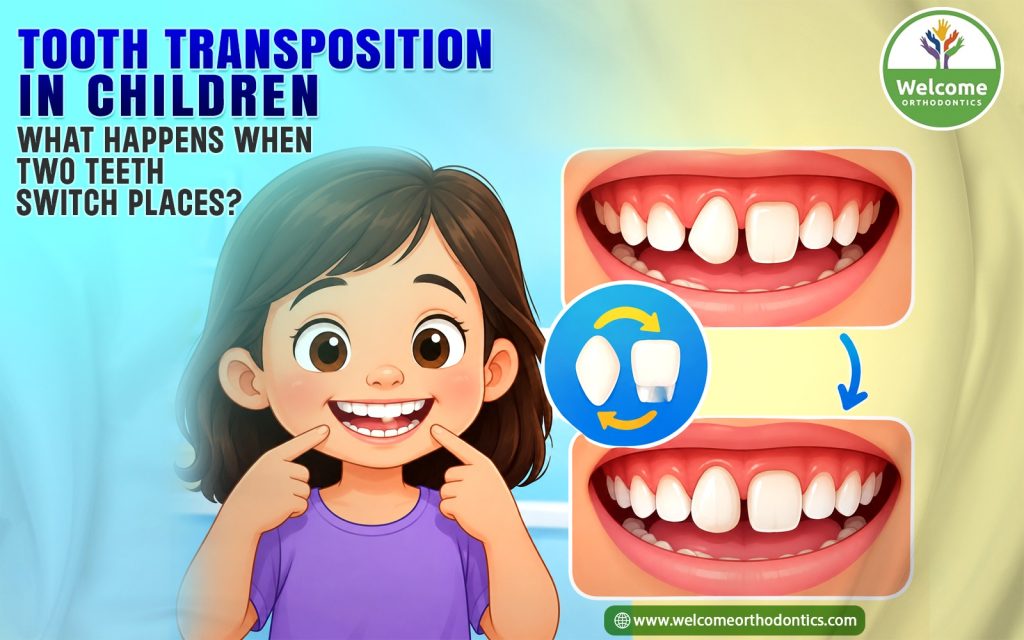
A child’s permanent teeth usually follow a predictable path as they develop and erupt. Occasionally, however, two teeth can deviate from their expected positions and end up occupying each other’s place. This unusual dental development is known as tooth transposition.
Because it can look like severe crowding or an oddly positioned tooth, transposition may not always be obvious to parents. It is also different from simply having a crooked tooth. In true transposition, the positions of two teeth have become interchanged within the same area of the dental arch.
Understanding what tooth transposition is, which teeth are most often involved, and why it happens can help parents recognize why an unusual eruption pattern may require closer evaluation.
What Is Tooth Transposition in Children?
Tooth transposition is a developmental dental anomaly in which two permanent teeth exchange their usual positions within the same quadrant of the dental arch.
For example, a permanent canine normally develops and erupts in a particular location next to the lateral incisor and first premolar. In a transposition, the canine may develop or erupt in a position normally occupied by one of those neighboring teeth, while the other tooth occupies the canine’s expected position.
The condition can involve either the upper or lower jaw, although the upper jaw is affected much more frequently. The permanent canine is also involved in the large majority of reported cases. Tooth transposition is generally classified as either complete or incomplete.
Complete Tooth Transposition
In a complete transposition, both the crowns and roots of the affected teeth have exchanged positions. The teeth are therefore fully positioned in each other’s usual locations.
This represents a more established change in the developing positions of the teeth and can make later orthodontic correction particularly complex.
Incomplete Tooth Transposition
An incomplete transposition occurs when the crowns have crossed or changed their relative positions, while the roots remain closer to their normal locations.
This is sometimes described as a partial or pseudo-transposition. Because the roots have not completely exchanged positions, the condition may have different treatment considerations from a fully transposed pair of teeth.
How Is It Different From a Crooked Tooth?
A crooked tooth may be rotated, tilted, or displaced because there is insufficient space or because the tooth has followed an abnormal eruption path. That does not necessarily mean transposition has occurred.
The defining feature of transposition is the interchange in position between two teeth. This distinction matters because an unusual-looking tooth does not automatically indicate that two teeth have switched places. Dental examination and imaging are needed to determine the actual position of the crowns and roots.
Which Teeth Are Most Commonly Involved in Tooth Transposition?
Although transposition can involve different combinations of teeth, some patterns occur much more frequently than others.
The maxillary canine, or upper permanent canine, is particularly associated with this condition. Research reviews report that canines are involved in approximately 90% of transposition cases. Among these, the most frequently reported combination is the upper canine and first premolar, followed by transposition involving the upper canine and lateral incisor.
Canine and First Premolar Transposition
This is the most commonly reported type of tooth transposition. Instead of following its expected path, the permanent canine moves toward the area normally occupied by the first premolar. The first premolar may consequently occupy a position closer to where the canine would ordinarily erupt.
Because the canine has a long and relatively complex eruption path, changes in its developing position can result in significant displacement.
Canine and Lateral Incisor Transposition
Another recognized pattern involves the permanent canine and lateral incisor.
In this situation, the canine may develop or erupt toward the position normally associated with the lateral incisor, while the lateral incisor is positioned farther away from its expected location.
This type can create a noticeable change in the arrangement of the front teeth and may be detected when a child’s permanent canine or lateral incisor does not appear to be following its expected eruption path.
Other Types of Transposition
Less common forms can involve other neighboring teeth, including combinations involving central incisors or molars. A classification described in the orthodontic literature includes transpositions involving:
- Canine and first premolar
- Canine and lateral incisor
- Canine and central incisor
- Central and lateral incisors
- Canine and first molar
These patterns are considerably less common than canine-premolar or canine-lateral-incisor transposition.
Transposition can also occur in the lower jaw, although mandibular cases are less frequently reported than those involving the upper jaw.
Why Does Tooth Transposition Happen?
There is no single confirmed explanation for why tooth transposition develops. Researchers have proposed a multifactorial origin, meaning that several genetic and local developmental factors may contribute. In some children, the position of developing tooth buds may change during development. In others, local conditions may interfere with the normal eruption path.
Several factors have been associated with tooth transposition.
Genetic and Developmental Factors
Genetic influences are considered important because tooth transposition can occur alongside other dental developmental anomalies and may sometimes appear within families.
However, genetics alone does not explain every case. Current evidence supports a multifactorial model in which inherited susceptibility may interact with local developmental factors.
Abnormal Position of Developing Tooth Buds
Permanent teeth develop within the jaw before they erupt into the mouth.
If a developing tooth bud becomes positioned differently from its expected location, the tooth may subsequently follow an altered eruption path. When the paths of two neighboring teeth become sufficiently altered, their positions can eventually become interchanged.
This helps explain why transposition is considered a developmental eruption anomaly rather than simply a problem that develops after the teeth have already erupted.
Retained Baby Teeth
A primary tooth that remains in place longer than expected can interfere with the eruption path of its permanent successor.
Long-term retention of primary teeth has been reported as one of the local factors associated with transposition. However, a retained baby tooth does not automatically cause transposition, and not every child with delayed loss of a primary tooth will develop this condition.
Early Loss of Primary Teeth
The timing of tooth loss can also influence the developing permanent dentition.
When a baby tooth is lost earlier than expected, the surrounding teeth may change position or available space may be altered. In certain circumstances, this can affect the eruption path of a developing permanent tooth.
Again, this is considered one possible contributing factor rather than a direct explanation for every case.
Trauma and Local Mechanical Factors
Trauma involving the primary teeth or developing permanent teeth has also been associated with tooth transposition.
Local mechanical interference may influence how a developing tooth moves through the jaw. The relationship between trauma and transposition is not always straightforward, however, and a history of dental trauma is not present in every affected child.
Why There May Not Be One Identifiable Cause
Tooth development involves multiple stages, from the formation of the tooth bud to its movement and eventual eruption into the mouth. Changes at different stages may influence the final position of a tooth.
As a result, it may not be possible to identify one specific event that caused a child’s transposition.
This is why clinicians generally consider the child’s dental development, eruption pattern, tooth positions, and other findings together rather than attributing the condition to one factor.
What Other Dental Problems Can Occur With Tooth Transposition?
Tooth transposition does not always occur as an isolated finding. Some children with transposition may also have other dental developmental or eruption abnormalities. Recognizing these additional findings can help an orthodontist understand the child’s overall dental development and plan treatment appropriately.
Missing Teeth
Some cases of tooth transposition are found alongside congenitally missing teeth, particularly when the development of neighboring teeth has also been unusual.
A missing permanent tooth can alter the amount of space available in the dental arch and change the eruption environment for the surrounding teeth. However, having a missing tooth does not mean that transposition will necessarily occur.
Impacted or Unerupted Teeth
A tooth affected by an abnormal eruption path may fail to emerge normally.
An unerupted tooth can remain within the jaw while neighboring teeth continue to develop and erupt. Depending on its position, this may contribute to a complicated arrangement in which the crowns and roots of several teeth are close to one another.
Abnormal Tooth Development
Changes in tooth shape or development may occasionally be identified alongside transposition.
These findings are important because treatment planning depends not only on where the transposed teeth are located, but also on the condition and developmental status of the affected teeth.
Crowding and Other Eruption Disturbances
Crowding may occur alongside transposition, particularly when a tooth is attempting to erupt outside its expected path.
Other eruption disturbances can also make the developing dentition appear unusual. For this reason, an orthodontic assessment should consider the position of the entire group of developing teeth rather than focusing only on the tooth that looks out of place.
How Is Tooth Transposition Diagnosed?
Tooth transposition cannot always be diagnosed simply by looking at the teeth that have erupted.
The visible crowns provide useful information, but the roots may be positioned differently beneath the gum. This is particularly important in incomplete transposition, where the crowns and roots may not have exchanged positions to the same degree.
Diagnosis therefore combines clinical examination with dental imaging.
Clinical Examination
The orthodontist first examines the child’s teeth and eruption pattern.
They may look at:
- Which permanent teeth have erupted
- Which teeth are delayed or unerupted
- The position of an erupting canine or other affected tooth
- Available space within the dental arch
- The position of neighboring teeth
- Any retained primary teeth
The child’s dental history can also provide useful context, including previous trauma or unusual patterns of tooth eruption.
Dental X-Rays
Radiographs allow the orthodontist to see structures that cannot be assessed from the visible teeth alone. A panoramic X-ray, for example, can provide an overview of the developing permanent dentition and show whether a tooth is following an unusual path.
Additional radiographs may be used when more detailed information about a particular tooth is needed.
Evaluating Crown and Root Positions
One of the most important parts of diagnosis is determining how the crowns and roots relate to one another.
Two teeth may appear to have switched places based on their crowns, while their roots remain relatively close to their normal positions. Alternatively, both the crowns and roots may have exchanged positions.
This distinction helps establish whether the transposition is incomplete or complete and provides information that may influence treatment planning.
When May 3D Imaging Be Considered?
Cone-beam computed tomography, or CBCT, can provide three-dimensional information about the location of transposed teeth and their roots.
It can show the relationship between the affected teeth, neighboring roots, and the surrounding bone more precisely than conventional two-dimensional images. This information can be particularly useful when orthodontic movement is being considered or when the roots are positioned close to one another.
CBCT is not automatically necessary for every child with an unusual tooth position. The decision to use three-dimensional imaging depends on the clinical situation and whether the additional information would affect diagnosis or treatment planning.
How Is Tooth Transposition Treated?
Treatment for tooth transposition is individualized because the anatomy can differ substantially from one child to another.
There is no single treatment protocol that applies to every transposed tooth. Recent reviews have specifically noted that treatment decisions depend on factors such as the child’s dental development, the position of the teeth and roots, available bone, occlusion, and the feasibility and risks of moving the teeth.
The main approaches include correcting the tooth positions, maintaining the teeth in their transposed positions, or removing one of the affected teeth in selected situations.
Orthodontic Movement Into the Expected Positions
In some cases, orthodontic treatment can move the transposed teeth toward their normal positions.
This involves carefully controlling the direction and sequence of tooth movement. The orthodontist must consider not only the visible crowns but also the roots and the amount of supporting bone available.
Correcting a complete transposition can be particularly challenging because the roots may also have exchanged positions. Moving the teeth past one another requires careful biomechanical planning.
Maintaining the Teeth in Their Transposed Positions
Correction to the normal tooth order is not always the safest or most practical approach.
In selected cases, the teeth may be orthodontically aligned while remaining in their transposed positions. The final arrangement can then be adjusted to provide a functional and aesthetically acceptable result.
This approach may be considered when attempting to move the teeth back to their expected positions would create excessive risk to the roots, supporting bone, or surrounding structures. In some situations, reshaping the affected teeth may also be considered to improve their appearance and function.
Extraction in Selected Cases
Extraction may be considered when one of the transposed teeth has a poor prognosis or when maintaining both teeth would make treatment unnecessarily difficult.
For example, extraction may enter the discussion when a tooth has severe decay, a history of significant trauma, inadequate periodontal support, or when there is insufficient space for a safe and stable arrangement.
The decision is based on the condition and position of the individual teeth rather than on transposition alone.
Combined Orthodontic and Restorative Treatment
Sometimes the final appearance of transposed teeth can be improved through a combination of orthodontic positioning and restorative treatment.
If teeth remain in an unusual order, their different shapes may become more noticeable. In selected cases, carefully planned reshaping or restorative procedures can help create a more natural appearance.
Whether this is appropriate depends on the individual teeth, their health, their position, and the desired functional outcome.
Conclusion
Tooth transposition is an uncommon developmental condition in which two permanent teeth exchange their expected positions within the dental arch. It most frequently involves the upper canine, particularly in combination with the first premolar or lateral incisor.
Because the condition can involve both the crowns and roots, determining exactly how the teeth are positioned is an important part of diagnosis. Clinical examination and dental X-rays can establish the basic arrangement, while three-dimensional imaging may provide additional information when the relationship between roots and surrounding structures needs closer evaluation.
Treatment is not the same for every child. Depending on the position and condition of the teeth, orthodontic correction, alignment in the transposed positions, extraction, or a combination of orthodontic and restorative approaches may be considered. The anatomy of the individual case, available bone, root positions, dental development, and overall treatment goals all influence the decision.
For parents, the important point is that an unusually positioned permanent tooth does not necessarily mean that two teeth have switched places. When an eruption pattern looks unusual, an orthodontic assessment can determine what is actually happening and what options may be appropriate for the child’s developing smile.
0 comments on “Tooth Transposition in Children: What Happens When Two Teeth Switch Places?”