

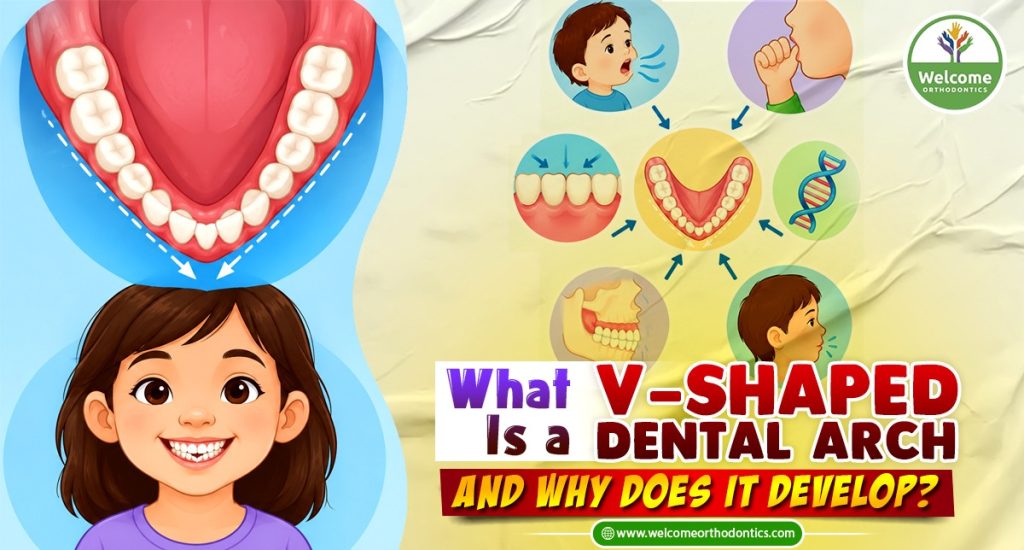
A child’s dental arch can have different shapes as the teeth and jaws develop. Some children have a broad, rounded upper arch, while others may have an upper arch that looks narrower toward the front and resembles the letter “V.” A V-shaped dental arch is not automatically a dental problem, but it can sometimes occur alongside crowding, a crossbite, or other changes in the developing bite.
Because children’s jaws and permanent teeth are still developing, the shape of the dental arch needs to be considered alongside the child’s age, tooth eruption, bite, and oral habits. Understanding what creates a narrow arch can help parents recognize when an unusual shape is simply part of development and when it may deserve an orthodontic evaluation.
What Is a V-Shaped Dental Arch?
A dental arch is the curved arrangement formed by the teeth within the upper or lower jaw. Ideally, the upper dental arch has a relatively broad, rounded shape. In some children, however, the upper arch is narrower and more pointed toward the front, giving it a V-like appearance.
The term V-shaped dental arch describes an arch form rather than a specific diagnosis. A narrow arch can result from the position of the teeth, the underlying width of the upper jaw, or a combination of dental and skeletal factors. It may also occur with a relatively high palatal vault, although a V-shaped arch and a high palate are not the same finding.
The distinction matters because an arch can look narrow without necessarily causing a functional problem. An orthodontist therefore looks beyond its appearance to determine whether the child’s teeth fit together normally and whether there is sufficient space for the permanent teeth.
What Does a Narrow Dental Arch Look Like in a Child?
Parents may notice a narrow dental arch when looking at the upper teeth from above. Instead of forming a wide curve, the teeth may appear to angle inward toward the front. The upper front teeth may look crowded or rotated, particularly if there is limited room for permanent teeth to align.
Other features may include:
- A narrow upper arch from the canine region toward the back teeth
- A high or narrow-looking palate
- Crowding or overlapping of permanent teeth
- Teeth that appear rotated or displaced
- Upper back teeth that sit inside the lower teeth when the child bites
The appearance can change as children lose baby teeth and permanent teeth erupt. A temporary irregularity during the mixed-dentition stage does not necessarily mean that the final dental arch will remain narrow. This is why parents should avoid trying to judge arch development from appearance alone.
Why Does a Child Develop a V-Shaped Dental Arch?
There is usually no single explanation for a narrow dental arch. The shape of the dental arches is influenced by genetics, jaw development, tooth eruption, oral habits, and the forces acting on the teeth.
Genetic and Skeletal Growth Patterns
Children inherit many characteristics that influence the size and shape of their jaws and teeth. The width of the upper jaw and the overall facial growth pattern can therefore contribute to the shape of the dental arch. A child may naturally have a narrower arch than another child without having a significant malocclusion.
The important consideration is whether the width is adequate for the developing teeth and whether the upper and lower arches fit together appropriately.
Tooth Position and Eruption
The position of individual teeth also affects the visible shape of the arch. If several teeth erupt toward the inside of the arch, the dental arch may appear narrower even when the underlying jaw width is not significantly reduced. Similarly, crowding can change the appearance of the arch because teeth may rotate or overlap when available space is limited.
Balance of Oral Forces
The developing dental arch is influenced by the surrounding muscles and soft tissues. The tongue exerts pressure from inside the mouth, while the lips and cheeks exert pressure from the outside. The balance between these forces can influence the position of the teeth over time. This does not mean that one muscle or one habit determines the shape of every child’s arch. Dental arch development is a complex process involving multiple factors.
Can Thumb Sucking or Pacifier Use Narrow the Dental Arch?
Prolonged non-nutritive sucking habits can influence developing dental relationships. When a child repeatedly sucks a thumb, finger, or pacifier, the habit can alter the pressure placed on the developing teeth and supporting structures. Persistent habits have been associated with changes in the developing occlusion, including posterior crossbite and other malocclusions.
Thumb and Finger Sucking
The effect of thumb or finger sucking depends partly on how often and how long the habit continues. A short-lived habit during early childhood is different from a persistent habit that continues while the permanent dentition is developing. The position of the finger, the intensity of sucking, and the child’s individual growth pattern can also influence the dental effect.
Pacifier Use
Prolonged pacifier use has similarly been associated with changes in the developing bite. However, parents should not assume that any use of a pacifier will produce a narrow dental arch. Duration and frequency are important, and individual responses vary. If a child has a persistent sucking habit alongside a narrow arch or developing crossbite, discussing the habit with a pediatric dentist or orthodontist can help determine whether it is contributing to the dental changes.
Can Tongue Position Affect the Shape of the Dental Arch?
The tongue plays an important role in the oral environment. At rest, the tongue normally occupies much of the space inside the mouth and contributes to the balance of forces around the teeth. Changes in tongue posture or swallowing patterns may influence tooth position in some children.
A low tongue posture has traditionally been proposed as one factor associated with a narrow upper arch, particularly in children who mouth-breathe. Recent evidence, however, indicates that the relationship between breathing pattern, tongue posture, and arch shape is more complex than a single cause-and-effect pathway. Tongue thrusting may also be associated with certain developing malocclusions. Rather than assessing tongue position in isolation, an orthodontist considers it alongside the child’s bite, breathing pattern, oral habits, and dental development.
What Dental Problems Can Be Associated With a Narrow Upper Arch?
A narrow upper arch does not automatically create dental problems, but it can occur alongside several types of malocclusion.
Crowding
If the upper arch does not provide enough room for the developing permanent teeth, crowding may occur. Teeth may overlap, rotate, or erupt outside their expected positions.
Rotated or Displaced Teeth
When space is limited, individual teeth may change their orientation as they erupt. This can make the dental arch appear even narrower.
Posterior Crossbite
A narrow upper arch may also contribute to a transverse discrepancy between the upper and lower arches. This can result in a posterior crossbite, where one or more upper back teeth bite inside the corresponding lower teeth.
The relationship between a narrow arch and a crossbite is important, but the two should not be treated as identical diagnoses.
Can a V-Shaped Dental Arch Cause a Crossbite?
A posterior crossbite occurs when the normal relationship between the upper and lower back teeth is reversed.
Normally, the upper posterior teeth sit slightly outside the lower posterior teeth. If the upper arch is too narrow relative to the lower arch, some upper teeth may bite inside the lower teeth instead. A crossbite may affect one side or both sides.
In some children, the bite can also cause the lower jaw to shift sideways when the child closes their mouth. This is known as a functional mandibular shift. The American Academy of Pediatric Dentistry recognizes crossbites as part of the developing occlusion that may require assessment for appropriate timing and management. A crossbite therefore deserves attention not simply because of appearance, but because of how the upper and lower jaws and teeth function together.
How Is a V-Shaped Dental Arch Diagnosed?
An orthodontic evaluation begins with a detailed examination of the child’s developing dentition.
The orthodontist may assess:
- Width and shape of the upper and lower dental arches
- Relationship between the upper and lower teeth
- Presence of crowding or spacing
- Posterior crossbite
- Position of erupting permanent teeth
- Jaw relationship
- Palatal shape
- Oral habits
- Tongue and lip function
The child’s dental history can also provide useful information about thumb sucking, pacifier use, mouth breathing, previous dental concerns, and the timing of tooth eruption.
Diagnostic Records
Depending on the child’s situation, the orthodontist may use photographs, digital scans, dental impressions, or X-rays. These records can provide information that cannot be determined simply by looking at the teeth. For example, an orthodontist may need to distinguish between a dental narrowing caused primarily by tooth position and a broader skeletal discrepancy involving the upper jaw.
The American Academy of Pediatric Dentistry emphasizes that diagnosis and appropriate treatment timing should be based on the child’s stage of dentition, clinical findings, and necessary diagnostic records.
Does Every Child With a Narrow Dental Arch Need Treatment?
No.
A V-shaped or narrow-looking dental arch does not automatically require orthodontic treatment.
If the teeth are developing appropriately and the bite is functioning well, an orthodontist may recommend observation. Treatment becomes more relevant when the narrow arch is associated with a significant crossbite, crowding, functional shift, abnormal tooth eruption, or another developing malocclusion.
The child’s age is also important. A narrow arch in a young child may need to be monitored differently from a similar finding in a child whose permanent teeth are already well established. The purpose of an early evaluation is therefore not necessarily to begin treatment immediately. It is to understand how the child’s dental development is progressing and identify whether intervention may be useful.
How Is a Narrow Dental Arch Treated in Children?
Treatment depends on the underlying problem rather than the V-shaped appearance alone.
Addressing Oral Habits
If a persistent sucking habit is contributing to the developing malocclusion, addressing the habit may be part of management. The appropriate approach depends on the child’s age, the habit, and the extent of the dental changes.
Maxillary Expansion
When the upper arch is genuinely constricted and a transverse discrepancy is present, maxillary expansion may be considered. Expansion appliances are designed to increase the width of the upper dental arch. The type of appliance and the amount of expansion depend on the child’s growth, dental development, and whether the problem is primarily dental or skeletal.
Expansion is commonly considered in children with a narrow upper arch and posterior crossbite, but treatment should be individualized.
Alignment After Expansion
Once adequate arch width has been established, some children may still have crowding or teeth that require alignment. In those cases, additional orthodontic treatment may be considered to position the teeth appropriately. Not every child who undergoes expansion will require the same next step. The treatment plan depends on the child’s individual alignment and bite.
When Should Parents Have a Child’s Narrow Dental Arch Evaluated?
Parents may want to seek an orthodontic evaluation when a child’s upper arch appears significantly narrow, particularly if other signs are present.
An evaluation can be especially useful when there is:
- A posterior crossbite
- Noticeable crowding
- Permanent teeth erupting in unusual positions
- A lower jaw that shifts when the child bites
- Persistent thumb or finger sucking
- Prolonged pacifier use
- Frequent mouth breathing
- Regular snoring
- Difficulty biting or chewing
An evaluation does not mean that a child automatically needs braces, expansion, or another appliance.
Instead, it provides an opportunity to determine whether the arch shape is simply part of the child’s individual development or whether it is associated with a condition that may benefit from monitoring or treatment.
Conclusion
A V-shaped dental arch describes an upper arch that appears narrower and more pointed toward the front than a broad, rounded arch. In children, this appearance can be influenced by jaw development, tooth position, oral habits, and functional factors. A narrow arch may occur alongside crowding or posterior crossbite, but these conditions are not interchangeable. Similarly, mouth breathing may be associated with narrower upper arches in some children, but current evidence does not support treating it as the sole cause.
The most useful approach is to consider the child’s complete dental development. An orthodontist can evaluate the arch width, bite, erupting teeth, oral habits, and jaw relationship to determine whether the V-shaped appearance represents a meaningful orthodontic concern. When treatment is appropriate, options may include addressing contributing habits, monitoring development, or using an expansion approach for a constricted upper arch. The timing and type of treatment depend on the child’s individual needs rather than the shape of the arch alone.
0 comments on “What Is a V-Shaped Dental Arch? Understanding Narrow Dental Arches in Children”