

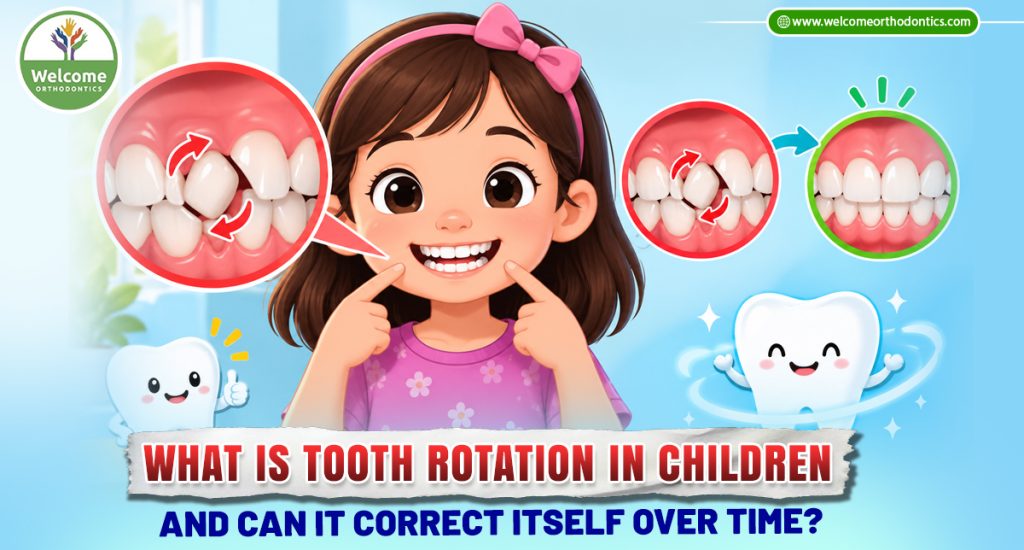
As children’s teeth develop, parents may notice that one tooth looks twisted, overlaps another tooth, or appears to be facing a slightly different direction from the rest. These changes can become more noticeable when permanent teeth begin to erupt and replace baby teeth.
This condition is known as tooth rotation. It occurs when a tooth turns around its long axis instead of sitting in its expected position within the dental arch. The rotation may be mild and barely noticeable or significant enough to affect the alignment of neighboring teeth.
Tooth rotation can develop for several reasons, including limited space, differences in tooth and jaw size, unusual eruption patterns, and certain developmental factors. Understanding why it happens helps parents recognize when a rotated tooth may simply need monitoring and when an orthodontic assessment could be beneficial.
What Is Tooth Rotation in Children?
Tooth rotation is a type of dental misalignment in which a tooth turns around its long axis. Rather than facing the expected direction within the dental arch, part of the tooth may turn toward the tongue, cheek, or neighboring teeth. Rotation can affect both baby teeth and permanent teeth, although parents often notice it during the mixed-dentition stage, when children have a combination of primary and permanent teeth.
A rotated tooth is different from a tooth that is simply tilted forward or backward. With rotation, the tooth turns around its own axis. Its position may also involve crowding or tilting, but these are separate alignment features that an orthodontist evaluates during an examination. Almost any tooth can rotate. However, the appearance and significance depend on which tooth is affected, how much it has turned, and whether there is sufficient room within the dental arch.
A slightly rotated tooth may have little effect on the overall bite. A more severely rotated tooth may overlap neighboring teeth or contribute to an irregular dental arch.
What Does a Rotated Tooth Look Like?
The appearance of tooth rotation depends on the tooth’s original position and the direction in which it has turned. In the front of the mouth, a rotated incisor may look as though one corner is positioned farther forward than the other. The tooth may appear twisted when the child smiles, even if its overall height and size seem normal.
Parents may notice several signs:
- One front tooth appears to face a different direction from the adjacent teeth.
- A tooth overlaps part of its neighbor.
- The visible surface of a tooth appears angled or unusually narrow.
- A permanent tooth erupts behind or in front of the expected dental arch.
- The child’s teeth look uneven even though there is no obvious gap between them.
Rotation may be more noticeable when permanent incisors and canines begin to erupt. These teeth can emerge into limited space or follow an unusual eruption path, making their alignment appear irregular.
However, a tooth that looks crooked is not necessarily rotated. It may be tilted, displaced, crowded, or affected by more than one alignment problem. An orthodontic examination can distinguish these possibilities.
Why Do Some Children’s Teeth Rotate?
Tooth rotation does not have one established cause. Research describes it as a condition that can involve developmental, genetic, environmental, and local dental factors.
Limited Space in the Dental Arch
One common contributing factor is insufficient space for the teeth. When the combined width of the teeth exceeds the space available in the dental arch, some teeth may erupt in less favorable positions. A tooth may turn, overlap a neighboring tooth, or emerge outside the expected alignment.
Crowding can become more apparent when permanent teeth replace smaller baby teeth. Permanent teeth generally require more space than the primary teeth they replace, and the available room may not be sufficient for every tooth to align ideally. Limited space does not always produce rotation, but it can make normal alignment more difficult.
Differences in Tooth and Jaw Size
The relationship between tooth size and jaw size also influences alignment. A child may inherit relatively large teeth, a narrower dental arch, or a combination of characteristics that leaves insufficient room for all the teeth. These differences can contribute to crowding and increase the likelihood of irregular tooth positioning.
However, tooth rotation should not automatically be attributed to genetics or jaw size alone. A child with adequate arch space may still develop a rotated tooth because of a local developmental or eruption-related issue.
Developmental and Eruption Factors
Teeth develop within the jaws before becoming visible in the mouth. Their position and direction during development influence how they eventually erupt. If a developing tooth is positioned unusually or follows an altered eruption path, it may emerge rotated or out of alignment.
The presence of another tooth or an obstruction can also interfere with normal eruption. In some cases, the precise reason for a tooth’s rotation remains unclear even after examination.
Can Extra Teeth or Delayed Eruption Cause Rotation?
Sometimes, a tooth rotates because its normal eruption path is disrupted.
Extra Teeth
Some children develop supernumerary teeth, which are additional teeth beyond the usual number. When an extra tooth develops near a permanent incisor or another developing tooth, it may interfere with the neighboring tooth’s eruption or position.
For example, an extra tooth between the upper front teeth can delay or redirect the eruption of a permanent incisor. The affected tooth may remain unerupted, emerge in an unusual position, or require further orthodontic assessment. Not every extra tooth causes rotation, and its effect depends on its location and orientation.
Retained Baby Teeth
A baby tooth that remains in place longer than expected can sometimes interfere with the eruption of its permanent successor. This may affect the direction in which the permanent tooth emerges. Delayed eruption can also occur for other reasons, including insufficient space, an unusual tooth position, or an obstruction within the jaw.
When a permanent tooth appears significantly delayed or emerges in an unexpected location, a dentist may recommend an examination and, when indicated, dental imaging to investigate the cause.
Can Thumb Sucking or Other Oral Habits Rotate Teeth?
Certain prolonged oral habits can influence the developing teeth and bite. Thumb sucking, finger sucking, and tongue-thrusting patterns may place repeated pressure on the teeth and surrounding structures. Depending on the habit’s duration, frequency, intensity, and the child’s developmental stage, these forces can contribute to changes in tooth position.
However, the relationship between oral habits and tooth rotation is not straightforward. These habits are more commonly discussed in connection with broader changes in dental alignment and bite development, and they should not be assumed to be the cause of an individual rotated tooth.
For example, a child who sucks their thumb may develop changes in the position of the front teeth or the relationship between the upper and lower arches. Whether a particular tooth rotates depends on several additional factors. If a persistent habit is present alongside unusual tooth positioning, a dentist or orthodontist can assess whether the habit is contributing to the developing problem and advise parents on appropriate management.
How Is Tooth Rotation Diagnosed in Children?
An orthodontist or dentist can usually identify a rotated tooth through a clinical examination. The clinician looks at the tooth from different angles and evaluates how its visible surface is positioned relative to neighboring teeth. The examination also considers the child’s overall dental alignment, available space, and bite.
The assessment may include:
- Checking the direction and degree of rotation.
- Examining neighboring teeth for crowding or displacement.
- Assessing the space available in the dental arch.
- Reviewing the eruption pattern of permanent teeth.
- Checking whether the upper and lower teeth fit together properly.
- Looking for retained baby teeth or other possible obstructions.
Dental X-rays may be recommended if the clinician suspects an unerupted tooth, a supernumerary tooth, or another developmental problem that cannot be evaluated through a visual examination alone. Digital scans or dental models may also help assess tooth positions and arch space when more detailed orthodontic planning is needed.
The purpose of diagnosis is to identify the rotation and determine why it may have developed. This helps the clinician decide whether observation, treatment of an underlying issue, or orthodontic correction is appropriate.
Do All Rotated Teeth Need Orthodontic Treatment?
No. The need for treatment depends on the severity of the rotation, the child’s age, the tooth involved, and its effect on the developing bite. A mildly rotated tooth may not require immediate correction if it is not causing a functional problem and the child’s dental development can be monitored safely.
In other cases, treatment may be recommended when the rotation contributes to significant crowding, affects the bite, makes cleaning difficult, or forms part of a broader orthodontic problem.
The stage of dental development also matters. A child who still has several baby teeth may need a different approach from an adolescent whose permanent teeth have erupted. Some eruption-related problems require attention before conventional orthodontic alignment can begin. For example, if an extra tooth is obstructing a permanent tooth, the clinician may first need to address that obstruction.
The American Academy of Pediatric Dentistry recommends assessing developing teeth and bite relationships throughout childhood so that treatment decisions can be based on the individual child’s needs rather than age or appearance alone.
How Is Tooth Rotation Corrected?
When correction is necessary, orthodontic treatment aims to turn the affected tooth into a more appropriate position within the dental arch.
Braces
Braces use brackets and orthodontic wires to apply controlled forces to the teeth. These forces can gradually correct rotations while also addressing other alignment problems. The treatment plan depends on how far the tooth has rotated, how much space is available, and whether neighboring teeth also need to move.
Clear Aligners or Removable Appliances
In selected cases, clear aligners or other removable orthodontic appliances may be used to correct tooth rotation. Their suitability depends on the degree of rotation, the tooth involved, and the overall complexity of the treatment.
Not every rotated tooth can be corrected effectively with the same appliance. An orthodontist determines which approach is appropriate after evaluating the child’s bite and dental development.
Creating Space When Necessary
If a tooth is rotated because there is insufficient room, simply turning it may not be enough. The orthodontist may first need to create or manage space within the dental arch. Depending on the diagnosis, this could involve moving neighboring teeth, using appropriate space-management techniques, or addressing an obstruction that interferes with eruption.
The objective is to achieve an alignment that works with the rest of the bite, rather than correcting one tooth in isolation.
When Should Parents Have a Rotated Tooth Evaluated?
Parents should consider arranging a dental assessment if a tooth appears noticeably twisted, especially if the rotation is becoming more pronounced or other alignment changes are developing.
An evaluation is particularly useful when:
- A permanent tooth erupts in an unusual position.
- A tooth appears to overlap or turn sharply toward its neighbor.
- Crowding is becoming more noticeable.
- A baby tooth remains in place while its permanent successor appears delayed.
- A tooth is difficult to clean because of its position.
- The child’s bite appears uneven.
- A dentist has identified a possible eruption problem.
Parents do not need to wait until all permanent teeth have erupted to discuss these concerns. Monitoring during the mixed-dentition stage can help identify developmental issues and determine whether early intervention is appropriate.
At the same time, not every rotated tooth is an emergency or requires immediate braces. The purpose of an evaluation is to understand the cause, assess the potential effects, and decide on an appropriate plan.
Conclusion
Tooth rotation in children occurs when a tooth turns around its long axis instead of sitting in its expected position within the dental arch. It may appear as a twisted front tooth, an overlapping tooth, or an irregularity that becomes more noticeable as permanent teeth erupt.
Limited space, differences in tooth and jaw size, unusual eruption patterns, premature loss of baby teeth, and certain developmental factors can contribute to tooth rotation. Prolonged oral habits may also influence dental alignment, although they should not automatically be considered the cause of an individual rotated tooth. Not every rotated tooth needs orthodontic treatment. The appropriate approach depends on the degree of rotation, the child’s dental development, the available space, and whether the tooth affects the bite or oral hygiene.
A dental or orthodontic evaluation can help parents understand why the tooth has rotated and whether monitoring, space management, or orthodontic correction is appropriate. Identifying the problem early can also help the clinician address eruption-related concerns before they complicate the child’s developing bite.
0 comments on “What Is Tooth Rotation in Children? Why Do Some Teeth Twist Out of Position?”