

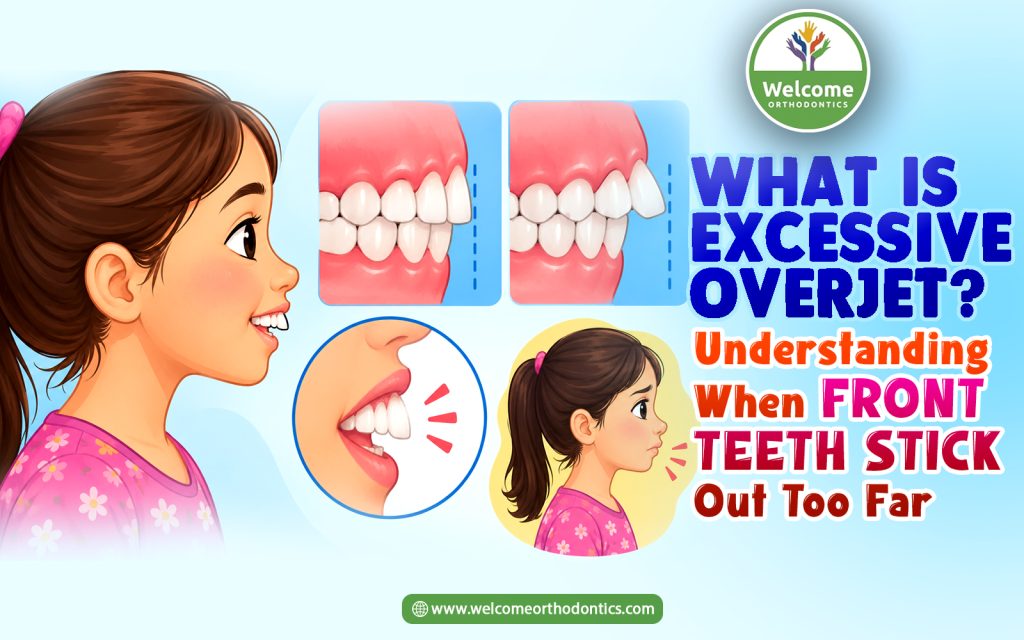
A child’s permanent front teeth may sometimes appear more prominent than expected, especially when viewed from the side. Parents often describe this as their child’s teeth “sticking out,” but there is a specific orthodontic term for this horizontal relationship: excessive overjet.
Overjet describes the horizontal distance between the upper and lower front teeth. A small amount of horizontal overlap is normal, but when the upper front teeth extend considerably farther forward than the lower teeth, the overjet is considered increased. Excessive overjet is relatively common in children and can have several possible causes. In some cases, the position of the teeth is the main factor. In others, the relationship between the upper and lower jaws contributes more significantly. Oral habits and the child’s pattern of facial growth can also influence how the front teeth develop.
Understanding what excessive overjet means can help parents recognize the difference between a normal variation in tooth position and a bite problem that may benefit from orthodontic evaluation.
What Is Excessive Overjet?
Overjet is the horizontal distance between the upper and lower front teeth when the child bites normally. In a typical bite, the upper incisors sit slightly ahead of the lower incisors. This small horizontal relationship allows the front teeth to work together during biting and helps the upper and lower dental arches fit together.
With excessive overjet, the upper front teeth are positioned noticeably farther forward relative to the lower front teeth. The condition is sometimes described simply as protruding front teeth or buck teeth, although these informal terms do not explain why the teeth appear prominent.
Excessive overjet can result from several different relationships:
- The upper front teeth may be positioned or angled too far forward.
- The lower front teeth may be positioned farther backward.
- The lower jaw may sit farther back relative to the upper jaw.
- The upper jaw may be positioned farther forward.
- A combination of dental and skeletal factors may be involved.
This distinction is important because the visible appearance of the teeth does not necessarily reveal the underlying cause.
Overjet vs. Overbite
Overjet and overbite are often confused because both describe relationships between the upper and lower front teeth.
Overjet is horizontal: It describes how far the upper front teeth sit in front of the lower teeth.
Overbite is vertical: It describes how much the upper front teeth overlap the lower front teeth from top to bottom.
A child can have excessive overjet without excessive overbite, excessive overbite without excessive overjet, or both conditions at the same time.
What Does Excessive Overjet Look Like in a Child?
The most noticeable feature is usually the position of the upper front teeth. When viewed from the side, the upper incisors may appear significantly farther forward than the lower incisors. The difference may become particularly noticeable when the child closes their mouth or smiles.
Parents may notice:
- Upper front teeth that appear prominent
- A visible horizontal gap between the upper and lower incisors
- Upper incisors that seem tilted forward
- Difficulty getting the lips to rest comfortably together
- A noticeable difference in the child’s side profile
However, appearance alone cannot determine how severe the overjet is.
A child’s teeth may temporarily look prominent while permanent teeth are erupting. The relationship can also change as the jaws grow and additional permanent teeth emerge. This is why orthodontists assess excessive overjet in the context of the child’s overall dental and facial development.
What Causes Excessive Overjet in Children?
Excessive overjet does not have one universal cause. The condition may develop because of differences in tooth position, jaw relationships, oral habits, or a combination of these factors.
Upper and Lower Jaw Relationship
One important consideration is the position of the jaws relative to one another. If the lower jaw is positioned farther back relative to the upper jaw, the upper incisors may appear more prominent even if the upper teeth themselves are not significantly tilted forward.
Likewise, differences in the forward position of the upper jaw can contribute to the horizontal relationship between the two dental arches. These skeletal relationships are assessed as part of an orthodontic examination.
Position of the Front Teeth
The teeth themselves can contribute to excessive overjet. If the upper incisors are tipped forward or positioned too far toward the front of the dental arch, the horizontal distance between the upper and lower incisors can increase. This is considered a dental contribution to overjet rather than a problem caused primarily by the position of the jaws.
Lower Incisor Position
The position of the lower front teeth also affects the measurement. Lower incisors that are positioned farther backward can make the horizontal distance between the upper and lower front teeth appear greater. This illustrates why excessive overjet cannot be evaluated by looking at the upper teeth alone.
Growth Pattern
Children’s jaws continue to grow throughout development. The direction and amount of growth can influence how the upper and lower jaws relate to each other over time. A child whose overjet appears moderate at one age may have a different relationship later as facial growth continues. This is one reason orthodontists consider growth potential when deciding whether a child needs monitoring or treatment.
Can Thumb Sucking Cause Excessive Overjet?
Persistent thumb or finger sucking can influence the developing position of the front teeth. When a child repeatedly places a thumb or finger between the upper and lower teeth, the habit can apply pressure to the developing dental arches. Depending on the duration, frequency, and intensity of the habit, this may contribute to changes in the position of the upper incisors and the developing bite. Pacifier use can have similar effects when it continues for an extended period.
However, not every child with a sucking habit develops excessive overjet. The effect depends on the individual child’s growth pattern and the characteristics of the habit. The timing of the habit is also important. A habit that stops during early childhood may have a different effect from one that continues while the permanent front teeth are developing.
Is Mouth Breathing Linked to Excessive Overjet?
Mouth breathing has been associated with several types of developing malocclusion, but it should not automatically be considered the cause of excessive overjet.
Children may breathe through their mouths because of nasal obstruction, allergies, enlarged tonsils or adenoids, or other factors. Persistent mouth breathing can also be accompanied by changes in resting oral posture.
Parents may notice:
- Sleeping with the mouth open
- Frequent snoring
- Difficulty breathing comfortably through the nose
- Dry mouth
- Restless sleep
These signs warrant attention because the underlying breathing issue may need medical evaluation.
An orthodontic assessment can identify whether the child’s dental development shows changes that may be associated with their oral posture or breathing pattern. However, excessive overjet usually has multiple possible influences rather than one single cause.
Can Excessive Overjet Affect a Child’s Teeth?
One of the most important concerns associated with prominent upper front teeth is the possibility of dental injury.
Upper incisors that extend farther forward may be more exposed during falls, collisions, sports injuries, or other accidents. Evidence reviewed by Cochrane indicates that prominent upper front teeth are more likely to experience trauma, which is one reason early orthodontic assessment may be considered for some children.
The risk is not identical for every child.
It can depend on the amount of prominence, lip coverage, the child’s activities, age, and previous history of dental trauma.
Risk of Incisor Trauma
A child with significantly protruding incisors may have less natural protection from the lips when the mouth is at rest.
If the front teeth are struck, they may be more vulnerable to chips, fractures, displacement, or other injuries.
This does not mean that every child with excessive overjet will experience dental trauma. It simply represents one factor that may influence treatment timing.
Other Dental Effects
The position of the front teeth may also affect how the child bites into food.
In some cases, a significant overjet can make it more difficult for the upper and lower incisors to work together efficiently.
The extent of any functional effect depends on the individual bite.
Can Excessive Overjet Affect a Child’s Bite or Facial Appearance?
Yes, although the extent varies.
Because overjet reflects the horizontal relationship between the upper and lower front teeth, a significant discrepancy can affect the appearance of the smile and facial profile.
From the side, the upper incisors may appear more prominent. If the underlying cause involves the relationship between the upper and lower jaws, the overall facial profile may also appear different.
It is important to distinguish dental overjet from skeletal jaw discrepancy.
A child may have prominent upper incisors because the teeth themselves are positioned forward. Another child may have a similar-looking overjet because the lower jaw is positioned farther back.
The two situations can look similar to a parent but may require different treatment considerations.
Does Excessive Overjet Affect Eating or Speaking?
Not every child with excessive overjet experiences functional difficulties. Some children can bite, chew, speak, and close their lips normally despite having a noticeable horizontal discrepancy. Others may experience difficulty bringing the front teeth together efficiently when biting into food.
Biting Food
The upper and lower incisors normally work together to cut or bite food. A pronounced horizontal gap can change how this contact occurs. However, the back teeth usually continue to perform most of the chewing function, so excessive overjet does not automatically cause difficulty eating.
Lip Closure
Some children with significantly protruding upper incisors may have difficulty achieving relaxed lip closure. This can sometimes result in a child habitually resting with their lips apart. Again, this is not present in every case and should be evaluated alongside other findings.
Speech
Speech is influenced by the position of the teeth, tongue, lips, and other structures. While some bite discrepancies may affect particular sounds, excessive overjet does not automatically cause a speech disorder. If a child has a noticeable speech concern, it should be evaluated separately rather than assuming that the overjet is responsible.
When Should a Child With Excessive Overjet See an Orthodontist?
Parents do not need to wait until all permanent teeth have erupted before asking about a noticeably prominent bite.
An orthodontic assessment may be useful when:
- The upper front teeth appear significantly prominent.
- The child has already experienced an injury to the front teeth.
- The lips do not close comfortably over the teeth.
- The child has difficulty biting into certain foods.
- The overjet appears to be increasing.
- There are other bite or alignment concerns.
- Parents are concerned about how the teeth are developing.
An evaluation does not automatically mean that treatment should begin immediately. In some children, monitoring growth and tooth eruption may be appropriate. In others, the risk of trauma or the severity of the discrepancy may make earlier treatment worth considering.
How Is Excessive Overjet Treated in Children?
Treatment depends on what is causing the excessive overjet and the child’s stage of growth.
Monitoring
Some children may be monitored while their permanent teeth erupt and their jaws continue to grow. This allows the orthodontist to determine whether the discrepancy is stable, improving, or becoming more pronounced.
Orthodontic Appliances
Orthodontic treatment can be used to change the position of the front teeth and improve the relationship between the upper and lower arches. Depending on the diagnosis and the child’s growth stage, treatment may involve fixed braces, removable appliances, functional appliances, or other orthodontic approaches. The choice depends on the individual bite rather than simply the amount of overjet.
Functional Appliances
When the relationship between the upper and lower jaws contributes significantly to the overjet, functional appliances may be considered in appropriate growing children.
These appliances are designed to influence the relationship between the jaws and teeth during growth. Evidence reviewed by Cochrane found that functional appliances used during adolescence can reduce the prominence of upper front teeth compared with no treatment, although the quality of evidence for several comparisons was low.
Addressing Oral Habits
If a persistent thumb, finger, or pacifier habit is contributing to the developing bite, addressing the habit may be included in the overall management plan.
The appropriate approach depends on the child’s age and the nature of the habit.
What Happens If Excessive Overjet Is Left Untreated?
The outcome depends on its severity and underlying cause. A mild overjet may remain relatively stable without causing significant problems.
A more pronounced overjet may continue to affect the appearance of the smile and may increase the child’s risk of injury to the upper front teeth. If the overjet is part of a broader jaw discrepancy, the underlying relationship may also remain as the child grows. Leaving a bite untreated does not necessarily mean that serious problems will develop. However, monitoring allows an orthodontist to identify whether the relationship is changing and whether intervention may become beneficial.
Conclusion
Excessive overjet describes a larger-than-expected horizontal distance between the upper and lower front teeth. It is different from overbite, which describes vertical overlap. A child may develop excessive overjet because of the position of the front teeth, the relationship between the upper and lower jaws, oral habits, facial growth, or a combination of these factors. The condition can affect the appearance of the smile and, when pronounced, may increase the risk of injury to the upper front teeth.
Not every child with prominent front teeth needs immediate treatment. Some children can be monitored as their permanent teeth erupt and their jaws continue to develop. Others may benefit from earlier intervention, particularly when the risk of trauma is significant.
An orthodontic evaluation can determine whether the overjet is primarily dental or skeletal, how it relates to the child’s overall bite, and whether monitoring or treatment is appropriate. The goal is not simply to make the front teeth look less prominent, but to support a healthy, functional, and stable developing bite.
0 comments on “What Is Excessive Overjet? Understanding When Front Teeth Stick Out Too Far”