

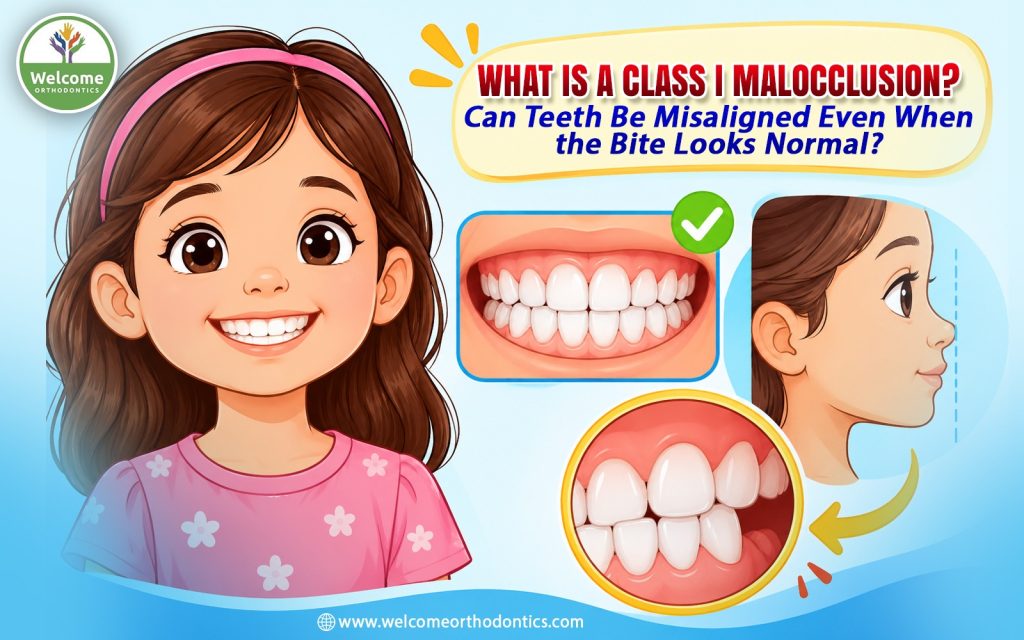
When parents think about orthodontic problems, they often picture teeth that overlap, stick out, or appear visibly crooked. However, not every alignment concern is obvious from the way the upper and lower teeth fit together. A child may have a seemingly normal bite at the back of the mouth while some of the front teeth are crowded, rotated, or positioned unevenly.
This can occur with a condition called Class I malocclusion. The term describes a particular relationship between the upper and lower first permanent molars. It does not necessarily mean that every tooth is straight or that the overall bite is ideal.
Understanding this distinction can help parents recognize why an orthodontic evaluation may be useful even when their child’s bite appears normal. It also explains why an orthodontist looks beyond the relationship between the back teeth when assessing dental alignment.
What Is a Class I Malocclusion?
Class I malocclusion is a type of dental misalignment identified using Angle’s classification system. This system evaluates how the upper and lower first permanent molars meet when a person bites down. In a typical Class I molar relationship, the upper first molar fits into a specific position relative to the lower first molar. This relationship is considered normal in the front-to-back direction.
However, the rest of the teeth may not be ideally positioned. A child can have a Class I molar relationship while experiencing crowding, spacing, rotated teeth, or other alignment irregularities. Orthodontists distinguish between the molar relationship and the overall arrangement of the teeth. This is important because the classification describes only one aspect of the bite. It does not provide a complete picture of dental alignment, jaw development, or how the teeth function together.
For comparison, Class II describes a molar relationship in which the upper first molar is positioned farther forward than in Class I. Class III describes a relationship in which it is positioned farther back. These classifications help orthodontists describe the front-to-back relationship between the dental arches.
How Can Someone Have a Class I Bite but Still Have Crooked Teeth?
The upper and lower molars can meet in the expected relationship even when other teeth do not have enough room to sit properly within their dental arches. Think of the dental arch as the curved space that holds the teeth. The back teeth may fit together normally, but the available space along the arch may not be sufficient for every tooth to line up evenly.
For example, a child’s first molars may have a normal relationship, while the front teeth overlap because they compete for limited space. Another child may have one or more rotated teeth even though the back of the bite appears balanced. This happens because tooth alignment and molar classification measure different features. The molar relationship describes how the upper and lower arches meet from front to back. Individual tooth positions describe how each tooth is arranged within its own arch.
Therefore, a normal-looking relationship between the back teeth should not be taken as proof that all the teeth are properly aligned. A complete orthodontic assessment considers the entire mouth rather than relying on the molars alone.
What Types of Dental Alignment Problems Can Occur With Class I Malocclusion?
Several alignment concerns can occur alongside a Class I molar relationship. Their appearance and severity vary depending on the child’s dental development.
Crowding and overlapping teeth: Crowding occurs when there is not enough room in the dental arch for all the teeth to line up properly. Teeth may overlap or appear compressed, particularly around the front of the mouth.
Rotated or tilted teeth: A tooth may erupt at an angle or turn away from its expected position. This can make the dental arch look uneven even when the surrounding teeth are relatively well aligned.
Gaps and uneven spacing: Some children have spaces between their teeth rather than crowding. These gaps may occur because of differences in tooth size, the shape of the dental arch, or the absence of a tooth.
Teeth positioned inward or outward: Individual teeth may sit too far toward the tongue or lips compared with the surrounding teeth. This can affect the appearance of the smile and, in some cases, how the upper and lower teeth meet.
Crossbite or other bite irregularities: A child may also have a transverse discrepancy, such as a crossbite, in which some upper teeth sit inside the lower teeth rather than outside them. This is another reason why a Class I molar relationship does not automatically indicate an ideal bite. These features may occur individually or in combination. An orthodontist assesses each one to understand the overall alignment pattern and determine whether it affects dental health or function.
What Causes Misaligned Teeth in a Class I Bite?
Class I malocclusion with dental irregularities can develop for several reasons. Often, more than one factor contributes to the final arrangement of the teeth.
Limited space in the dental arch: When the available arch space is smaller than the combined width of the teeth, some teeth may overlap or rotate. This is one of the common explanations for dental crowding.
Differences between tooth size and jaw size: A child may inherit relatively large teeth from one parent and a smaller dental arch from the other. The combination can create a mismatch between the amount of space available and the space required.
Genetic and developmental factors: The size and shape of the jaws, tooth dimensions, and general pattern of dental development can run in families. These inherited characteristics may influence how teeth erupt and align.
Early loss of baby teeth: Baby teeth help maintain space for the permanent teeth developing underneath them. If a primary tooth is lost earlier than expected, neighbouring teeth may shift into the space. This can reduce the room available for the permanent tooth when it begins to erupt.
Changes in tooth eruption: Permanent teeth do not always emerge in the expected position or sequence. A tooth may erupt at an angle, become displaced, or encounter an obstruction that affects its position.
Certain childhood habits, including prolonged thumb sucking or pacifier use, can also influence dental development and the relationship between the arches. Their effects depend on factors such as the habit’s duration and frequency.
What Problems Can Misaligned Teeth Cause?
Not every child with Class I malocclusion experiences discomfort or functional difficulties. Mild irregularities may have little effect on daily activities. However, more noticeable misalignment can create certain challenges.
One concern is oral hygiene. Overlapping and closely positioned teeth can make it harder to reach some surfaces with a toothbrush or clean between teeth. When plaque remains in these areas, the risk of tooth decay and gum inflammation may increase.
Some alignment problems can also affect how the teeth come into contact during biting and chewing. Depending on the position of the teeth, certain areas may experience uneven contact or wear.
In other cases, the main concern may be appearance. Children who feel uncomfortable about crowded or visibly crooked teeth may become self-conscious when smiling or speaking. The effect varies from child to child, and not every child will feel distressed by the appearance of their teeth. It is important to remember that these outcomes are not inevitable. The significance of misalignment depends on its severity, location, and effect on the child’s oral health and function.
How Is Class I Malocclusion Diagnosed?
An orthodontist evaluates more than whether the upper and lower molars fit together correctly. The examination is intended to identify the type of alignment concern, understand its extent, and assess how the child’s teeth and jaws are developing.
The evaluation may include:
Clinical examination: The orthodontist examines the upper and lower dental arches, the position of individual teeth, and how the teeth meet when the child closes their mouth.
Assessment of available space: The width of the teeth is considered in relation to the space available in each arch. This helps identify whether crowding or spacing is present and how much correction may be needed.
Evaluation of tooth development: The orthodontist checks which permanent teeth have erupted, which are still developing, and whether any teeth appear delayed, displaced, or blocked.
Bite and jaw assessment: The relationship between the upper and lower arches is examined in different directions. The orthodontist may also assess the child’s facial development and jaw symmetry.
Diagnostic records: Depending on the findings, photographs, digital scans, dental models, and X-rays may be recommended. Imaging can help evaluate unerupted teeth, root positions, and other features that cannot be assessed through a visual examination alone.
Not every child needs every type of diagnostic record. The orthodontist selects the appropriate assessments according to the child’s clinical findings and treatment needs.
What Treatment Options Can Correct Misaligned Teeth in Class I Malocclusion?
Treatment is selected according to the type and severity of the alignment problem, the child’s age, and the stage of dental development. The objective is to improve tooth positioning while maintaining a healthy and functional bite.
Traditional braces: Braces use brackets and wires to apply controlled pressure that gradually moves teeth into more suitable positions. They can address a wide range of alignment concerns, including crowding, rotations, and uneven spacing.
Clear aligners: These removable trays gradually move teeth according to a planned sequence. They may be suitable for selected cases, depending on the complexity of the movement required and the child’s ability to wear them as instructed.
Space management: If a child loses a baby tooth earlier than expected, a space maintainer may sometimes be recommended to help preserve the room needed for a permanent tooth. In other cases, an orthodontist may consider ways to regain space that has already been lost.
Growth-related orthodontic care: When a developing bite problem is identified, treatment may sometimes be planned around the child’s stage of growth and tooth eruption. The specific approach depends on the clinical findings rather than the Class I label alone.
Tooth extraction is not automatically necessary for Class I malocclusion. Some children can be treated without removing permanent teeth, while others may need a different approach depending on the amount of crowding, tooth positions, and overall treatment goals.
The orthodontist explains the available options after evaluating the child’s individual needs.
When Should a Child Be Evaluated by an Orthodontist?
Parents do not need to wait until teeth become noticeably crooked before arranging an orthodontic assessment. Certain signs may indicate that a child’s developing teeth or bite should be evaluated.
Consider scheduling an appointment if you notice:
- Permanent teeth erupting behind or in front of other teeth.
- Visible overlapping or crowding.
- Unusual gaps between several teeth.
- Teeth that appear significantly rotated or tilted.
- Upper and lower teeth that do not meet comfortably.
- Difficulty biting or chewing certain foods.
- Early or premature loss of baby teeth.
- A noticeable difference between the right and left sides of the bite.
These signs do not necessarily mean that treatment is required. Some may be part of normal dental development, while others may need closer attention. An orthodontic evaluation helps distinguish between the two and provides guidance on the appropriate timing of care.
Why Choose Welcome Orthodontics for Your Child’s Orthodontic Evaluation?
Understanding a child’s bite requires careful attention to both the relationship between the dental arches and the position of individual teeth. At Welcome Orthodontics, Dr. Mark Tavakoli brings more than 30 years of clinical experience in orthodontic care, supported by specialist training in orthodontics and dentofacial orthopedics from the University of California, San Francisco (UCSF). The practice uses modern diagnostic technology, including digital scanning and imaging tools, to evaluate dental alignment and support personalized treatment planning.
Welcome Orthodontics follows a conservative approach, recommending treatment according to each child’s clinical needs. If a developing alignment concern does not require immediate correction, monitoring may be appropriate. When treatment is recommended, parents can discuss the available options and understand the reasons behind the proposed plan.
Conclusion
Class I malocclusion describes a normal front-to-back relationship between the upper and lower first permanent molars. However, it does not guarantee that every tooth is properly positioned. Crowding, spacing, rotations, and other alignment concerns can occur even when the molars fit together as expected.
The right approach depends on the child’s overall dental development, the severity of the irregularities, and whether they affect oral health or function. An orthodontic evaluation can help identify these concerns and determine whether monitoring or treatment is appropriate.
By assessing the entire bite rather than focusing only on the back teeth, parents and orthodontists can make informed decisions about a child’s developing smile.
0 comments on “What Is a Class I Malocclusion? Can Teeth Be Misaligned Even When the Bite Looks Normal?”