

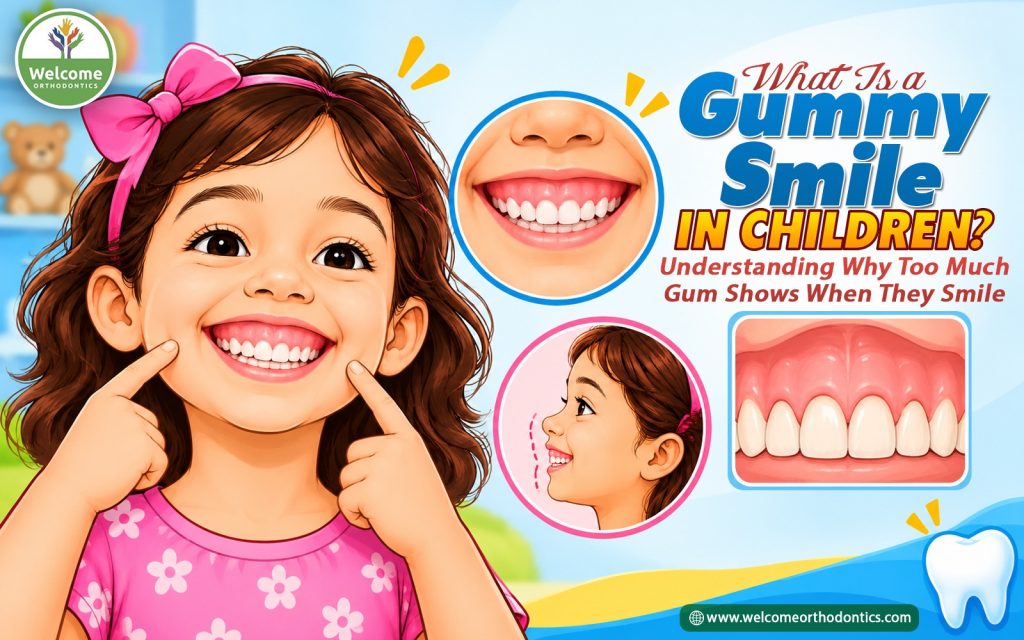
A child’s smile changes as their face, jaws, and teeth develop. During this process, parents may notice that their child shows a noticeable amount of gum tissue above the upper front teeth when smiling. This appearance is commonly called a gummy smile or excessive gingival display.
Seeing more gum tissue does not automatically mean something is wrong. The appearance may be related to natural facial features, the position of the upper lip, tooth eruption, or the way the upper jaw is developing. In some children, more than one factor contributes to the amount of gum visible when they smile.
Understanding the possible reasons behind a gummy smile can help parents decide whether their child needs a dental evaluation or simply routine monitoring. It is also important to remember that treatment decisions for children differ from those for adults because their facial structures and permanent teeth may still be developing.
What Is a Gummy Smile in Children?
A gummy smile describes a smile in which a noticeable amount of gum tissue above the upper teeth becomes visible. Dentists use the term excessive gingival display to describe this appearance.
Some gum visibility is a normal part of smiling. There is no single measurement that determines whether a child’s smile is a gummy smile because the appearance varies with facial proportions, lip movement, age, and individual preferences. In children, the amount of visible gum can also change as permanent teeth erupt and the face grows. A smile that looks different during one stage of development may become less noticeable over time.
A gummy smile is generally an appearance-related observation rather than a dental disease by itself. However, the underlying reason may sometimes involve gum tissue, tooth positioning, or jaw development. Identifying that reason is more useful than judging the smile by how much gum is visible alone.
What Does a Gummy Smile Look Like?
The most noticeable feature is the amount of gum tissue visible above the upper front teeth when a child smiles naturally or broadly.
Parents may observe one or more of the following:
- A wide band of gum tissue appears above the upper front teeth.
- The upper teeth look shorter than expected because gum tissue covers more of their visible surface.
- The upper lip rises noticeably when the child smiles.
- The gums appear more visible around the front teeth than around the side teeth.
- The amount of gum showing changes between a relaxed expression and a full smile.
These observations do not establish the cause. For example, teeth that look short may have naturally smaller crowns, or gum tissue may cover part of their normal visible length. Similarly, a high upper lip during smiling may reflect the way the lip moves rather than a problem with the teeth.
Parents should also distinguish a gummy smile from swollen or inflamed gums. Redness, tenderness, bleeding during brushing, or persistent swelling may indicate a gum health concern that needs dental attention.
Why Do Some Children Develop a Gummy Smile?
A gummy smile can develop for several reasons. The cause may involve the upper jaw, the upper lip, the gum tissue, or the position of the teeth. These factors can also occur together.
Differences in Upper Jaw Growth
The upper jaw, known as the maxilla, supports the upper teeth and forms part of the middle region of the face. In some children, its vertical development may contribute to a longer appearance of the upper jaw and increased visibility of the gums during smiling.
Dentists may describe excessive vertical development of the upper jaw as vertical maxillary excess. It is one possible skeletal explanation for a gummy smile. This does not mean that every child who shows more gum has an unusually developed upper jaw. A dental professional needs to assess facial proportions, bite relationships, and jaw position before reaching that conclusion.
A Short or Highly Mobile Upper Lip
The upper lip influences how much of the upper teeth and gums can be seen during a smile. Some children naturally have a shorter upper lip. Others have an upper lip that moves upward more than usual when they smile. This increased movement is sometimes described as upper-lip hypermobility.
In either situation, the lip may expose more gum tissue even when the teeth and jaw are otherwise positioned appropriately. This is why examining the lips only when the face is relaxed may not provide enough information. Their movement during a natural smile is also important.
Excess Gum Tissue Covering the Teeth
Sometimes, gum tissue covers a larger portion of the visible tooth crown than expected. One possible explanation is altered passive eruption.
After a tooth emerges into the mouth, the gum margin normally settles into a position that reveals more of the tooth crown. If this process does not occur as expected, additional gum tissue may remain over the crown. As a result, the teeth can appear shorter even when their actual size is normal. A dentist or periodontist can examine the relationship between the gum margin, tooth structure, and supporting tissues to determine whether this condition is present.
Tooth Eruption and Positioning
The position of the upper front teeth can also influence gum visibility. If these teeth erupt or sit in a position that changes the relationship between the teeth, gums, and upper lip, more gum tissue may become visible during smiling. In some cases, the front teeth may also be positioned farther downward than expected. This can contribute to excessive gingival display.
Because children’s teeth are still erupting and their bites are developing, the dental professional must consider the child’s stage of growth before deciding whether the tooth position needs attention.
Can a Gummy Smile Affect a Child’s Oral Health or Bite?
A gummy smile does not automatically cause cavities, gum disease, or bite problems. Its significance depends on the factor responsible for the appearance. For example, if the visible gum tissue is healthy and the teeth are positioned properly, the gummy smile may be primarily an aesthetic feature. In that situation, it may not require treatment.
However, certain underlying conditions can have separate oral health implications:
- Gum enlargement: Excess gum tissue may make some tooth surfaces harder to clean, allowing plaque to accumulate.
- Gum inflammation: Red, swollen, or bleeding gums may indicate gingivitis and require improved oral hygiene and professional care.
- Bite discrepancies: The position of the upper front teeth may be associated with an overbite or other alignment concerns.
- Jaw development differences: A skeletal discrepancy may affect the relationship between the upper and lower jaws, not just the appearance of the smile.
It is important to evaluate these issues individually. Treating gum inflammation, for example, is a matter of maintaining oral health, while correcting a jaw or tooth-position concern may require a different approach. Parents should not assume that a gummy smile itself will damage their child’s teeth. The priority is to identify whether a separate dental or orthodontic issue is present.
How Is a Gummy Smile Diagnosed in Children?
A dental professional evaluates the child’s overall facial and dental development rather than relying only on the amount of gum visible in a photograph.
The assessment may include several steps:
Facial and smile examination: The orthodontist observes the child’s facial proportions, upper lip position, and the amount of gum visible during a natural smile. The upper lip is also assessed when the face is relaxed.
Tooth and gum examination: The professional checks the size and visible length of the teeth, the position of the gum margins, and the health of the surrounding tissues. This helps distinguish excess gum coverage from naturally shorter teeth or gum inflammation.
Bite assessment: The way the upper and lower teeth meet is examined to identify alignment concerns, excessive vertical overlap, or other bite discrepancies.
Growth and dental history: The child’s age, stage of tooth eruption, previous dental treatment, oral habits, and relevant medical history may help explain the findings. Certain medications can contribute to gum enlargement, so parents should mention any medicines their child takes.
Imaging, when needed: Dental X-rays or other imaging may be recommended if the examination suggests an issue involving tooth position, jaw structure, or supporting bone. These tests are not necessary for every child.
The purpose of this assessment is to identify the underlying cause and determine whether the child needs treatment, monitoring, or a referral to another dental or medical specialist.
How Is a Gummy Smile Treated in Children?
Treatment depends on the cause, the severity of the underlying concern, and the child’s growth stage. There is no single approach that is suitable for every child.
Monitoring During Growth
If the gummy smile appears to be associated with normal dental development and there is no underlying problem requiring intervention, periodic monitoring may be appropriate.
The orthodontist can review changes in tooth eruption, jaw relationships, and facial development during routine appointments. This helps determine whether the appearance is changing naturally or whether further assessment is needed.
Managing Gum Inflammation or Enlargement
If swollen or enlarged gums contribute to the appearance, the first step is to identify why the tissue has changed.
Professional cleaning, improved brushing and flossing, and treatment of gum inflammation may help when plaque-related irritation is involved. If medication is suspected of contributing to gum enlargement, parents should discuss this with the prescribing healthcare professional. They should not stop or change a child’s medication independently.
In selected cases, a periodontist may assess whether a procedure involving the gum tissue is appropriate. Such treatment requires careful consideration of tooth development and the supporting structures.
Orthodontic Treatment
If tooth position or bite alignment contributes to excessive gum visibility, orthodontic treatment may be considered.
Depending on the child’s needs, an orthodontist may recommend braces or another suitable appliance to guide tooth movement and improve the bite. Treatment is planned according to the specific dental problem rather than the appearance of the gums alone.
Not every child with a gummy smile needs braces. Orthodontic treatment is recommended only when the examination identifies a reason to move the teeth or correct their relationship.
Treatment for Skeletal Concerns
When the appearance is associated with vertical differences in upper jaw development, the orthodontist needs to assess the child’s growth pattern and the severity of the discrepancy.
Some developing jaw-related concerns may be monitored or managed with carefully selected orthodontic or growth-guidance approaches. More complex skeletal conditions may require input from an oral and maxillofacial surgeon.
Major jaw surgery is generally reserved for significant skeletal problems and is not a routine treatment for a child’s gummy smile. The timing of any intervention requires specialist planning, particularly while facial growth is ongoing.
Procedures commonly discussed for adults, such as lip repositioning or cosmetic injections, should not be presented as standard solutions for children. A child’s treatment plan must account for ongoing development, clinical need, and long-term outcomes.
When Should Parents Have Their Child’s Gummy Smile Evaluated?
Parents can mention a gummy smile during their child’s regular dental or orthodontic visit. An earlier appointment may be useful if the appearance is accompanied by other concerns.
Consider arranging an evaluation if:
- The upper front teeth appear unusually short or partly covered by gum tissue.
- The gums are persistently swollen, red, tender, or bleed during brushing.
- The child’s upper and lower teeth do not meet comfortably.
- The front teeth appear significantly protruded or the bite seems uneven.
- The child has persistent mouth breathing, snoring, or difficulty breathing through the nose.
- The child is becoming self-conscious or avoiding smiling because of the appearance.
An orthodontist can assess whether the concern is related to tooth alignment, jaw development, or another factor. If the findings suggest a gum condition or a breathing-related issue, the child may also need evaluation by a periodontist, dentist, or appropriate medical specialist.
Parents do not need to wait until all permanent teeth have erupted to ask questions about their child’s dental development. An early assessment can help identify concerns and establish whether monitoring or treatment is appropriate.
Why Choose Welcome Orthodontics for Your Child’s Orthodontic Care?
Understanding the reason behind a child’s gummy smile is an important part of deciding whether any intervention is necessary. An orthodontic evaluation should consider the child’s facial development, tooth position, bite, and individual treatment needs.
At Welcome Orthodontics, Dr. Mark Tavakoli brings more than 30 years of clinical experience in orthodontic care. His specialist training in orthodontics and dentofacial orthopedics at the University of California, San Francisco (UCSF) supports a comprehensive approach to evaluating developing smiles.
The practice uses modern diagnostic technology, including digital scanning and imaging tools, to help assess dental structures and plan treatment when needed. Each recommendation is based on the patient’s clinical condition rather than a one-size-fits-all approach.
Welcome Orthodontics also emphasizes a conservative approach to care. This means considering whether a child would benefit from treatment or whether observation is the more appropriate option while dental and facial growth continues. For parents concerned about their child’s gummy smile, a professional evaluation can provide a clearer understanding of the cause and the next steps, if any are needed.
Conclusion
A gummy smile in children can be related to several factors, including upper jaw development, upper lip movement, gum tissue coverage, and tooth positioning. Because children’s faces and teeth continue to change as they grow, the appearance may also change over time.
Not every child who shows more gum when smiling needs orthodontic or cosmetic treatment. The first step is to understand what is contributing to the appearance and whether it is associated with a separate dental or developmental concern.
If you have questions about your child’s smile, bite, or dental development, an orthodontic evaluation can help you understand the available options. With an appropriate assessment, parents can make informed decisions about whether their child needs treatment or simply continued monitoring.
0 comments on “What Is a Gummy Smile in Children? Understanding Why Too Much Gum Shows When They Smile”