

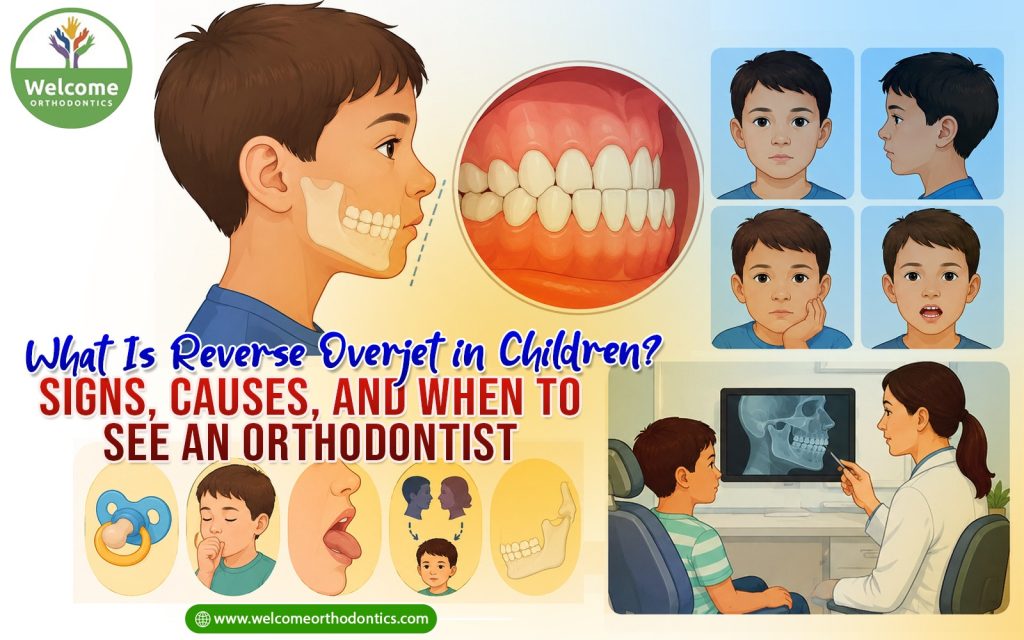
When a child closes their mouth, the upper front teeth normally sit slightly ahead of the lower front teeth. But sometimes, parents notice the opposite: the lower front teeth appear to sit in front of the upper teeth. This bite relationship is known as reverse overjet, and it can be an important sign of how a child’s teeth and jaws are developing.
Reverse overjet can range from a relatively localized tooth-position problem to a more complex difference in upper and lower jaw growth. Because these situations can look similar from the outside, simply looking at the front teeth does not always reveal what is causing the problem.
For parents, understanding reverse overjet is especially important because a child’s bite can change as the face and jaws grow. An orthodontic evaluation can help determine whether the condition needs treatment, should be monitored over time, or reflects a growth pattern that may benefit from earlier attention.
What Is Reverse Overjet?
Reverse overjet is an orthodontic condition in which the lower front teeth sit horizontally ahead of the upper front teeth when the mouth is closed. This is the opposite of the usual front-tooth relationship, where the upper incisors extend slightly in front of the lower incisors.
The condition can vary considerably from one child to another. In a mild case, only one or two front teeth may be involved, and the difference may be barely noticeable. In a more pronounced case, several lower front teeth may extend visibly beyond the upper teeth, creating a more obvious change in the bite.
Reverse overjet is important because the appearance of the front teeth does not always reveal what is happening underneath. In some children, the problem is primarily dental, meaning the teeth have erupted or become positioned in a way that creates the reversed relationship. In others, it may be skeletal, involving differences in the position or development of the upper and lower jaws. A child may also have a combination of dental and skeletal factors.
What Does Reverse Overjet Look Like in a Child?
Reverse overjet may become noticeable when permanent front teeth begin erupting, although signs can sometimes appear earlier. The appearance depends on how many teeth are involved and whether jaw development contributes to the condition.
Lower Front Teeth Positioned Ahead of Upper Front Teeth
The clearest sign is that the lower incisors sit in front of the upper incisors when the child closes their mouth naturally. The difference may involve only one or two teeth or extend across several front teeth.
Changes in the Way the Teeth Meet
Parents may notice that their child seems to move the lower jaw forward when biting down. Some children develop a comfortable way of closing their mouth that compensates for tooth interference. This can make the bite appear different depending on how the jaw is positioned.
Facial Features That May Accompany the Bite
When reverse overjet has a significant skeletal component, changes may also be visible in the facial profile. For example, the lower jaw or chin may appear more prominent, or the middle portion of the face may appear less projected. However, facial appearance alone cannot determine the cause or severity of reverse overjet.
What Causes Reverse Overjet in Children?
Reverse overjet does not have one universal cause. Several dental, skeletal, and developmental factors can produce a similar-looking bite.
Genetics and Family Growth Patterns
Jaw shape and facial growth are strongly influenced by genetics. A child may inherit a tendency toward a larger or more forward-positioned lower jaw, limited upper jaw development, or a combination of both. A family history of underbites or similar jaw relationships can therefore be useful information during an orthodontic evaluation.
Underdevelopment of the Upper Jaw
Sometimes the lower jaw is not unusually large. Instead, the upper jaw may not have developed sufficiently forward. This can make the lower teeth appear more prominent relative to the upper teeth. Because this involves facial growth rather than simply crooked teeth, orthodontists carefully evaluate the upper jaw when assessing reverse overjet.
Excessive Growth or Forward Positioning of the Lower Jaw
In other children, the lower jaw may develop farther forward than the upper jaw. This growth pattern may become increasingly noticeable during childhood or adolescence, particularly during periods of rapid facial growth.
Tooth Position and Abnormal Eruption
Not every reverse overjet is caused by the jaws. Upper front teeth may erupt too far backward, or lower incisors may tilt forward. These tooth-position differences can create a reverse relationship even when the underlying jaw proportions are relatively balanced.
Functional Forward Shifting of the Lower Jaw
Sometimes a child moves the lower jaw forward because the teeth interfere with comfortable closure. This is known as a functional shift. When the child first closes the mouth, certain teeth may contact prematurely, causing the jaw to slide into another position to achieve a more comfortable bite. Recognizing a functional shift is important because it differs from a true skeletal discrepancy.
Dental vs Skeletal Reverse Overjet: Why the Difference Matters
Two children can have front teeth that look remarkably similar while having completely different underlying orthodontic problems. This distinction directly influences treatment planning.
When the Problem Mainly Involves Tooth Position
A dental reverse overjet occurs primarily because of the position or angulation of the teeth. For example, an upper incisor may erupt behind the lower teeth even though the jaws themselves have a relatively normal relationship. Treatment in these situations generally focuses on correcting tooth position and establishing appropriate front-tooth contact.
When Jaw Growth Is the Primary Factor
A skeletal reverse overjet involves differences in the size, position, or growth of the jaws. The upper jaw may be underdeveloped, the lower jaw may be positioned farther forward, or both factors may be present. Because children are still growing, understanding the direction and pattern of future growth becomes an important part of treatment planning.
Why Similar-Looking Bites May Require Different Treatment
Treating only the visible tooth position without understanding the underlying cause may fail to address the complete problem. This is why orthodontists evaluate the teeth, jaws, facial proportions, and growth stage together before recommending care.
How Orthodontists Diagnose Reverse Overjet
Diagnosis focuses on answering a critical question: Why are the lower front teeth sitting ahead of the upper teeth?
Clinical Bite Examination
The orthodontist examines how the teeth meet when the child closes naturally. This helps identify individual tooth discrepancies, premature contacts, and possible functional shifts.
Evaluating Jaw Relationships and Facial Profile
The upper and lower jaws are assessed in relation to each other and to the rest of the face. This helps determine whether skeletal development contributes to the reverse overjet.
Digital Imaging and X-Rays
Diagnostic imaging can provide information about developing permanent teeth, tooth roots, jaw structures, and skeletal relationships that cannot be fully evaluated through visual examination alone.
Assessing Current and Future Growth
A child’s age, developmental stage, and remaining growth potential are considered when planning care.
This is particularly important when jaw development contributes to the condition because treatment timing may influence which options are appropriate.
When Should a Child See an Orthodontist for Reverse Overjet?
Parents should consider an orthodontic evaluation when they notice the lower front teeth consistently sitting ahead of the upper front teeth or significant changes in the way their child bites.
Signs That Warrant an Earlier Evaluation
An assessment may be particularly useful if a child has:
- Lower incisors visibly ahead of the upper incisors
- A lower jaw that shifts forward when closing
- Difficulty biting comfortably
- Unusual wear on the front teeth
- A noticeably prominent lower jaw
- A family history of significant underbites or jaw discrepancies
These signs do not necessarily mean extensive treatment will be required, but they can provide a reason to evaluate development more closely. Some orthodontic problems can safely wait until most permanent teeth have erupted. Growth-related bite discrepancies may require a different approach.
Evaluating reverse overjet while a child is still growing gives the orthodontist an opportunity to understand how the jaws are developing rather than assessing the problem only after growth is nearly complete.
When Monitoring May Be Recommended Instead of Immediate Treatment
An orthodontic evaluation does not automatically mean treatment. If the condition is mild, growth is favorable, or the timing is not yet appropriate for intervention, periodic observation may be recommended. Monitoring allows treatment decisions to be based on actual developmental changes rather than assumptions about how the child’s bite will progress.
How Is Reverse Overjet Treated in Children?
There is no single treatment for every reverse overjet. The appropriate approach depends primarily on whether the condition is dental, skeletal, functional, or a combination.
Correcting Tooth-Related Reverse Overjet
When individual teeth are responsible, orthodontic treatment may reposition them to establish a healthier front-tooth relationship. The exact method depends on the number of teeth involved, available space, and the rest of the bite.
Growth-Guidance Approaches for Developing Jaws
When jaw development contributes significantly to the condition, certain growing patients may benefit from approaches designed around their remaining growth. Treatment planning considers which jaw is contributing to the discrepancy and the child’s stage of facial development.
Braces and Other Orthodontic Appliances
Braces and other orthodontic appliances may be used to improve tooth alignment and coordinate the upper and lower dental arches. Some children require treatment in stages, while others may be monitored until comprehensive orthodontic care becomes appropriate.
Why Treatment Timing Depends on the Cause
Timing is especially important with reverse overjet. A tooth-position problem and a developing skeletal discrepancy do not necessarily benefit from treatment at the same age.
The orthodontist must consider the diagnosis, severity, eruption stage, growth pattern, and likely future development before deciding when intervention offers the greatest benefit.
How Welcome Orthodontics Evaluates and Manages Reverse Overjet
At Welcome Orthodontics, evaluating reverse overjet begins with determining why the bite has developed rather than focusing only on what the front teeth look like.
With more than 30 years of clinical experience, Dr. Mark Tavakoli carefully assesses tooth position, jaw relationships, bite function, facial development, and remaining growth. Advanced digital imaging and diagnostic technology provide additional information that helps distinguish a localized dental problem from a broader skeletal or functional concern.
For growing children, timing is an important part of this process. Some patients may benefit from treatment at a particular stage of development, while others are better served by careful monitoring until the appropriate time for intervention.
Following a conservative treatment philosophy, recommendations are personalized according to each child’s specific diagnosis and developmental needs. Families receive a clear explanation of what is causing the reverse overjet, whether it appears likely to change with growth, and which treatment or monitoring approach may offer the greatest long-term benefit. The goal is not simply to move the front teeth into a more attractive position. It is to support a balanced, functional bite and a healthy smile that remains stable as the child continues to grow.
Conclusion
Reverse overjet occurs when the lower front teeth sit ahead of the upper front teeth, but that visible relationship does not tell the entire story. In one child, the problem may involve only the position of a few teeth. In another, it may reflect differences in upper or lower jaw growth. A functional shift can create yet another variation.
These distinctions matter because they influence whether treatment is necessary, what type of care may be appropriate, and when that care should begin.
Parents do not need to determine the cause by looking at their child’s smile alone. If the lower front teeth appear ahead of the upper teeth, the jaw shifts forward during biting, or facial growth raises concerns, an orthodontic evaluation can provide a clearer picture of what is happening.
Early assessment does not always lead to immediate treatment. Sometimes its greatest value is establishing a baseline and monitoring how the bite changes as a child grows. By identifying the type of reverse overjet and understanding the growth pattern behind it, orthodontists can make more informed decisions about the right care at the right time.
0 comments on “What Is Reverse Overjet in Children? Signs, Causes, and When to See an Orthodontist”