

An ideal bite allows the upper front teeth to overlap the lower front teeth slightly, creating a balanced relationship that supports efficient chewing, protects the teeth from excessive wear, and promotes healthy jaw function. When this relationship changes, even slightly, it can affect much more than the appearance of a smile.
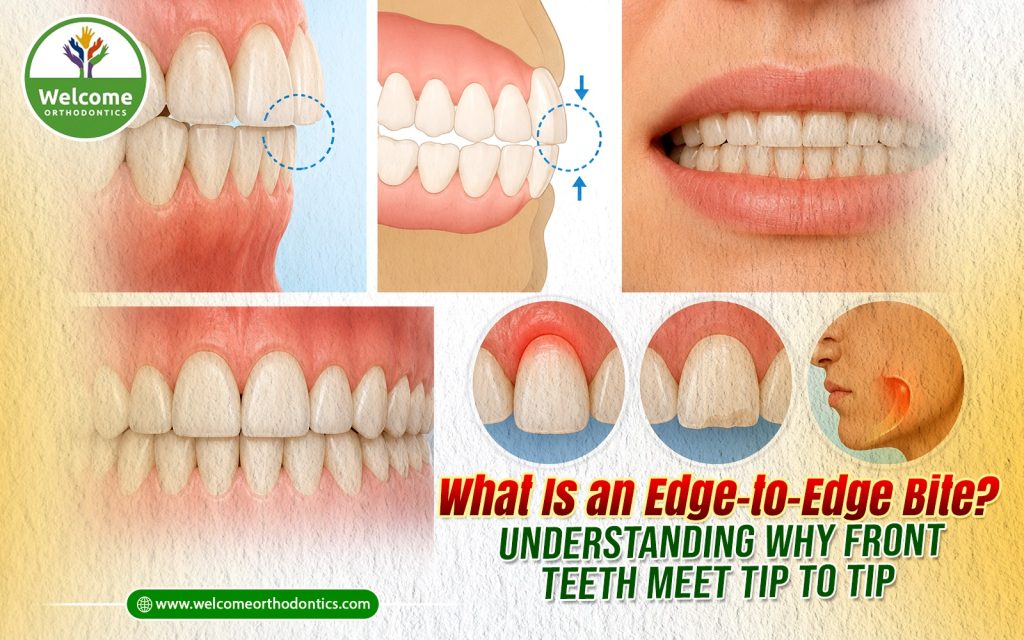
One bite problem that often raises questions is an edge-to-edge bite. Instead of the upper front teeth resting slightly in front of the lower front teeth, the biting edges of both sets of teeth meet directly, almost like two flat surfaces touching tip to tip. While some people may not notice any immediate discomfort, this bite relationship can place unusual forces on the front teeth every time a person bites, chews, or speaks.
Because an edge-to-edge bite may develop gradually, many children and adults are unaware they have it until a dentist or orthodontist points it out during a routine examination. Understanding what an edge-to-edge bite is, why it occurs, and how it differs from other bite problems can help families recognize when an orthodontic evaluation may be beneficial.
What Is an Edge-to-Edge Bite?
An edge-to-edge bite is a type of malocclusion in which the upper and lower front teeth meet directly along their biting edges instead of overlapping slightly. Under normal circumstances, the upper front teeth extend just beyond the lower front teeth. This slight overlap allows biting forces to be distributed efficiently while protecting the teeth from unnecessary stress. With an edge-to-edge bite, however, the front teeth contact one another directly every time the mouth closes.
How a Normal Bite Should Look
In a healthy bite:
- The upper front teeth overlap the lower front teeth slightly.
- The upper teeth help guide the lower jaw during movement.
- Biting pressure is distributed across multiple teeth.
- The front teeth protect the back teeth during certain jaw movements.
This balanced relationship helps minimize excessive wear and supports efficient oral function.
What Happens in an Edge-to-Edge Bite?
When the front teeth meet tip to tip, the bite functions differently. Instead of overlapping, the upper and lower incisors collide directly during biting. This changes how forces are distributed throughout the mouth and may increase stress on the front teeth.
Depending on the individual, the condition may involve:
- All four front teeth
- Only the central incisors
- Several upper and lower front teeth
The severity varies from person to person.
How Is an Edge-to-Edge Bite Different From Other Bite Problems?
Parents often confuse edge-to-edge bites with several other orthodontic conditions because they all involve the front teeth. However, each condition affects the bite differently.
Edge-to-Edge Bite vs Overbite
An overbite refers to the amount the upper front teeth vertically overlap the lower front teeth. In a normal overbite, there is moderate overlap. With a deep overbite, the upper teeth cover too much of the lower teeth. In an edge-to-edge bite, there is essentially no overlap at all. Instead, the upper and lower teeth meet directly.
Edge-to-Edge Bite vs Underbite
An underbite occurs when the lower front teeth extend ahead of the upper front teeth. Although both conditions involve the front teeth, they are different.
With an edge-to-edge bite:
- Upper and lower teeth meet evenly.
With an underbite:
- Lower teeth extend beyond the upper teeth.
The underlying causes and treatment approaches may also differ.
Edge-to-Edge Bite vs Anterior Crossbite
Anterior crossbites involve one or more upper front teeth positioned behind the lower front teeth. An edge-to-edge bite does not involve the upper teeth sitting behind the lower teeth. Instead, both sets of teeth meet directly without either arch extending significantly beyond the other. Understanding these distinctions helps orthodontists identify the true source of the bite problem.
Signs and Symptoms of an Edge-to-Edge Bite
Not everyone with an edge-to-edge bite experiences noticeable symptoms. Some individuals discover the condition only during routine dental examinations. Others develop functional concerns over time.
Visible Changes in the Smile
Parents or patients may notice:
- Front teeth meeting directly
- Minimal overlap between upper and lower front teeth
- Flattened edges on the front teeth
- Small chips developing along the incisal edges
These visible changes often become more pronounced as tooth wear progresses.
Functional Symptoms
An edge-to-edge bite may also affect everyday oral function.
Some patients report:
- Difficulty biting into firm foods
- Increased pressure on the front teeth
- Sensitivity during biting
- Teeth contacting unusually when chewing
The severity varies depending on the individual bite relationship.
Signs Parents May Notice in Children
Parents may observe:
- A child biting directly on the tips of the front teeth
- Uneven wear on newly erupted permanent incisors
- Complaints of discomfort while biting certain foods
- Gradual changes in the appearance of the front teeth
Routine orthodontic evaluations help determine whether these findings require monitoring or treatment.
Can an Edge-to-Edge Bite Cause Problems Over Time?
An edge-to-edge bite does not always cause immediate symptoms, but the long-term effects of repeated tooth-to-tooth contact can become more noticeable over time.
Excessive Tooth Wear
Because the front teeth repeatedly strike one another during normal function, enamel may gradually wear away. Unlike other tissues in the body, enamel cannot regenerate once it has been lost. As wear progresses, the teeth may become shorter, flatter, or more sensitive.
Chipped or Fractured Front Teeth
The biting edges of the front teeth are designed for cutting food, not absorbing excessive force.
Repeated direct contact increases the likelihood of:
- Small chips
- Cracks
- Fractured incisal edges
Individuals who participate in sports or grind their teeth may face an even greater risk.
Bite Instability
An edge-to-edge bite may reduce the natural guidance normally provided by the front teeth during jaw movement. Over time, this altered contact pattern can affect how the teeth function together and may contribute to changes elsewhere in the bite.
Jaw Discomfort and TMJ Concerns
Although an edge-to-edge bite does not automatically lead to temporomandibular joint (TMJ) disorders, some individuals may experience increased strain on the jaw muscles and joints because of altered bite mechanics.
Symptoms may include:
- Jaw fatigue
- Muscle soreness
- Clicking or popping
- Occasional discomfort while chewing
Because many factors contribute to TMJ disorders, an edge-to-edge bite is evaluated as part of a comprehensive assessment rather than viewed as the sole cause.
Difficulty Biting Certain Foods
The front teeth play an important role in cutting foods such as sandwiches, apples, and vegetables. When the teeth meet tip to tip, biting efficiency may be reduced. Some individuals naturally compensate by using their back teeth more frequently or changing the way they bite into food without realizing it.
How Orthodontists Diagnose an Edge-to-Edge Bite
An edge-to-edge bite cannot be evaluated based solely on how the front teeth appear. Orthodontists look beyond the visible bite to understand why the teeth meet tip to tip and whether the condition is related to tooth position, jaw growth, or both.
A comprehensive evaluation helps determine the severity of the bite and whether it is likely to create problems over time.
Clinical Examination
The evaluation begins with a detailed examination of the teeth, gums, and bite.
The orthodontist observes:
- How the upper and lower teeth fit together
- The amount of tooth wear present
- Jaw movement during opening and closing
- Overall bite function
This examination provides valuable information about how the teeth are functioning during everyday activities.
Bite Analysis
A bite analysis evaluates how the teeth contact each other when the mouth closes and during various jaw movements.
This helps determine:
- Which teeth contact first
- Whether excessive pressure is being placed on the front teeth
- If other bite discrepancies are also present
Because every bite is unique, understanding these contact patterns is essential for treatment planning.
Digital Imaging and X-Rays
Digital X-rays and modern imaging allow orthodontists to examine structures that cannot be seen during a visual examination.
These images help evaluate:
- Tooth positioning
- Root alignment
- Bone support
- Developing permanent teeth
- Jaw relationships
Diagnostic imaging also helps rule out other orthodontic conditions that may contribute to the bite problem.
Evaluating Jaw Growth
In children and adolescents, jaw growth is an important part of diagnosis. Orthodontists assess whether the bite is likely to change as the child continues growing or whether intervention may become beneficial at a particular stage of development. Growth evaluation helps ensure treatment recommendations are made at the most appropriate time.
Treatment Options for an Edge-to-Edge Bite
Treatment varies depending on the patient’s age, the severity of the bite, and the underlying cause. The goal is not simply to improve appearance but also to establish a bite that functions comfortably and protects the teeth from excessive wear.
Growth Monitoring in Children
Not every child with an edge-to-edge bite requires immediate orthodontic treatment. If the bite appears stable and growth is progressing normally, orthodontists may recommend periodic monitoring.
Follow-up evaluations allow specialists to observe:
- Tooth eruption
- Jaw development
- Bite changes
- Tooth wear
Monitoring ensures that treatment begins only if it becomes beneficial as development continues.
Braces
Traditional braces remain one of the most effective methods for correcting many edge-to-edge bites. By gradually repositioning the teeth, braces help establish a healthier relationship between the upper and lower arches while improving bite function. Treatment plans are customized according to each patient’s needs and the complexity of the bite.
Clear Aligners
Some patients with mild or moderate edge-to-edge bites may be candidates for clear aligner therapy. Clear aligners use a series of custom-made trays to gradually reposition the teeth into improved alignment.
Whether aligners are appropriate depends on factors such as:
- Tooth positioning
- Bite complexity
- Jaw relationships
- Patient compliance
An orthodontic evaluation determines whether clear aligners are a suitable option.
Bite Correction Techniques
In some cases, correcting an edge-to-edge bite requires more than simply aligning individual teeth.
Additional orthodontic techniques may be used to improve:
- Tooth angulation
- Arch coordination
- Bite relationships
- Functional tooth contact
The exact approach depends on the underlying cause of the condition.
Adult Treatment Options
Adults can also successfully correct an edge-to-edge bite. Although jaw growth has already been completed, orthodontic treatment can often improve tooth alignment, bite function, and overall smile aesthetics.
Because every adult case is unique, treatment planning focuses on achieving stable, long-term results while preserving healthy tooth structure.
When Should You Schedule an Orthodontic Evaluation?
An orthodontic evaluation is recommended whenever parents or patients notice changes in how the front teeth come together.
You should consider scheduling an assessment if you observe:
- Front teeth meeting directly edge to edge
- Increasing wear on the front teeth
- Chipped or flattened incisors
- Difficulty biting into foods
- Changes in jaw comfort during chewing
- Concerns about your child’s bite development
Early evaluation does not always mean treatment will begin immediately.
In many cases, monitoring allows orthodontists to determine the ideal timing for future care while preventing small concerns from becoming larger problems.
How Welcome Orthodontics Helps Patients With Edge-to-Edge Bites
At Welcome Orthodontics, every bite evaluation begins with understanding the underlying cause of the problem rather than focusing solely on the visible position of the teeth. Since an edge-to-edge bite may result from tooth alignment, jaw relationships, or growth patterns, Dr. Mark Tavakoli performs a comprehensive assessment to determine how the bite is functioning and how it may change over time.
With more than 30 years of clinical experience, Dr. Tavakoli combines advanced digital imaging, careful bite analysis, and personalized treatment planning to create solutions that support both oral function and long-term stability. Whether a patient requires simple monitoring during growth or comprehensive orthodontic treatment, recommendations are always based on individual needs rather than a one-size-fits-all approach.
Our goal is to protect the health of the teeth, improve bite function, and help every patient achieve a balanced, confident smile through conservative, patient-centered care.
Conclusion
An edge-to-edge bite may seem like a minor variation in tooth alignment, but the way the front teeth meet can have a lasting impact on oral health and function. Unlike a normal bite, where the upper front teeth slightly overlap the lower teeth, an edge-to-edge bite places direct pressure on the biting edges every time a person chews, bites, or speaks. Over time, this can contribute to enamel wear, chipped teeth, bite instability, and other functional concerns.
The good news is that not every edge-to-edge bite requires immediate treatment. Some patients simply benefit from regular monitoring, while others may need orthodontic care to improve the relationship between the teeth and jaws. The key is identifying the underlying cause through a comprehensive evaluation rather than relying on appearance alone.
Whether the condition develops during childhood or persists into adulthood, early assessment provides valuable insight into how the bite is functioning today and how it may change in the future. With timely evaluation and personalized care, patients can protect their teeth, support healthy jaw function, and reduce the risk of more complex orthodontic concerns later in life.
0 comments on “What Is an Edge-to-Edge Bite? Understanding Why Front Teeth Meet Tip to Tip”