

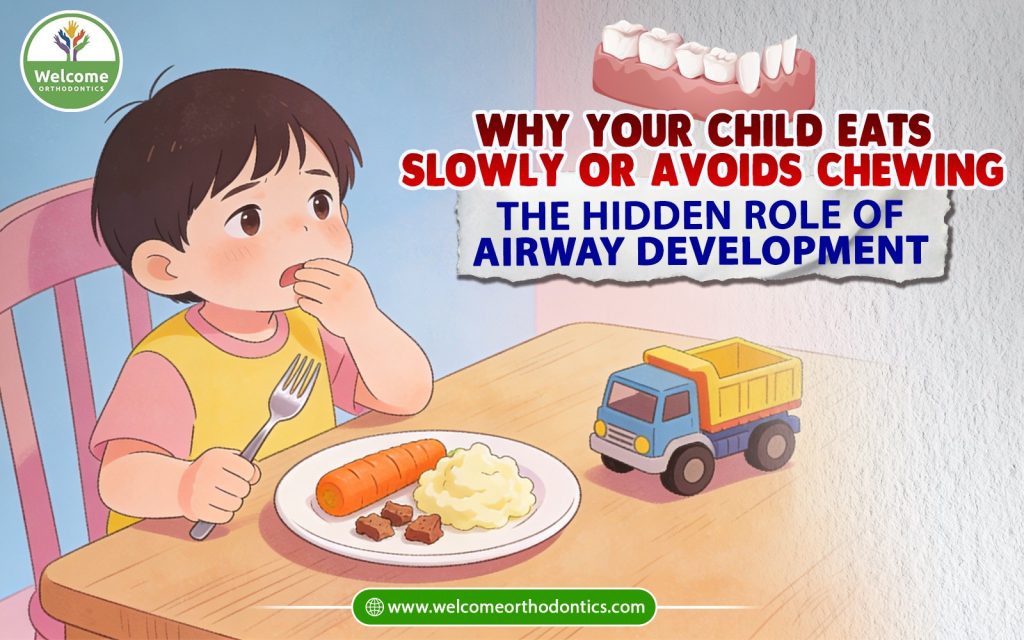
If your child takes a long time to finish meals, avoids certain foods, or seems to struggle with chewing, it’s easy to assume it’s just a phase. Many parents hear the same explanations, picky eating, distraction, or just how they are. And while those can sometimes be true, they don’t always explain the full picture.
Eating is not just a habit, it’s a complex function that involves coordination between the teeth, jaws, muscles, and breathing. When any part of that system isn’t working efficiently, children often adapt in ways that look like behavioral issues but are actually functional challenges.
One of the most overlooked factors in this equation is airway development. Breathing and chewing are closely connected. A child who has difficulty breathing comfortably, especially through their nose, may struggle to chew properly. They may eat slowly, avoid certain textures, or rely on habits that make eating feel easier but less effective.
The challenge is that these patterns develop gradually. Children don’t usually complain, they adapt. Over time, these adaptations can affect not just eating habits, but jaw development, tooth alignment, and overall oral health. Understanding the connection between airway development and eating behavior can help parents move beyond guesswork and take a more informed approach to their child’s health.
When Slow Eating Isn’t Just a Habit
It’s common for parents to notice their child lingering at the table long after everyone else has finished. While this is often dismissed as distraction or personality, slow eating can sometimes signal an underlying functional issue.
Common assumptions parents hear
When children eat slowly or avoid chewing, parents are often told it’s due to:
- Picky eating habits
- Lack of focus during meals
- Preference for certain textures
- Behavioral patterns
These explanations may apply in some cases, but they don’t always address why the behavior is happening.
Why chewing difficulties are often misunderstood
Chewing requires coordination between:
- Jaw muscles
- Teeth alignment
- Tongue movement
- Breathing patterns
If any of these elements are not working efficiently, chewing can feel tiring or uncomfortable. Instead of expressing this, children may:
- Take smaller bites
- Eat more slowly
- Avoid certain foods
The connection between eating and function
When chewing is not efficient, children adapt their eating habits. Over time, these adaptations become routine, making it easy to assume they are simply preferences rather than signs of an underlying issue. Understanding that slow eating can be functional, not just behavioral, is the first step toward identifying the root cause.
Understanding Airway Development in Children
Airway development plays a crucial role in how a child breathes, sleeps, and even eats. While it may not be something parents think about often, the way a child’s airway forms and functions can influence multiple aspects of their growth from energy levels to chewing efficiency and even facial structure.
What airway development means
The airway is the pathway that allows air to move in and out of the body during breathing. In children, this pathway is still developing and is closely connected to surrounding structures. The size, shape, and efficiency of the airway are influenced by how the jaws grow, where the tongue rests, and how the face develops over time.
When these structures develop in harmony, breathing is smooth and effortless. The tongue rests naturally against the roof of the mouth, the jaws grow to provide adequate space, and airflow remains unobstructed. This creates a strong foundation not just for breathing, but for chewing, speaking, and overall oral function.
Mouth breathing vs nasal breathing
Nasal breathing is the body’s natural and most efficient way to breathe. The nose filters, warms, and humidifies the air before it reaches the lungs, helping protect the respiratory system. It also supports proper tongue posture, with the tongue resting on the roof of the mouth, an important factor in guiding jaw development.
Mouth breathing, on the other hand, is often a sign that something isn’t functioning optimally. Children who breathe through their mouth may be compensating for restricted airflow through the nose. This can become a habit over time, especially if it begins early in childhood. Mouth breathing bypasses the natural filtration system and can alter how the tongue, lips, and facial muscles function, which in turn affects development.
How airway affects jaw growth
Breathing patterns have a direct influence on how the jaws grow. When a child breathes through the nose, the tongue stays in a position that gently supports the upper jaw, encouraging it to widen and develop properly. This creates enough space for teeth to align and for the airway to remain open.
When mouth breathing is present, the tongue often rests lower in the mouth instead of supporting the upper jaw. This can lead to a narrower upper arch, which reduces the space available for both teeth and the airway. At the same time, improper tongue posture can affect how the lower jaw positions itself, potentially limiting airway depth.
Over time, these changes can influence not just how the teeth align, but how efficiently the jaws function during activities like chewing. A restricted airway can also lead to weaker muscle engagement, making chewing more effortful and less coordinated.
Why airway issues go unnoticed
One of the biggest challenges with airway-related concerns is how easily they can be missed. Children are highly adaptable, and they often adjust to breathing patterns that are not ideal without expressing discomfort. What may seem like a simple habit, such as mouth breathing or slow eating, can actually be a sign of an underlying issue.
Another reason airway concerns go unnoticed is that many of the effects occur during sleep. Parents may not observe subtle breathing disruptions at night, especially if the child appears to sleep through without waking. However, even small disturbances in airflow can affect sleep quality and, in turn, daily function.
Because the signs are often subtle and gradual, they are easy to attribute to normal childhood behavior. This is why early awareness is so important. Recognizing how airway development connects to breathing, eating, and growth allows parents to take a more informed and proactive approach to their child’s health.
How Airway Issues Affect Chewing and Eating Behavior
Airway development directly influences how comfortably and efficiently a child can chew.
Impact on jaw strength and coordination
When breathing is compromised, children may not use their jaws fully during chewing. This can lead to:
- Reduced muscle strength
- Limited chewing efficiency
- Fatigue during meals
Difficulty maintaining closed-mouth chewing
Proper chewing requires the mouth to remain closed while food is processed. Children with airway concerns may:
- Open their mouth frequently to breathe
- Struggle to maintain a consistent chewing pattern
- Alternate between chewing and breathing
This disrupts the natural rhythm of eating.
Fatigue during meals
Chewing should not feel exhausting. However, when breathing and chewing compete for coordination, children may tire quickly. This can result in:
- Slower eating
- Taking frequent breaks
- Leaving meals unfinished
Preference for soft foods
Children often choose foods that require less effort. They may:
- Avoid crunchy or chewy textures
- Prefer soft, easy-to-swallow foods
- Limit variety in their diet
This preference is often functional rather than behavioral.
Avoidance of certain textures
Foods that require more chewing, like meats or raw vegetables, may be avoided entirely. This can impact nutrition and create long-term eating habits that are difficult to change.
Early Signs Parents Should Watch For
Recognizing early signs can help identify whether slow eating is linked to airway or functional concerns.
Eating slowly or taking small bites
Children may take longer than usual to finish meals or rely on very small bites to make chewing easier.
Avoiding chewy or hard foods
A noticeable preference for soft foods can indicate difficulty with chewing coordination or strength.
Chewing on one side
Children may favor one side of the mouth, often because it feels more comfortable or efficient.
Mouth breathing during meals
If a child frequently opens their mouth to breathe while eating, it may signal airway limitations.
Signs of fatigue while eating
Children may:
- Pause frequently
- Lose interest in meals
- Appear tired before finishing
Frustration during mealtime
Eating may become a stressful experience, leading to:
- Resistance to meals
- Irritability
- Avoidance of certain foods
If these signs appear consistently, it may be time to explore underlying causes.
How Orthodontic Evaluation and Airway-Focused Care Can Help
Understanding the connection between airway development and chewing is only the first step. The next is knowing how to address it.
The role of airway orthodontics
Airway orthodontics focuses on improving:
- Jaw structure
- Airway space
- Functional breathing patterns
It looks beyond alignment to support overall development.
How jaw development supports chewing
When the jaws are properly developed:
- Teeth align more naturally
- Chewing becomes more efficient
- Muscle coordination improves
Early intervention makes a difference
Because children are still growing:
- Their jaws are adaptable
- Development can be guided
- Treatment is often simpler and more effective
How Welcome Orthodontics Helps Children Eat, Breathe, and Develop Better
At Welcome Orthodontics, care goes beyond straightening teeth. The focus is on understanding how breathing, jaw development, and function are connected.
During evaluation, the team looks at:
- Bite alignment
- Jaw growth patterns
- Airway considerations
- Functional habits like chewing and breathing
This comprehensive approach helps identify whether eating challenges are linked to underlying structural or airway-related factors. Using advanced diagnostic tools, subtle issues can be detected early, even before they become more noticeable. This allows for more targeted and effective care.
What sets Welcome Orthodontics apart is its balanced, conservative approach. Not every child needs immediate treatment. In many cases, monitoring growth is the best step. When treatment is recommended, it is designed to work with natural development rather than forcing changes too early.
With over 30 years of clinical experience, Dr. Tavakoli brings a deep understanding of how airway and orthodontic factors influence daily function. This ensures that care is both thoughtful and precise. Parents also benefit from clear communication. Every recommendation is explained in a way that makes sense, helping families feel confident in their decisions. For those searching for Affordable orthodontics near me, the practice offers flexible financing and supports insurance use, making care accessible without added stress. Most importantly, every plan is personalized, because every child’s development is unique.
Conclusion
When a child eats slowly or avoids chewing, it’s easy to assume it’s just a habit. But in many cases, there’s more beneath the surface. Airway development plays a significant role in how children breathe, chew, and function daily. When breathing is compromised, even slightly, it can affect eating patterns, energy levels, and overall development.
By recognizing early signs and understanding the connection between airway and function, parents can take a more informed approach to their child’s health. With the right evaluation and support from practices like Welcome Orthodontics, families can move from uncertainty to clarity, helping children not only eat better, but grow, breathe, and thrive with confidence.
0 comments on “Why Your Child Eats Slowly or Avoids Chewing: The Hidden Role of Airway Development”