

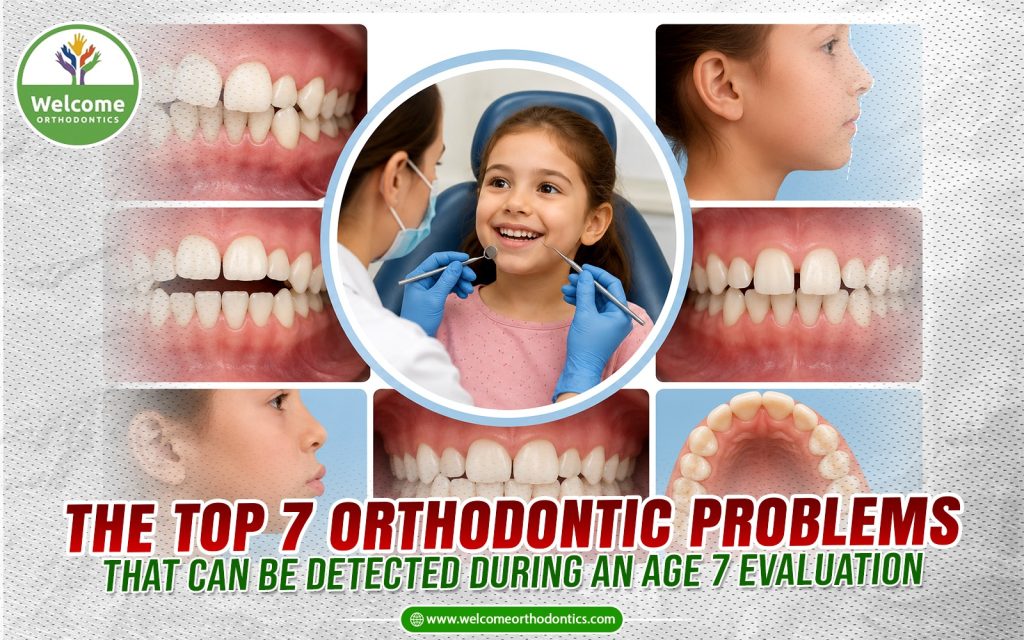
Many parents are surprised when they learn that orthodontists recommend an evaluation around age seven. After all, most children at this age still have a mix of baby teeth and permanent teeth, and their smiles may appear perfectly normal. This often leads parents to wonder why an orthodontic assessment is necessary so early.
The answer lies in timing. An age 7 evaluation is not primarily about determining whether a child needs braces immediately. Instead, it allows orthodontists to assess growth, monitor dental development, and identify potential concerns before they become more difficult to manage.
By age seven, enough permanent teeth have typically erupted for orthodontists to evaluate how the bite is developing, whether adequate space exists for incoming teeth, and whether jaw growth is progressing normally. Early detection does not always lead to early treatment, but it often provides valuable insight that helps guide future care.
Here are seven of the most common orthodontic problems that can be identified during an age 7 evaluation.
What Makes Age 7 an Important Milestone in Orthodontic Development?
Around age seven, children enter what orthodontists call the mixed dentition stage. During this period, baby teeth and permanent teeth exist together in the mouth.
This stage provides a unique opportunity to evaluate:
- Eruption patterns
- Jaw development
- Tooth positioning
- Bite relationships
- Available arch space
Many developing orthodontic concerns become visible for the first time during this stage, making it an ideal time for an initial assessment.
1. Developing Crowding and Lack of Space
One of the most common concerns identified during an age 7 evaluation is crowding.
As permanent teeth begin replacing baby teeth, orthodontists can assess whether there appears to be enough room within the dental arches for future eruption.
Early Signs of Future Crowding
Certain warning signs may suggest that crowding could become a problem later.
These include:
- Overlapping front teeth
- Limited spacing between baby teeth
- Teeth erupting outside the dental arch
- Rotated permanent teeth
Even mild crowding at age seven can provide important clues about future space limitations.
Why Space Analysis Matters
Permanent teeth are significantly larger than the baby teeth they replace. If the developing jaws cannot comfortably accommodate these larger teeth, crowding may worsen as additional permanent teeth erupt.
By identifying space concerns early, orthodontists can monitor development and determine whether intervention may eventually be beneficial.
2. Anterior and Posterior Crossbites
Crossbites are another orthodontic concern that often becomes apparent during the mixed dentition stage. A crossbite occurs when certain upper teeth bite inside the lower teeth instead of outside them.
Anterior Crossbites
Anterior crossbites involve the front teeth. Parents may notice one or more upper front teeth sitting behind the lower front teeth when the child bites down.
Posterior Crossbites
Posterior crossbites affect the back teeth. These bite discrepancies can alter chewing patterns and influence jaw development over time.
Why Early Detection Is Important
Crossbites can sometimes affect the way a child’s jaws grow and function. Because the bite relationship may influence development, identifying crossbites early allows orthodontists to monitor potential changes and determine whether correction may be beneficial.
3. Impacted or Ectopic Erupting Teeth
Not all permanent teeth follow their intended eruption paths. Some teeth begin developing in positions that may prevent them from emerging normally.
What Is Ectopic Eruption?
Ectopic eruption occurs when a tooth follows an abnormal path as it develops. Instead of emerging in its proper position, the tooth may become displaced or blocked.
Why This Matters
When eruption pathways are altered, several complications may occur:
- Delayed eruption
- Damage to neighboring teeth
- Increased crowding
- Impaction
Orthodontic imaging allows these concerns to be identified long before they become visible to parents.
Monitoring Future Development
Early detection does not necessarily mean treatment will begin immediately. However, understanding how developing teeth are positioned helps orthodontists anticipate future challenges and create appropriate monitoring plans.
4. Harmful Jaw Growth Discrepancies
One of the most valuable aspects of an age 7 evaluation is the opportunity to assess jaw development. While teeth receive much of the attention, the relationship between the upper and lower jaws plays a major role in long-term bite function.
Identifying Early Signs of Underbites
An underbite occurs when the lower jaw extends ahead of the upper jaw. At age seven, orthodontists can evaluate whether jaw growth patterns suggest that an underbite may develop or worsen over time.
Recognizing Excessive Overjet
Some children exhibit excessive overjet, where the upper front teeth project significantly forward relative to the lower teeth. This may increase the risk of dental trauma and indicate an imbalance in jaw relationships.
Why Growth Evaluation Matters
Because children are still growing, orthodontists can observe how jaw development is progressing rather than waiting until growth is complete.
Monitoring these patterns helps determine whether future treatment may be needed and when it should ideally occur.
5. Premature Loss of Baby Teeth
Baby teeth serve an important purpose beyond helping children chew and speak. They also maintain space for incoming permanent teeth.
How Early Tooth Loss Affects Development
When baby teeth are lost prematurely due to:
- Cavities
- Trauma
- Infection
- Extraction
Neighboring teeth may begin drifting into the empty space. This movement can reduce the room available for permanent teeth.
Potential Consequences
Space loss may contribute to:
- Crowding
- Eruption disturbances
- Misalignment
- Increased treatment complexity later
Why Orthodontists Monitor Space Loss
During an age 7 evaluation, orthodontists assess whether premature tooth loss has altered normal eruption patterns.
Monitoring helps ensure that developing teeth have the best possible opportunity to erupt properly.
6. Oral Habits Affecting Dental Development
Certain childhood habits can influence how teeth and jaws develop. Although many habits seem harmless, prolonged repetition may contribute to orthodontic concerns.
Thumb Sucking
Thumb sucking is common among young children. When the habit persists beyond the preschool years, it may affect tooth positioning and bite development.
Tongue Thrusting
Tongue thrusting occurs when the tongue presses against or between the teeth during swallowing. Over time, this repetitive force can influence alignment and bite relationships.
Prolonged Pacifier Use
Extended pacifier use may contribute to changes in tooth position and jaw development.
Mouth Breathing Habits
Consistent mouth breathing can sometimes influence facial growth patterns and oral function. Because these habits affect development differently, identifying them early allows orthodontists to evaluate whether they are contributing to existing concerns.
7. Airway and Facial Development Concerns
Modern orthodontics increasingly recognizes the connection between breathing, facial growth, and oral development. An age 7 evaluation may reveal indicators that warrant closer observation.
The Connection Between Breathing and Growth
Healthy facial development relies on a complex interaction between:
- Breathing patterns
- Tongue posture
- Jaw growth
- Muscle function
When these factors are altered, facial development may follow a different trajectory.
Signs Orthodontists Look For
During an evaluation, orthodontists may observe:
- Chronic mouth breathing
- Narrow dental arches
- Poor lip posture
- Facial asymmetry
- Restricted jaw development
These observations do not automatically indicate a problem but may provide valuable insight into how a child’s facial structures are developing.
A Broader View of Development
The goal is not simply to identify crooked teeth but to understand how the entire oral and facial system is maturing. This comprehensive perspective allows orthodontists to make more informed recommendations as growth continues.
Why Many Children Need Monitoring Rather Than Immediate Treatment
One of the most common misconceptions about age 7 evaluations is that they automatically lead to braces. In reality, many children require no immediate treatment following their first orthodontic visit.
Instead, orthodontists often recommend periodic observation to monitor how the teeth, jaws, and bite continue to develop. Because children grow at different rates, changes that are not obvious today may become clearer as additional permanent teeth erupt and facial growth progresses.
Monitoring allows specialists to:
- Track growth patterns
- Observe eruption changes
- Assess developing bite relationships
- Evaluate available space for incoming teeth
- Identify changes over time
These follow-up visits help orthodontists determine whether a developing concern is improving, remaining stable, or becoming more significant. In many cases, growth monitoring provides valuable information that simply cannot be obtained during a single examination.
By carefully observing development over time, orthodontists can recommend treatment at the most appropriate stage, when it is likely to be the most effective and efficient. This approach helps avoid unnecessary intervention while ensuring that potential problems are addressed before they become more complex.
What Happens During an Age 7 Orthodontic Evaluation?
A typical age 7 orthodontic evaluation is straightforward, comfortable, and designed to provide a clearer picture of how a child’s smile is developing. Rather than focusing solely on whether braces are needed, the appointment helps orthodontists assess current development and identify any concerns that may benefit from monitoring.
The evaluation may include:
- Clinical examination
- Digital imaging or X-rays
- Evaluation of tooth eruption patterns
- Bite assessment
- Jaw growth analysis
- Review of oral habits and breathing patterns
During the appointment, the orthodontist examines how the upper and lower teeth fit together, whether sufficient space exists for incoming permanent teeth, and how the jaws are developing relative to one another. Diagnostic images may also be used to evaluate teeth that have not yet erupted and identify potential concerns that are not visible during a routine dental examination.
After gathering this information, the orthodontist discusses the findings with parents and explains whether immediate treatment, periodic monitoring, or a future follow-up visit is recommended. Many families leave with reassurance that development is progressing normally, while others gain valuable insight into concerns that can be monitored proactively as their child continues to grow.
How Welcome Orthodontics Uses Growth Monitoring to Protect Developing Smiles
At Welcome Orthodontics, Dr. Mark Tavakoli understands that early orthodontic evaluations are about much more than determining whether a child needs braces. With more than 30 years of clinical experience, he carefully evaluates growth patterns, eruption pathways, bite relationships, and jaw development to build a complete picture of each child’s oral development.
Using advanced diagnostic technology, our team can identify subtle changes that may influence future dental health and create personalized monitoring plans based on each child’s needs. Because every child develops differently, treatment recommendations are never rushed. In many cases, careful observation provides the most appropriate path forward.
Our goal is to help families understand how their child’s smile is developing, what changes to watch for, and whether future treatment may be beneficial. Through ongoing growth monitoring and individualized care, we help ensure developing smiles have the best possible foundation for long-term health and function.
Conclusion
An age 7 orthodontic evaluation offers a valuable opportunity to identify concerns that may otherwise go unnoticed until they become more complex. From crowding and crossbites to eruption issues, jaw discrepancies, oral habits, and airway-related developmental concerns, early assessment provides important information about how a child’s smile is growing.
Perhaps most importantly, early detection does not always mean early treatment. In many cases, monitoring growth and development allows orthodontists to recommend care at the most effective time rather than intervening unnecessarily. This proactive approach helps ensure that developing problems are identified early while avoiding treatment that may not yet be needed.
An age 7 evaluation also gives parents a clearer understanding of what is happening beneath the surface. Even when teeth appear straight, important changes may be occurring in the jaws, bite, and eruption patterns that can influence future oral health. By evaluating these seven common orthodontic concerns during a critical stage of development, families gain valuable insight into their child’s growth and the confidence that comes from making informed decisions about future care. Ultimately, early evaluation is less about treating problems today and more about creating the foundation for a healthy, functional smile tomorrow.
0 comments on “The Top 7 Orthodontic Problems That Can Be Detected During an Age 7 Evaluation”